
Edition 93
Into the Archive
- Published 4th August, 2026
- ISBN: 978-1-923213-22-7
- Extent: 196pp
- Paperback, eBook, PDF
The archive has long been a form of collection, preservation and communication. As the internet and social media reshape what, why and how we record information, whether for personal or institutional means, the nature of the archive itself is also in flux. How does the archive mediate the relationship between public and private space? How to archives shape individual and collective memory? Should the archiveist preserve without intervention? What will the archives of the future look like? And in what ways do other mediums – bodies, places, cultures – act as their own kinds of archive?
This edition of Griffith Review goes on the record to reveal the spoils and surprises of the archive.
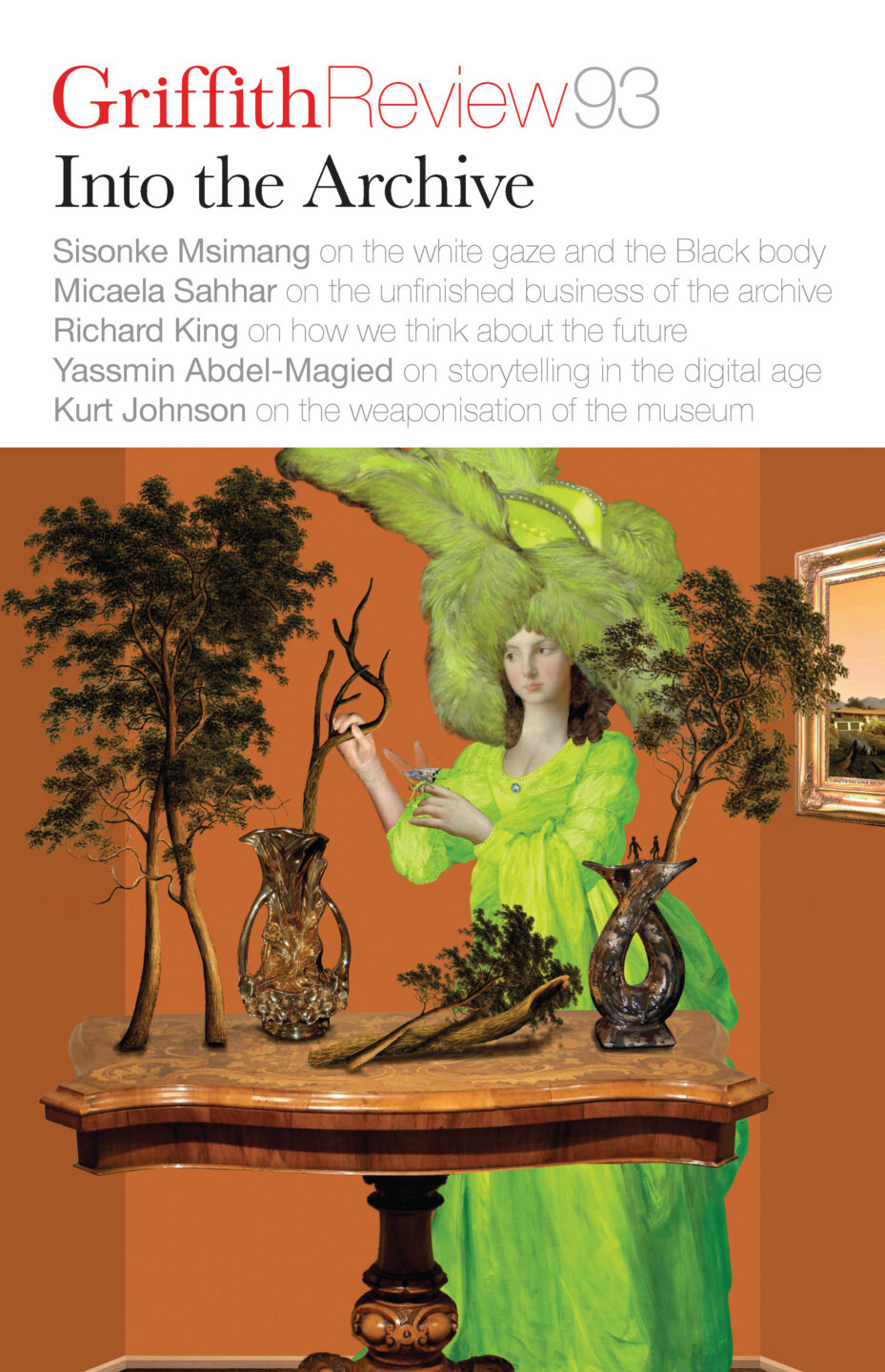
Cover image: Joan Ross, M’lady’s Ikebana room (2014), hand-painted pigment print on cotton rag paper, 91×71 cm
In this Edition
The museum of the future
The Museum of the Future is not a futuristic museum – a museum as it might look in, say, the twenty-second century. It is a museum devoted to the idea of the future: to the future’s past, in other words. Its exhibits are evidence of a remarkable, and peculiarly human, ability: to speculate on what tomorrow might bring.
(re)Verbing the archive
When I think about the archive, my mind wanders to trees and birds and seeds and springs and grandmothers long before it gets to brick and mortar. All things hold and carry on memory and knowledge – an inheritance for the younger generations.
I write of trees and birds and seeds and springs and grandmothers at the State Library of New South Wales. A prose poem on the final day of a work trip where I present a paper as a trained librarian-archivist. Too much caffeine and not enough sleep, but with a gnawing in my belly. There is an energy in this space that unsettles as much as it warms. The violence of invasion lives there under concrete and traffic, in the bones and sinew of the Land and her peoples. And so, I write. Of trees and birds and seeds and springs and grandmothers – of my place as descendant and future-Ancestor who carries millennia of knowledge and culture and kinship. I am always writing about archives when I write this way. I cannot separate myself into contexts. The archive and ancestry are one and the same.
Portrait of the artist as an archive
I began to hate JM Coetzee during the month I spent in his archives. It was January 2015 and the archives were still relatively recently opened, acquired in 2012 by the Harry Ransom Center at the University of Texas at Austin. Other scholars who had visited were abuzz with enthusiasm.
Rising tides and archival inundation
In January 2022, in the receding wake of a record king tide, the buried remains of a Kaurareg woman were exposed in the dunes above Long Beach, on Muralag (Prince of Wales Island) in the Torres Strait. The huge tide – ten centimetres higher than when monitoring began in 2015 – eroded swathes of beach and sand.
Vanishing acts
I don’t know when my sense of smell vanished, exactly. It left without fanfare, sometime during the days of fatigue and snot and rattling 4 am coughs. But I clearly recall the first time I noticed it was gone.
My archive fever
I completed a succession of degrees in creative writing, growing increasingly obsessed with finding my way back into the archive of words my mother had left me. I was determined to continue the collaborative practice we once had, though one of us would have to take part from beyond the grave.
Fragile memories
What are those pre-verbal memories like for him, not articulated, but rather felt, stored within the archive of the body? What does it feel like to have been separated from the archives of both your biological family and your homeland? There is never a clean break, of course. No neat stepping off the page, one book closed and another picked up in its place.
Defending the dead
When I think about Sarah Baartman, who lived in that same colonial city two hundred years before I did, I think about how she both belonged and did not belong in that place shaped by European fantasies of Africa. Cape Town was her city, even as it was not.
Non aprire che all’oscuro
The shop was split over two levels and relied heavily on the proprietor – a balding man with an elaborate comb-over – to connect each visitor to parts of the collection that might be of interest.
The shape of memory
I sit by the river searching for someone our national memory keepers sought to erase: my great-grandfather. Bundjalung man William Olive served across the Western Front in World War I. Aside from his digitised war record, the archives I have sought are almost silent. He enlisted when the Defence Act outlawed Aboriginal service. He suffered through two brutal offensives: the Somme and the Ypres Salient. He was wounded near Pozières in 1916, not far from this river in Amiens. William and I are separated by time and silence. But silence is a powerful act of agency. It can be revolutionary to hold your tongue, to refuse the container of words. Maybe a river can speak, but what if it, too, chooses silence?
Memory in the making
None of what I have seen so far prepares me for the glass elevator to the basement. Along with eight others, I am ushered in by an aging security guard. As we begin our descent, I recall an entry in the foyer guest book: ‘You need to warn people of the elevator. Not OK!’
The keepers of history
My name holds my history. That is to say, my name carries my father’s name, his father’s name and the father before him, seven generations back. My name allows us to time-travel several hundred years; these men kept alive through me. When I enter Sudan or Egypt, I am asked for at least the first four of these names for identification. My name places me in the context of the people I descend from, as a way to pinpoint to whom I belong.
In truth, my name holds one history. Yes, it is mine, but it is only a single, patriarchal version, rendering women invisible to such an extent that in its next iteration, I would be erased entirely. What can truly be gleaned from names shorn of context? My name is an archive that belongs to me, that defines me, but over which I have no curatorial power. I rankle at this, yet I understand this dynamic is the norm rather than an exception. The archive is a site of political struggle, whether in a name or national institution, speaking to who is remembered and who decides what is worth remembering.
Only dead writers have archives
I was surprised to find that the internet was also a useful place to teach creative writing. The student cohort for the course was satisfyingly international, and discussing assignments online sometimes made for more considered responses than those made during a more traditional in-person workshop setting when nerves or shyness might have intervened.
#CastLife
On Christmas Day, I post a picture of myself outside my parents’ house. I’m wearing a Santa hat and what will be my uniform for the rest of the summer months: blue denim shorts, a black T-shirt and a Nike sneaker on my ‘good’ foot. My injured leg is resting on my burgundy-coloured knee scooter. My family dog is attached to it and appears to be pulling it like a sleigh.
People ‘like’ this picture and say that my dog is cute. ‘What are you doing scrolling Instagram on Christmas Day?’ I want to ask them, as I scroll through Instagram on Christmas Day. A new follower – @blacksmith0173 – leaves a comment under my post:
‘Beautiful Merry Christmas’.
Does he mean ‘a beautiful Merry Christmas to you’? Or ‘you’re beautiful, Merry Christmas’? It doesn’t matter. I respond:
‘Merry Christmas to you too!’
I’m far from cool enough to not stalk my new followers. The man behind this profile has published seventeen photos, but I can’t see them. His profile is private. But I can see his profile picture: a selfie that reveals droopy blue eyes and a flat nose with turned-up nostrils; a rectangular face with pudgy, soft edges; and thick, slug-shaped brows that sit low on his forehead. Nothing unusual.
But what is unusual is that, over the next few weeks, @blacksmith0173 comments on every post that features my cast.
Archival notes
Stores are not easily accessible places. You need special permission to visit
and must be accompanied by someone who has clearance. Clearance will be
taken away if you don’t follow the rules. Once you figure out where you stand
on the ladder of access you can begin to plan your visit.
The McDonagh sisters
Initially, I didn’t question the generous-foreign- uncle story, and it’s the one Mandy Sayer went with in her 2022 biography, ‘Those Dashing McDonagh Sisters’. There are a few reasons, however, why the story doesn’t add up, but you have to dig into the archives to find them.
Finding Szpilki
I grew up before the new internet, before social media stole my attention
from me. But now, for an indiscernible reason, the old internet calls to me
once more.
The editress
At a time when women were confined to the gossip columns of the major mastheads and their hardships were reduced to comic-strip jokes, Louisa offered her women readership something truly radical – a chance to be taken seriously.
Stone secrets
Even as we gaze into the wondrous night sky in all its mystery, rarely do we take the time to wonder: what does it mean to live on an ancient planet, an Earth that keeps a careful archive in its bedrock?
The mangroves of Boykambil
I REALISED TODAY that for most of my life I have searched for a premise to explain what I once saw and felt when I looked into the mangroves of Boykambil. So that I can properly explain this realisation, I have waited until the house is quiet and for Alex to go to bed…
The rock
ONCE, I HAD a view across the valley. Green trees with sparkling leaves were home to squawking cockatoos. Once, red-bellied snakes slithered and bull ants scratched on my grey-and-white surface. Then there were flames. The bushfire left nothing but ash. All the Earth’s stories...
The elephant in the basement
WHEN I STARTED at the museum, the place seemed normal enough. The previous exhibition had just wrapped up, so I spent much of my time working on my laptop in the café upstairs, where I co-ordinated meetings and site inspections, developed timelines and reviewed...
Lost eyes
My eyes are lost in the past. I am hiding in my past, your past, my great-grandfather’s past. Our lost past. Hiding in this past is a black hole, a potato-shaped hole, a crawl hole. Millions of holes where they scrabbled for small pickings, a curl of apple...
Death of the ornithologist
The wind was shunting a heavy storm, with her binoculars she searched for him along the cliffs, he was still tracking petrels and albatross, his red jacket inflated by the wind like a frigatebird’s puffed out throat. She returns each year to the site. Still, the water susurrates...
Genealogy: 2
1983 in the mountains of smoke haze & roads hacked through sandstone, your father declares after trekking alone for hours, he made it to the rocks, volcanic, prehistoric: ‘The Castle!’ the next day, expectant, you spend a morning walking together along an animal track until it disappears like string in the...
Foxola
It isn’t small – a medium size female and no plaything. To reduce, make diminutive as panting with heat, potential of storms, build up to cross any human space a risk. But not here. To self-flatter is to think she knows, proud vixen when pride is an imposition, another artifice of fox-human relations in...
Featured Contributors
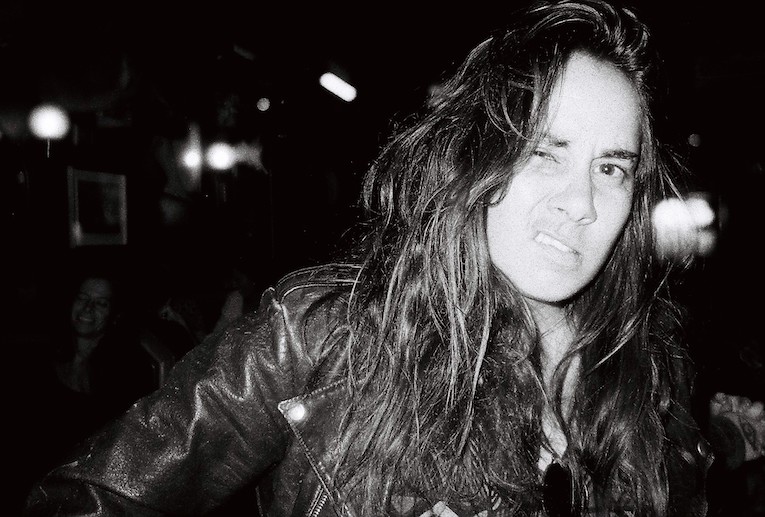
Coby Edgar
Coby Edgar is an independent, queer, multi-racial curator, writer and presenter. With over 13 years’ experience in government positions across education, galleries and...
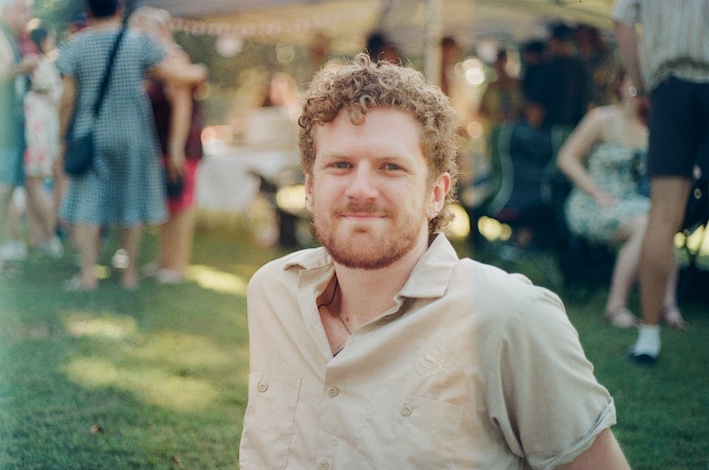
Connor Crossley
Connor Crossley is a writer from Meanjin/Brisbane. A failed healthcare worker, he is interested in the body, the stories...
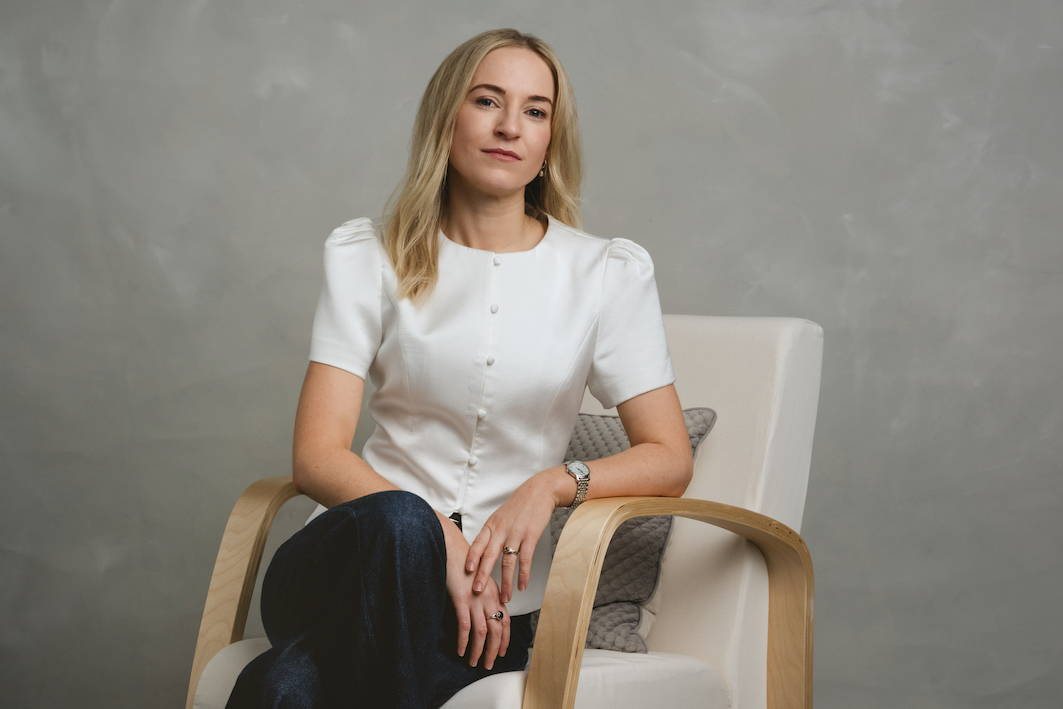
Lucy O’Connor
Lucy O’Connor is a New Zealand–based fiction and non-fiction writer. Her work examines how misogyny, power imbalances and modern technologies...
Victoria Reichelt
Victoria Reichelt has been working as a professional artist since 2006 after graduating with a Doctor of Visual Arts...
