The museum of the future

Utopian visions, transformative dreams

Featured in

  • Published 20260804
  • ISBN: 978-1-923213-22-7
  • Extent: 196pp
  • Paperback, eBook, PDF

IT IS, TO say the least, an odd-­looking building, its entrance hall an eccentric meld of nineteenth-­century municipal grandeur and twentieth-­century future schlock. While the plate-glass roof is reminiscent of the (now long destroyed) Crystal Palace in London – home to the Great Exhibition of 1851 – the atrium is in the ‘blobitecture’ style: a vaguely fin-­shaped steel-­and-­glass mesh fed by a swirling external staircase. This central ‘Pod’ comprises three levels: a gift shop (Ground Level) selling Futurismo postcards and eggtimers in the shape of Minkowski’s light cone; a play area (Level 1) where industrial tubes squirt squealing children into pits of plastic balls and toddlers rock tamely back and forth in Jetsons-­style flying cars; and a café (Level 2) selling little bags of lollies purporting to be three-­course meals in pill form. Set out in a fan around the Pod are the porticoed entrances to the museum’s three sections: the Marinetti, Hegel and Benjamin wings.

The Museum of the Future is not a futuristic museum – a museum as it might look in, say, the twenty-­second century. It is a museum devoted to the idea of the future: to the future’s past, in other words. Its exhibits are evidence of a remarkable, and peculiarly human, ability: to speculate on what tomorrow might bring. With its steampunk aesthetic and friendly staff (kitted out like the Maschinenmensch in Fritz Lang’s 1927 Metropolis), the Museum of the Future is a testament to the human imagination, no less so (indeed, one could argue slightly more so) for the fact that it is entirely a figment of mine.

Already a subscriber? Sign in here

If you are an educator or student wishing to access content for study purposes please contact us at griffithreview@griffith.edu.au

Share article

More from author
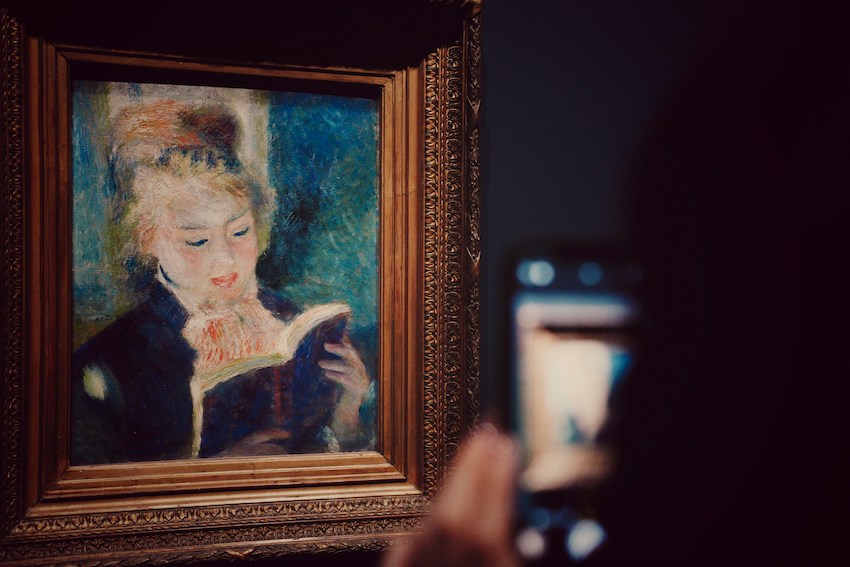
A picture of someone with a smartphone taking a picture of a classic portrait depicting a woman reading.

Gutenberg babble

In his essay, ‘The dawn of the post-literate society’, British columnist James Marriott argues that the recent decline in literacy – and book-reading in particular – amounts to a civilisational crisis. That he does so on Substack, in X-friendly paragraphs that unfurl beneath headings such as ‘World without mind’, ‘The end of creativity’ and ‘The death of democracy’, is not in itself a reason to dismiss his argument. But nor is it an irrelevant detail.

More from this edition

The shape of memory

Non-fictionTime isn’t just a linear arrow, but rather a swirling stream – so at any point ‘in time’ a river can also connect us...

Lost eyes

Poetry My eyes are lost in the past. I am hiding in my past, your past, my great-grandfather’s past. Our lost past. Hiding in this past is...

Stay up to date with the latest, news, articles and special offers from Griffith Review.