
Edition 94
Out of Office
- Published 3rd November, 2026
- ISBN: 978-1-923213-25-8
- Extent: 196pp
- Paperback, eBook, PDF
Most of us will spend a dispiriting 90,000 hours of our lives at work. That’s a third of the average lifespan; no wonder so many of us want to stick it to the man.
Love it or hate it, how we spend our working hours – whether for ourselves, for our families or for a faceless corporation – can have a profound influence on our self-worth, our social circles, and our sense of purpose and identity. But where did work come from? What rights should our employers have to circumscribe our speech? What’s the role of unions in the twenty-first century? Why don’t we have a universal basic income? How do we separate our jobs from our selves? And whatever happened to the four-hour work week?
This edition of Griffith Review clocks in for another day at the coalface.
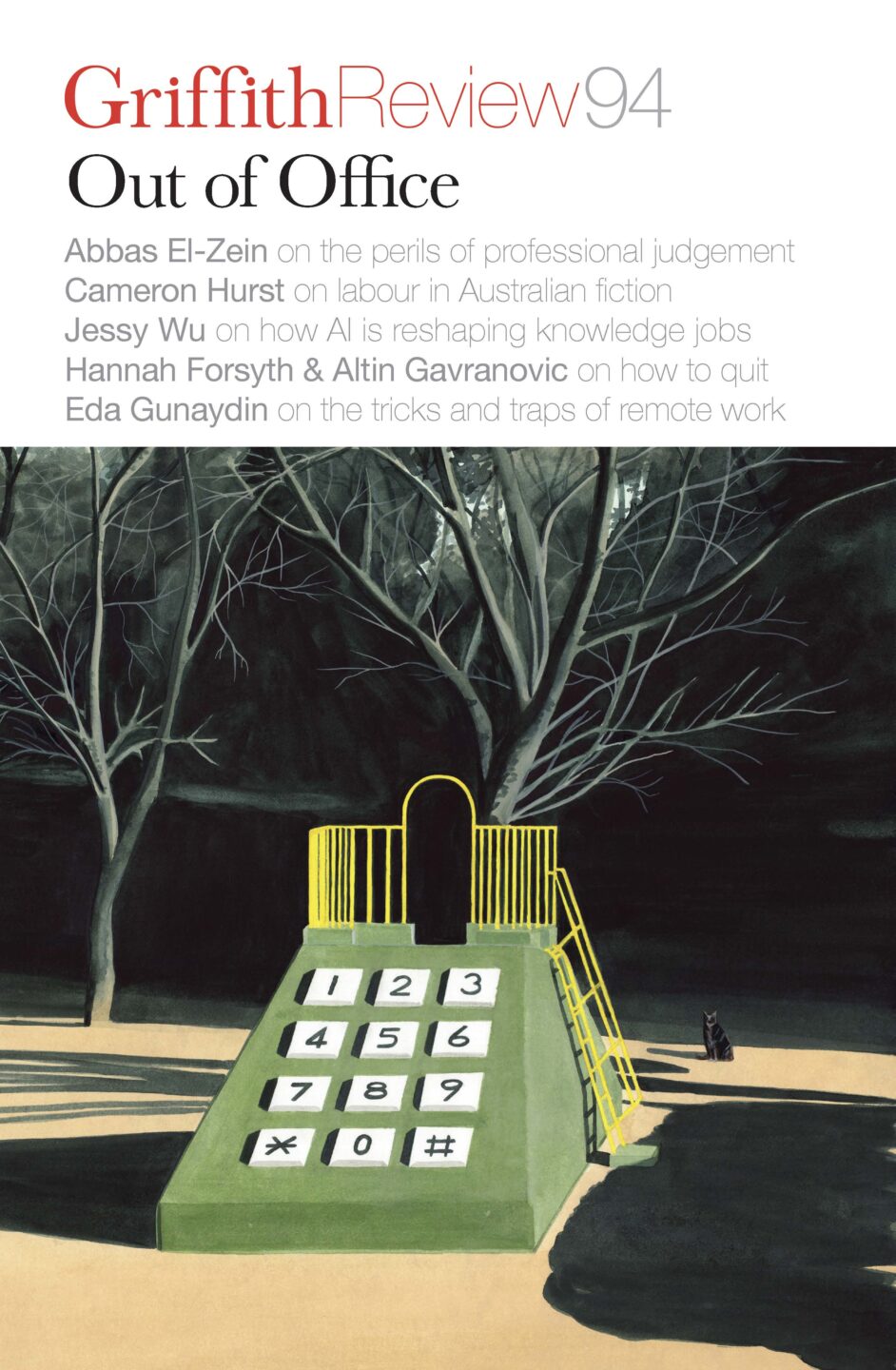
Marc Martin, Telephone (2023), 33 x 45 cm
In this Edition
Stop trying to make synergy happen
‘Workspeak’ has long attracted censure from mainstream media, as varied as BBC2’s Yes Minister and NBC’s Parks and Recreation to Scott Adams, creator of Dilbert, whose 1994 cartoon strip popularised the Buzzword Bingo concept. Yet it remains as pervasive today as it is unpopular, posing an uncomfortable question: if we all hate it so much, why do we use it so often?
I quit
Most readers will probably fall somewhere between our house-hold’s extremes of embracing and rejecting paid work. But while Silicon Valley has been violently taking up the grindcore ethos for the past year or so, quitting has become very on trend elsewhere. Covid sparked a ‘great resignation’, as people stuck in lockdowns reconsidered their relationship to work and quit their jobs in droves, enabled by temporary expansions of the social safety net. Then there was ‘quiet quitting’, where you still showed up to work but didn’t offer any additional enthusiasm, time or effort. The fact that just doing your job was seen as a sort of ‘quitting’ helped expose the expectation that we invest both unpaid overtime and unacknowledged emotional labour in work.
Cut flowers
Plants climbed all over each other. Everywhere I looked were bees, butterflies, hoverflies, spinebills, rainbow lorikeets… Some of them (the lorikeets) were tearing apart my money makers right in front of me. I opened a beer. Listen: we can’t all be captains of industry. Isn’t it enough just to grow flowers?
California dreaming
It started with a dream. I was on a long walk in the Cambridgeshire Fens, where I live, and I met a woman with long grey plaits, sitting on a gate, swinging her legs. She wanted to tell me something important. She told me she was my future: older me, my crone. Go to California, she said.
Chance governs all
Monday to Friday, you spent most of your waking hours there. It was the place where you fell in love, fell out with other people, or worked side by side with someone who filled your handbag with staplers. It was the fabric of your life, the woof and warp of it. This is the nature of the office, and why so many sitcoms and dramas are set there. But more than that, in the London of that period, just travelling to and from it placed you at the mercy of contingency.
Jobbing writer
Much of the work represented in McGregor’s oeuvre happens ‘out of the office’. In their fiction, the characters are often working class and employed in service or entertainment jobs, be that at a bar or a brothel. (Or they’re shoplifting to survive.) In A Novel Idea and ‘Acts of Avoidance’, they also sidestep any notion of a conventional nine-to-five.
Capital and care
Flavoured with the affective language of therapy and authorised by the stamp of academia, the concept of ‘emotional labour’ built on the macroeconomist vision popularised by feminists since the 1970s: that women’s unpaid work at home limited their participation in paid work in the market, and simultaneously brought a substantive contribution, economic and beyond, to how this world turns.
Disrupting Sam Altman’s magical capitalism
New technologies enable new possibilities and the restructuring of industries. But a technology itself doesn’t dictate the choices that are made regarding its use. Rather, human beings, often the most powerful ones, determine how work will be reorganised around new technologies, who will benefit and who will suffer.
Vale, ‘menial drudgery’
When a potter throws a pot again and again, she learns the coarseness of clay. She internalises the way that small variations in how she spins the wheel, how much pressure she applies with her hands, produce subtly different results. In the same way, ‘entry-level’ tasks are how knowledge workers gain grounding in a particular industry or workplace.
(Im)personal space
Rather than allowing people to focus and retreat into their own spaces, ‘Activity-Based Working’ offers them a bewildering number of options for doing work and conducting conversations, from sitting and standing desks to sofas and individual pods to phoneless phone booths. Employees are expected move between multiple workstations instead of having a permanently assigned desk.
Judgement calls
When we choose our career, we also choose the kind of people we will accept as our future judges. And, for better or for worse, most of us become part-time judges in older age, whatever professional path we take. We become cogs in a power edifice, spewing judgements, right and left, making or breaking careers, sometimes even lives – all in exchange for the privileged positions of authority the system has granted us.
Bandaids and bush turkeys
Personal development is a booming industry. The reported global market size in 2025 was an estimated $51 billion, though this varies slightly between reports, and is predicted to surge to $60.5 billion by 2030 – a trend alleged by GlobeNewswire to be ‘rooted in the growing societal emphasis on self-discovery, mental health, and the continuous pursuit of knowledge and skills’.
Your life’s work II
In 2020, I wrote an essay entitled ‘Your Life’s Work’ in which I indulged in what was, at the time, a healthy addiction to YouTube vloggers. In it, I observe that transformation of one’s private life into a work product – filming and uploading oneself going shopping, spending time with children at home or visiting the dentist – represents the collapsing of barriers between work and life.
R U OK, Bartleby?
Mental Health, it is routinely said, is in crisis. As with all of capitalism’s crises, vast quantities of profit, suffering, enjoyment and contradiction ensue. The current preoccupation with mental health/illness (antonyms that are often used interchangeably) reveals a discursive inconsistency.
Mouse jiggler
My colleagues were always ‘reaching out’, ‘circling back’ and ‘going forward’, and occasionally offered to ‘tick-tack about it offline’. These expressions were not literal, because almost everything occurred on Teams or by email. The meaning of other popular phrases – such as ‘workforce capability uplift’, ‘social prescribing’ and ‘vulnerable, highly mobile cohorts’ – were harder to ascertain.
Everything is everybody else’s fault
Around 2009, the first glimpses emerged that these companies had secretly known for decades that the science was correct. Gradually, a new narrative developed: leading climate commentators started asking why the hell individuals should be meticulously calculating their carbon footprints when the entire fossil fuel sector was not only the biggest emitter but also doing everything to delay action.
Deskbound
As the man starts sharing intricate details about central figure of his novel – an Aussie soldier starving in a prisoner-of-war camp in Papua New Guinea – I know something is wrong. Scanning the surrounding desks while he speaks, I realise that I’ve accidentally entered a different floor of the department – easy enough when each level possesses an uncanny familiarity and staff logins work on all company desktops.
The ghosts of labour past
I was one of few in my university cohort to study labour history. Writing my thesis on the Green Bans, I realised the memory of this movement was more complicated than today’s romanticised and oversimplified narratives suggest.
Uncorrected wrongs
The research here and overseas into the mental health of prison officers has them showing a significantly higher incidence than the general population in areas such as depression, anxiety, post-traumatic stress disorder (PTSD), suicide and risk of suicide, and alcohol and drug dependence. When occupations score so high on these issues, it is generally an indicator that all is not well in the work environment.
Snow
ILLEANA HAS BEEN sitting on the ground with her legs straight out in front of her for more than two hours. Her mouth is full of artificial snow, that stuff they make from paper. Breathe through your nose, they told her; it’ll be fine....
Left for the exit cleaner
TODAY IS MY last day working for you. I imagine you know that already. This is not my letter of resignation as much as it is my confession. You probably know that already too but I’m going to write it anyway. For the last year,...
Early works
THE GROUP SAT around the big table while Alexander talked to them. He appeared to be in his late twenties and was dressed in a white T- shirt and jeans and sneakers. His hair was just a touch too long, to hint at a non-corporate...
The Landscaper
You begin by describing the weather – hot, always hot – and your neighbour’s recently deceased lawn, how the young couple, committed to leisure and low-effort acts of beautification, compelled the soil to erupt in thick green wildflowers from a seed kit purchased online. You’d like something...
Slippery at best
something to be said what a neurotypical dog you have for the way we coach in riven phrases: soft & splashless hands program sessions in poetic form neutral spine, long neck, loud legs long dog & throwdown are not rapper’s...
hey, gov’nor
hey, gov’nor state corps(e) 21st century station manager hey, gov’nor green coat drill-panted protector of white four- wheeled empire Country will evict youwe will still be here we will bleed again on Country we will birth again with Country we will entrust our honoured dead to high Country you will coerce no more culture control we...
‘I’d put faith in that stock’
‘These nine micro- cap stocks are tipped to surge in 2024’ says AFR. & says the sign for the micro-cap conference with somewhat prophetic weight: Trade for Good – the ‘Good’ in red letters. Christ – what can I make of interest?
I swivel in my office chair
– my own private merry-go-round of anti-corp defiance. HR disapproves. I am put on probation for not writing enough poems. This is not a poem. This is a sackable offence. I am called into one meeting every hour and each one could definitely have been an email. I am slowly shuffled to another department. This...
Europe
‘Have you been to Europe?’ He said it just like that, as if Europe was a bar around the corner. ‘Four months,’ was part of her reply. ‘Nice,’ or something to that effect. You have to do it properly. As if it simply could be done no other...
Featured Contributors
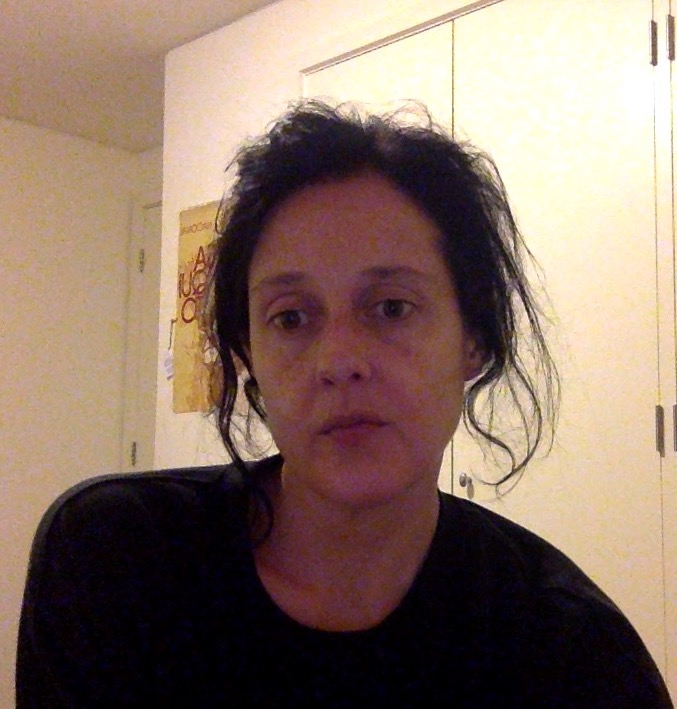
Mira Adler-Gillies
Mira Adler-Gillies is a freelance writer.

Altin Gavranovic
Altin Gavranovic lives on Dharug and Gundungurra country, otherwise known as the Blue Mountains. In a past life, he...
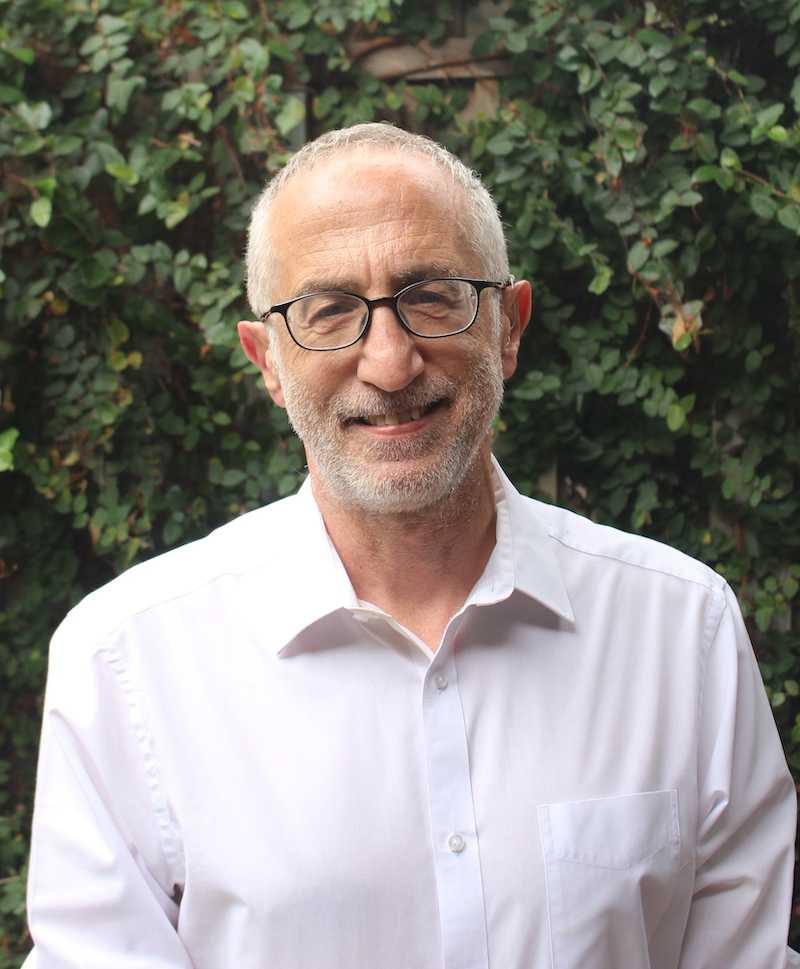
Abbas El-Zein
Abbas El-Zein’s essays, articles and stories have appeared in The Guardian, The New York Times, HEAT, Meanjin and Australian...
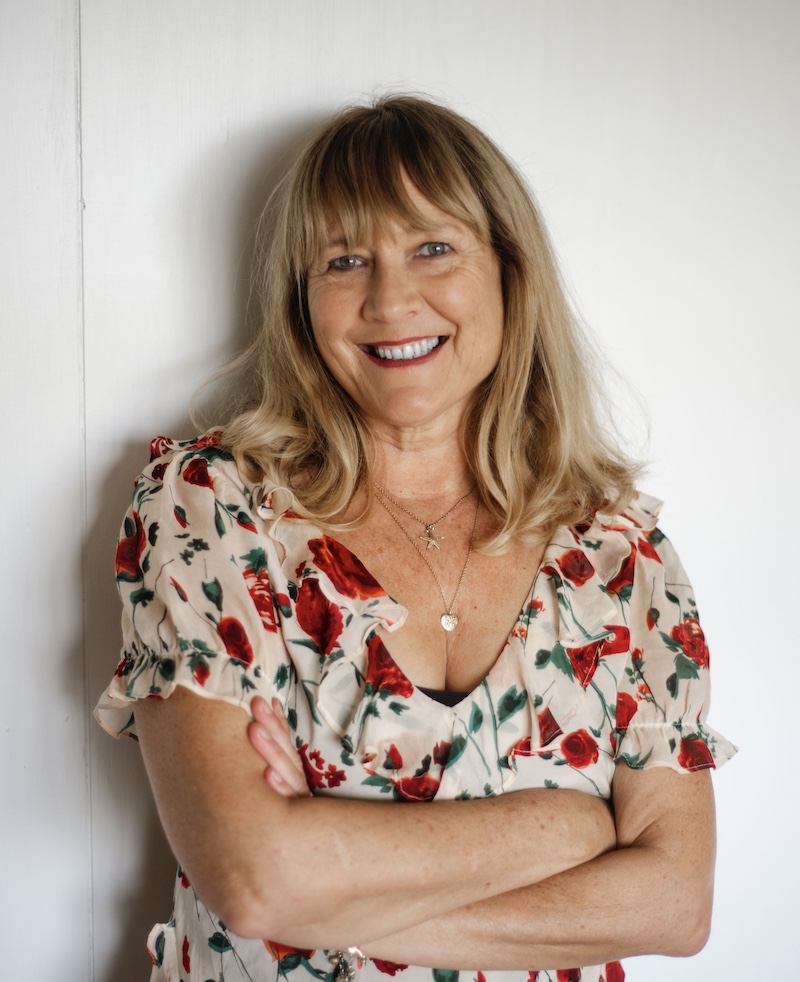
Jill Dawson
Jill Dawson is an award-winning British novelist, and the editor of six anthologies of poetry and stories. Her twelfth...
