
Featured in
- Published 20261103
- ISBN: 978-1-923213-25-8
- Extent: 196pp
- Paperback, eBook, PDF
EVERY OCTOBER, ONE of my favourite memes does the rounds: someone claims that their Halloween costume is ‘Former Gifted Child’, which involves waiting for people to ask, ‘What are you supposed to be?’ and then telling them, ‘I was supposed to be a lot of things.’ Ouch.
I wasn’t a gifted child, but I did grow up wanting to be a lot of things, many of them wildly unrealistic: a forensic pathologist (turns out you have to be good at science); a detective (turns out you have to be good at…detecting); a psychologist (see above re science); an FBI agent (the problem here is obvious). My X-Files obsession had a lot to answer for, but I did eventually figure out that I should probably aim for a job that played to my strengths rather than trying to cosplay as the antipodean version of Dana Scully. It took me several years, a PhD and a few false starts (including a brief and disastrous stint as a speech and drama teacher) to figure out where I wanted to be and how to get myself there, aided by a postgraduate scholarship and a print media industry that was, in the 2010s, in a state of mere decline rather than intractable crisis.
I was lucky; today’s labour market is vastly different for young graduates. Entry-level positions are thin on the ground, and while the stats show that having a degree still improves your employment prospects, the cost of that degree is increasingly untenable – particularly if you want to study arts or if you’re an international student. If you’re mid-career or have decades of experience, your working life may feel no less tenuous – artificial intelligence (AI) is reshaping white-collar roles, trade union membership is at historic lows and various Australian studies show that at least half of us are facing employment-related burnout. No wonder workers the world over are experiencing what Fortune calls ‘professional identity purgatory’ – and those are the people who are at least getting paid for their labour.
It’s enough to make you want to have a lie down, or at least to down your tools. Might I suggest a relaxing break with a good book – perhaps the one you’re reading right now?
THIS EDITION OF Griffith Review visits all manner of workplaces – from the office to the shop floor, from the factory to the film set, from the prison to the home – to explore our changing relationships with paid and unpaid work. You’ll witness the dangers and discoveries of the morning commute; tour a rogue’s gallery of famous and influential quitters; reflect on what AI is taking from us; find out how the workers of the past responded to technological upheaval; consider the anti-revolutionary nature of the work-from-home revolution; reassess how we memorialise the wins of the labour movement; question the wisdom of viewing domestic labour through an economic lens; parse the strangled syntax of corporate-speak; learn how not to be a florist; and so much more.
We owe a big thankyou to this edition’s contributing editor, the multi-talented Sam Elkin, who not only wrote an essay for Out of Office (a rollicking tale of a bewildering government gig that’s sure to trigger any current or former public servants) but who also commissioned social worker and author Bruce Perham, whose perceptive and moving piece reveals the working conditions of Australian prison officers and the broken system of which they’re a part. Sam and Bruce, we’re incredibly grateful to you both for the words and wisdom you’ve brought to these pages.
It’s fitting, of course, that this is our final 2026 edition, released just as many of us will be looking forward to an end-of-year break. If you’re one of the lucky ones who gets to turn on your out-of-office autoreply and forget about work for a couple of weeks, I hope you’ll keep this particular Out of Office within reach.
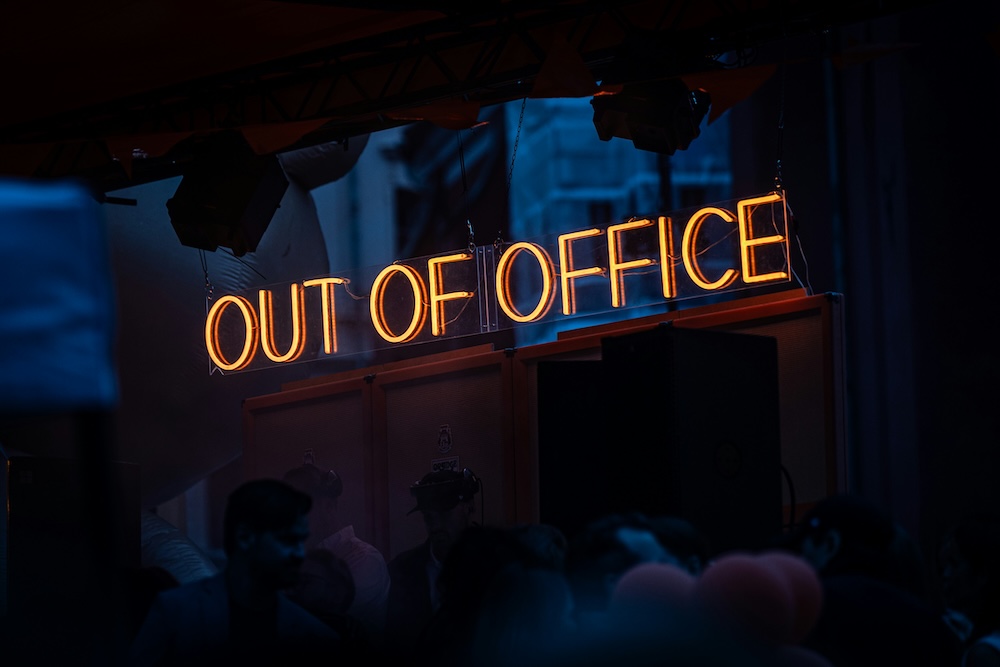
Image: Carl Tronders courtesy of Unsplash
Share article
More from author

Age of the tech empires
The data-centre movement is unlike anything we’ve ever seen before. The modern internet is obviously also built on data centres, but previously, the pace at which data centres were expanding roughly matched the pace at which they were improving their efficiency. So most developed countries were seeing a flatlining in energy demand or a decline in energy demand, even as more data centres were being built. Now, the pace has dramatically exceeded any efficiency gains, so we’re seeing a historic uptick in the amount of energy that needs to be consumed globally. Almost all that uptick is due to the data centres being built. These companies have run out of land and energy and fresh water for supporting this, especially in places that have those resources, because, at the same time this is happening, climate change is accelerating.
More from this edition

Capital and care
Non-fiction SAY I UPDATED my Instagram bio to Emotional labourer (derogative). I’d be on trend, to say the least. In the 1980s, the ascendant era...
Early works
Fiction THE GROUP SAT around the big table while Alexander talked to them. He appeared to be in his late twenties and was dressed in a...
hey, gov’nor
Poetry hey, gov’nor state corps(e) 21st century station manager hey, gov’nor green coat drill-panted protector of white four- wheeled empire Country will evict youwe will still be here we will bleed again on...
