
Journal
Articles

Radical love
People ask me how to manifest their greatest desires because I am clearly living the life of my dreams. I am renowned for my healing work and own a vast business empire connected to it, although this has not always been the case. Prior to my unlimited success, I dabbled in various careers but never settled on any, feeling there was more to existence if only I could grasp it.
Self-portrait in Joy Hester pocket mirror
All hail my inner bones, things have been troped yet now heat up. Being Bowie gone to Berlin, genuinely out of...
Lesbian search terms
how does a lesbian love a person can I use a rock to tenderise meat Amazon commercial with the lesbian couple wtf homemade real lesbian things that usually...
Dot and Ern
Like the hawk of fabric shears, cockatoo...
Roxy Music Has The Right To Children
The fun people had on TV then! The hair, and not only the hair, but full monster suits.
Run River: An exercise
Little space in this town for dead game. Steal a teal Corvette, hit the drive-in, Find the tatty shop. They serve a fish dish.
Vaudeville
If the magical colours aren’t even across the page, it’s a failure of art according to aesthetes. An obscenity of blues and reds, they say.
The Wrestling of Art
We’re tired of the caged horizon, the canned emotion. But the spectacle of the crimson world is a real slobber-knocker of a struggle.

The watergaw
One of the first poems MacDiarmid wrote, with his new name and his new sense of what was required of his existence, was ‘The Watergaw’. No doubt it came as a bolt out of the blue and required much fastening to the jinker, but it reads like a bit of the earth’s speech. It’s a burn steadily chanting over the brae, as they’d say in his part of the world.
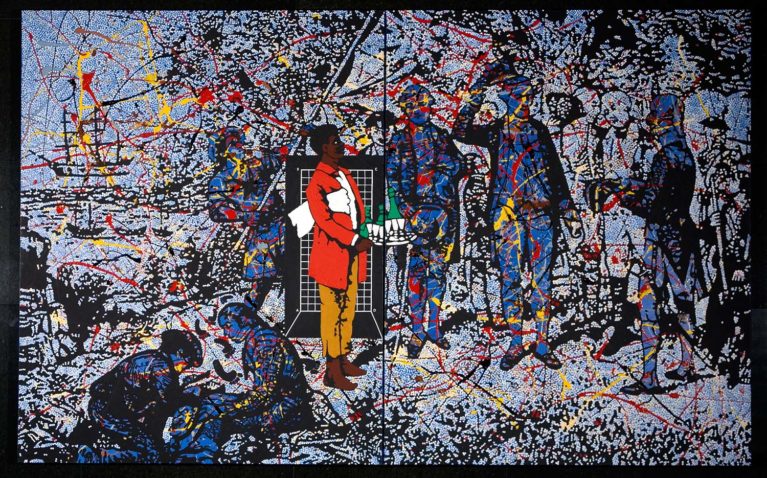
Possession
Bennett chose to excavate representations of colonial history. Old paintings, drawings, stamps, newspapers and textbooks – the kit and caboodle of scenes, images, stories and tropes that, in sum, form something like Australia’s visual common sense. It is just this assemblage that Gordon Bennett sought to unsettle in Possession Island.
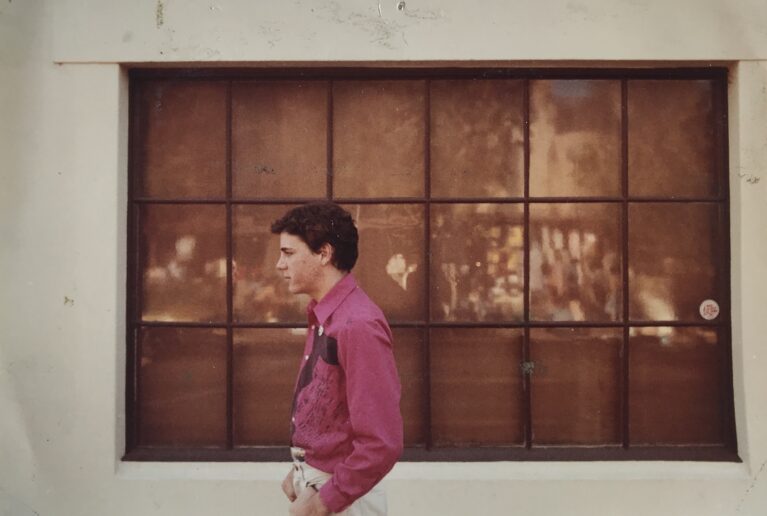
Looking for Johnny Burnaway
In suburban Brisbane, Johnny discarded his teenage nickname, Zap, and adopted a new identity: Johnny Burnaway. The name, which he took from a minor character in Anthony Burgess’ cult novel A Clockwork Orange, served as both punk persona and an accurate description of his future.

The empathy machine?
A cursory Google search soon reveals that ‘VR as the ultimate empathy machine’ – as VR filmmaker and proselytiser Chris Milk calls his 2015 TED talk – is not just a niche academic research interest, it’s a movement. And like all movements, it has its prophets and zealots. According to Milk in a 2016 TechCrunch interview, VR promises the ‘democratisation of human experience’.
