

Welcome to GR Online, a series of short-form articles that take aim at the moving target of contemporary culture as it’s whisked along the guide rails of innovations in digital media, globalisation and late-stage capitalism.

Buy, recycle, repeat
The tip shop creates a vacuum of sentimentality. This only adds to the thrill of the hunt, where the search becomes bigger than the thing itself. In that moment, time alters. The past and present merge and we step outside, just for a second, the familiar cycles of desire and need that shape our daily lives. For a moment, something can be treasured, even if the object of our fantasy exists only in our minds. We look for it in the piles of things people leave behind, searching through the rubbish; all we’re really looking for is ourselves. Reflected back to us are the rain-washed artefacts of our consumption that are lined up and sorted on pallets and old tables. The metallic shells of old fireplace flues, stacks of doors and aluminium windows, fishing nets and old tyres that fill the outside lot.

Home is a long way away
The Australian housing market is a wealth-generating machine, not a home-generating machine. So much is wrong with the current situation. No doubt you see it too; everybody seems to on some level. That’s why we keep hearing about the ‘Australian housing crisis’. I can see it, and I proudly consider myself an old-school capitalist, with a preference for free enterprise, fair competition, private property rights and the chance to make an occasional profit. We now find ourselves with a de facto caste system in Australia: the home owners relative to the home renters. Both groups need homes, but there is a marked wealth division between those collecting passive income on houses they own and those living solely on direct income who are forever chasing a rising market.

Shelf life
Shelves provide functional storage. But as we learnt from the setting of all those Covid lockdown interviews – the expert in front of their books, photographs and tchotchkes – shelves express personality, achievement and erudition. As those same interviews demonstrated, sometimes our best curatorial efforts might miss something too revealing about what we really read and truly value. For the Victorians, who were obsessed with privacy and established many of the norms around middle-class dwelling that continue to influence aspects of contemporary domesticity, shelves posed a particular problem precisely because you could never be sure who was looking at them and what kind of conclusions they might reasonably draw.
The great British architect of middle-class respectability, Robert Kerr, designed homes where privacy was the paramount and exalted objective, achieved through a complex network of ever more enclosable spaces designed to protect property and personal information from the apparently insatiable curiosity of servants.

More than maternity
Principle among art-history instances of breastfeeding are paintings, sculptures, tapestries and stained-glass art in churches that relay key Biblical moments of the Virgin Mary nursing the baby Jesus. Should you find yourself in the corridors of the Louvre, in the same halls where kings and princes are eternalised, one singular image of breastfeeding will make its way towards you time and time again: that of the Virgin Mary nursing the baby Jesus, which emerged in the twelfth century and proliferated in full bloom from the fourteenth as her cult of worship grew. In art, the nursing Virgin is called the Madonna Lactans, and she is a sanctity. Most of all, as the Church’s model of maternity, she is silent. The son of God as a human baby on Earth has presented something of a conundrum for theology. God may be all powerful, but humans are sinful and females are – in today’s parlance – problematic.

Steering upriver
At dawn I cross the bridge, Missouri to Iowa, and turn down the gravel drive. Though I’m different now, this place is the same as it always is this time of year: the sun glowing red over the paddock next door, the grass not yet green, the maple stark. I go away, come back again, and home is like a photograph where time winds back, slows into stasis; where the carpet has changed, but the dishes have not, the cookbooks have not, the piano and artwork and bath towels have not. Here, I can be a child again, my best self, briefly. I hold on to this moment for as long as I can, because too soon I’ll remember how disobedient I am, how bossy and domineering, how I slammed my door until Dad took it off its hinges, how soap tastes in my mouth, how I pushed on these walls until they subsided.

Follow the road to the yellow house
I first visited Varuna in 1994. I had just left my job as the Aboriginal Curator at the Australian National Maritime Museum, where I was involved in establishing the first gallery dedicated to addressing Aboriginal and Torres Strait Islander maritime history. I remember that visit well – even then I felt at home. I grew up in the Blue Mountains. My parents bought our family home there in the early 1970s. It was built in the 1940s, which means that it has a similar interior to Varuna, with ornate cornices, creamy white bathroom tiles, a green basin and bath, Bakelite door handles and even an old black phone.

Songs of the underclasses
Before his back deteriorated for good, Diē had imagined becoming a tour guide in his retirement years. To this end, he farewelled our geriatric SUV and bought a fourteen-seater HiAce. After I got my P-plates, he pulled out the back two seats so I could drive it legally and insisted I go on long drives – though never unsupervised. Wǒ zhīdào bu lōgǐcǎl, dànshì méibànfǎ, said Diē. Nǐ shì wǒ de nǚ’ér. ‘I know it’s illogical, but you are my daughter.’
Diē was the best driver I knew. ‘When you drive, you stare at everything but see nothing. You’re inexperienced,’ he lectured. ‘When I drive, I stare at nothing – I can chat, I can sing. But I see everything. Parking spaces, jaywalkers with a death wish, doggies and kitties. And for hours at time, without breaking concentration. It’s like meditation.’
Diē’s love language included showing me footage of near-miss traffic incidents on WeChat. Each trip of ours decreased my risk of appearing in his feed. These hours became the most time we had ever spent together. ‘I write stories too,’ said Diē, during one of our drives. It was early 2024, and he was accompanying me to a writing workshop in Parramatta.
Mudth
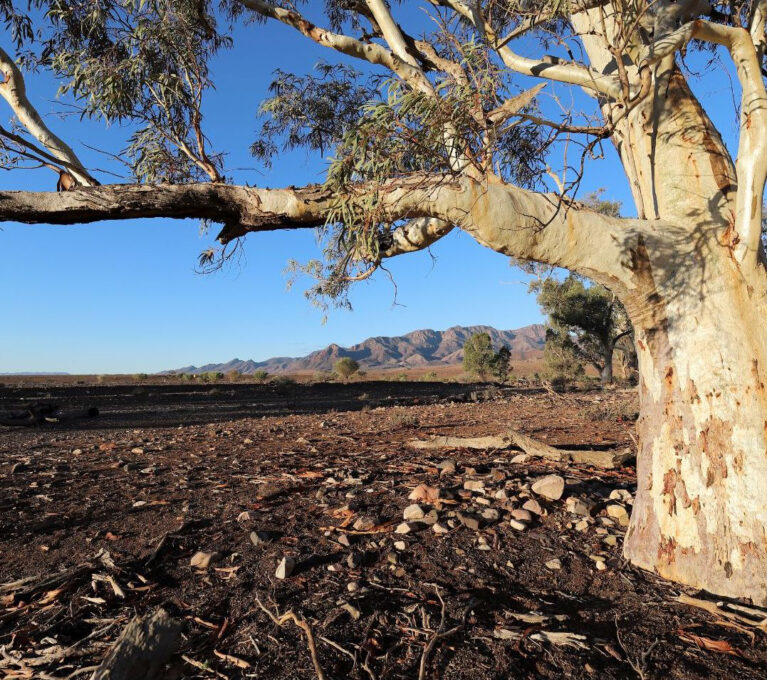
My family has its roots in several parts of the world: the Lui branch in New Caledonia, the Mosby branch in Virginia in the US, and the Baragud branch in Mabudawan village and Old Mawatta in the Western Province of PNG. Growing up, I spent most of my childhood with my Lui family at my family home, Kantok, on Iama Island. Kantok is a name we identify with as a family – it’s not a clan, it’s a dynasty. It carries important family beliefs and values, passed down from generation to generation. At Kantok, I learnt the true value and meaning of family: love, unity, respect and togetherness. My cousins were like my brothers and sisters – we had heaps of sleepovers and would go reef fishing together, play on the beach and walk out to the saiup (mud flats). I am reminded of these words spoken by an Elder in my family: ‘Teachings blor piknini [for children] must first come from within the four corners of your house.’
One language among many
I first used speech-recognition software in 2012. I was about to begin work on my novel The Crying Place, and I wanted to get closer to oral forms of storytelling – a sitting-around-a-campfire feel to the text. Also, I was intending to draft much of it on the road from Naarm (Melbourne) to Mparntwe (Alice Springs), then later in the desert, a moving vehicle not being the easiest place to type.
The software took a bit of getting used to. I had to train it to decipher the idiosyncrasies of my voice by reading texts out loud and using it in different environments. And I had to get the hang of directly narrating the story in character – a form of oral ‘method writing’… What soon became clear was that sounds other than my voice, such as birdsong and wind passing through trees, were being picked up by the software and ‘translated’ into words. Mulga came up as ‘will will’, desert oak as ‘with with’, birds varying according to song. At first I deleted these words from the text – treated them as errors or intrusions – but gradually I recognised what they were showing me. The direction the wind was travelling. The proximity of birds and their conversations, sometimes interspecies. Other languages.
Staying faithful to Earth
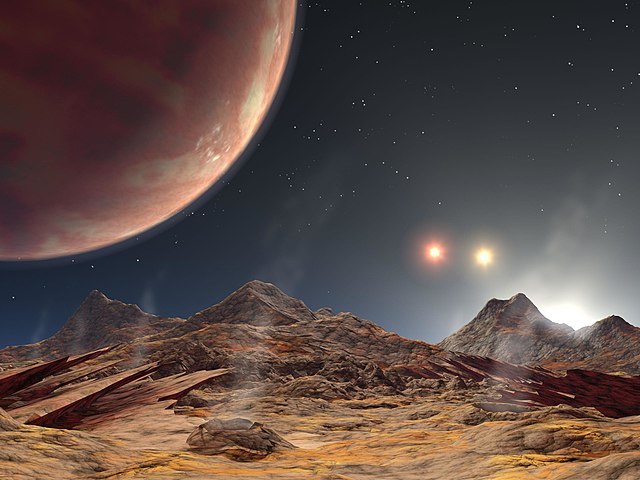
It is a startlingly new discovery that there are more planets than stars in our galaxy. Even if early astronomers (like Kepler) intuited that other suns must have planets, we didn’t have definitive proof until very recently that our solar system is not unique in consisting of planets orbiting a star. The first exoplanet was confirmed in 1992; the first exoplanet around a star similar to our sun was discovered in 1995. The latest count is over 5,000 and growing. Discoveries have stacked up so fast that astronomers and astrophysicists who used to know each individual exoplanet by name now say it’s impossible to keep track of those that exist in just one small part of the Milky Way, with thousands more expected to be found in the coming years.

The power of a curse
My father was mercurial, difficult to please and often critical of his children: but he would have killed anyone who laid a hand on us. And so, knowing I was upset, he showed me what to do.
‘Lick your thumb,’ he said, ‘and place it on the review…’
An effective curse, he went on to explain, should be proportionate. So, for instance, declaring to the author of that book review I hope you die would be ineffective – all it would do was prove that I did not have the power of life and death. ‘Think about it for a bit if you have to.’
I licked my thumb and placed it on the review. I closed my eyes and thought of the journalist who wrote it, and I said to myself, may you never publish a first novel as successful as Crazy Paving.

Adventures in the apocalyptic style
It's easy to laugh at preppers, dismissing their ideas in the process. It’s also easy to adopt the prepper worldview wholesale, and make fun of everyone else – all those sheeple – for not seeing what a mess we’re really in. It’s harder, but ultimately more productive, to see prepping as a complex, contradictory response to the multiple crises the world is facing. Prepping is more than just a freakshow, although it is that. And prepping is more than a useful instructional manual, although it is that, too. Neither wholly reasonable nor wholly ridiculous, prepping culture is a vivid and alarming reflection of a contemporary Anglophone culture that exists in a state of perma-crisis and can find only simple answers to wicked problems.
