
Featured in
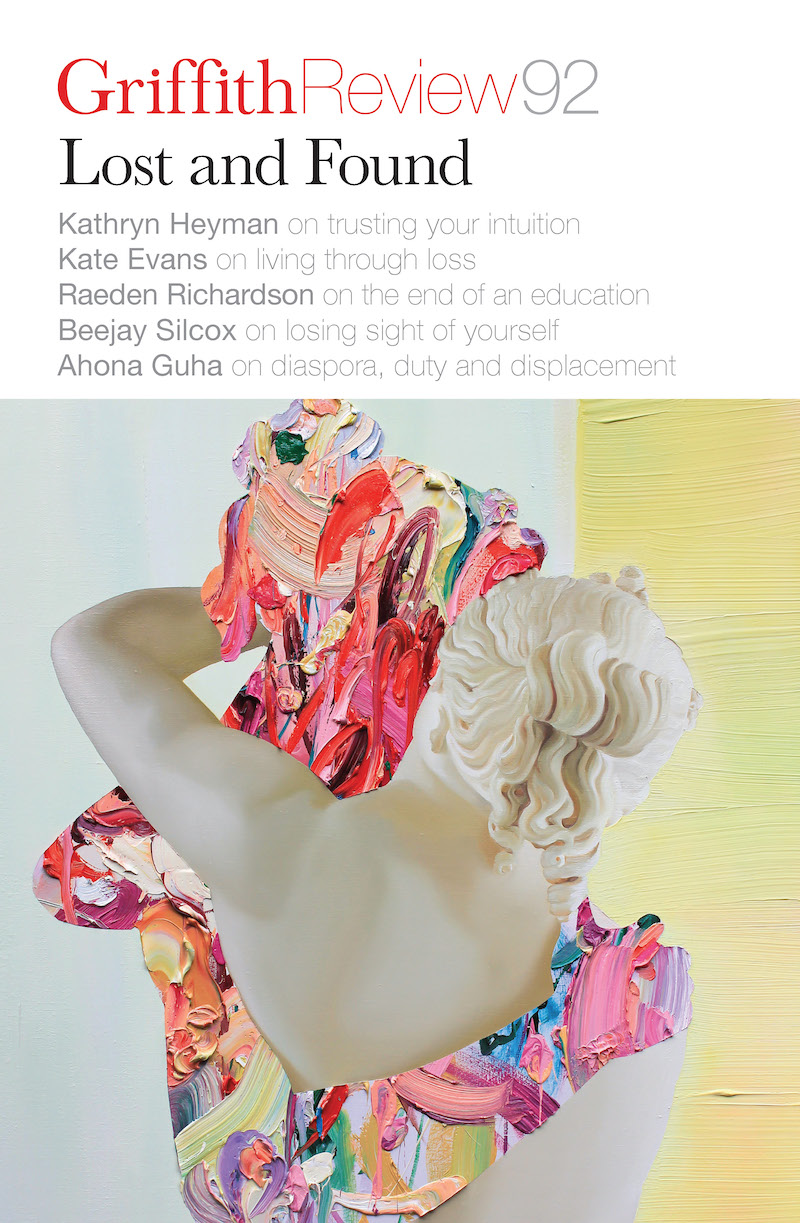
- Published 20260505
- ISBN: 978-1-923213-19-7
- Extent: 196pp
- Paperback, eBook, PDF

WHEN I WAS twenty-nine and in the throes of an underwhelming early-life crisis (yes, I did get a Sylvia Plath tattoo), I bought Adam Phillips’ book Missing Out: In Praise of the Unlived Life (2012). Phillips is a practising psychoanalyst as well as a philosopher, so perhaps I thought this book would be a cheaper alternative to seeing a therapist. In Missing Out, he makes an eloquent and elegant case for the influence our unlived lives – the paths not taken, the dreams unrealised, the aspirations left on the shelf – have on our real ones. In navigating the ever-present tension between our imagined and actual selves, Phillips proposes, we can determine what it is we really want; we can come to accept our essential incompleteness and our inherent contradictions. Much like desire can only exist in relation to its lack, as Lacan argued, our true lives can only be understood in relation to the ones we’re not living – the ones we may feel we’ve somehow lost out on.
It felt shocking, when I first read this book, to realise that it wasn’t just me who went about my day with an alternate self in my head: a flawless and infallible Carody who enjoyed a wildly exciting and accomplished existence and who always wore the most fabulous vintage outfits. And I couldn’t tell you if Phillips’ book or the Sylvia Plath tattoo was more successful at pulling me out of my late-twenties funk. But Missing Out has stayed with me, and I’ve returned to it many times over the years – sometimes for trivial reasons (Should I move to the Shetland Islands and live in a shed? Should I retrain as a florist?), and sometimes because it helps me contemplate real and difficult losses (Adam Phillips was one of my late father’s favourite philosophers; reading the work Dad loved is a way of momentarily conjuring him). But mostly, I think, I return to it because unspooling beside my unlived life is an actual one that I don’t want to lose sight of.
THIS EDITION OF Griffith Review considers all kinds of loss (and a few notable instances of its inverse). Losing something, of course, doesn’t have to connote pain or strife: some of the essays and stories in this collection view loss as a beginning rather than an end, a shucking off of old selves or a reappraisal of old habits and ideas. Others explore loss in a creative context: the polycrisis engulfing the Australian arts sector, the limitations of representation in literature, the role of art as a form of knowledge in our captious cultural and political moment, the hopes and desires we project onto the lost and rediscovered manuscripts of celebrated writers. Some pieces share incredibly moving personal stories – the loss of a child, the discovery of a long-buried secret, the complexity of caring for ageing parents, the confronting sight of a stranger in the mirror – while others explore questions of environmental loss, scientific possibility, and whether mushrooms might take over the world. It’s a rich and varied collection that was a joy to curate and edit.
Our contributing editor to Lost and Found was the wonderful Allanah Hunt, who commissioned and worked with Georgia Malu on the latter’s incisive and sharply observed memoir, ‘The lists’. Thank you, Allanah and Georgia, for bringing this delightful story to fruition. Lost and Found also includes two of our outstanding 2025 Emerging Voices competition winners: ‘Bucket of water’ by Shelley Eves and ‘A liability’ by Phoebe Cannard-Higgins.
The breadth of ideas and voices in this collection is testament to the infinite ways the concept of loss can be conceptualised and understood – just as we can play out an infinite number of alternate lives on the stage set of our imagination.
– March 2026
Image: Tom Barrett courtesy of Unsplash
Share article
More from author

Finer details
The team at GR HQ had some thought-provoking conversations while selecting the cover art for Griffith Review 91: On the Money. Of course, there are obvious symbols that convey this evergreen theme – bulging wads of cash, a bank, gold bullion – but these felt like low-hanging fruit. In the age of Amazon, online shopping and next-day delivery, how could we represent contemporary commerce?
More from this edition
The lists
Non-fiction Friday, 16 August 2019 9 pm I’M SEVENTEEN YEARS old. Billie Eilish’s brand new song, ‘bad guy’, blasts from my mini speaker as I pack up...

Final five days
Non-fiction THAT MONDAY IT was hot. Sydney hot. Classic hot. Veering towards 40 degrees even though it was early March and we should have been...

Blaming the pastries
Non-fiction A FEW YEARS ago, while I was complaining about something my old boyfriend had said, my mother misquoted a common saying as ‘You can’t...
