
Featured in

- Published 20260203
- ISBN: 978-1-923213-16-6
- Extent: 196pp
- Paperback, eBook, PDF
NOT LONG AFTER the 2018 Royal Commission into Misconduct in the Banking, Superannuation and Financial Services Industry, I attended a panel discussion that sought to consider its professional and ethical implications for bankers. Anna Bligh, CEO of the Australian Banking Association at the time, persistently used the #notallbankers hashtag, which was stretched beyond all rational use during the commission. Despite a #fewbadapples, she suggested, bank integrity was secure: Australians could sleep well at night knowing their money was safe.
Until then, it had never occurred to me that my money – such as it is – might not be safe in the bank. These institutions go to some trouble to present themselves as symbols of safety, stability and trustworthiness. For example, there was great excitement when the Commonwealth Bank’s vault – still one of the largest in the world – was hauled to Sydney’s Martin Place in 1926 by the twenty-five horses required to transport it. It was a public spectacle that demanded our trust in banking, saying look at the hefty measures the bank takes to protect your money. Banks are now more likely to flaunt their investment in cybersecurity, scam prevention and online fraud, like the ANZ Falcon® technology that ‘works around the clock’ in a way that’s ‘personal to each and every one of our customers’. The message is the same: sure, we have big bucks, but we use them to keep your money safe.
These days, although banks do much more than store cash, we have no choice but to use them for that core purpose. Back in 1990, when I had my first job, I received a little orange pay packet containing $14.75 – but wages are now deposited directly into the bank, so most of us cannot have a job without a bank account. With less cash circulating since Covid, we now literally tap our bank deposits when we buy stuff. Today, almost every transaction in our economy is managed (also overseen and sold as aggregated data) by banks.
As these institutions have grown more powerful, Australians have understandably become wary. The fact that banks function independently of any democratic process is an anomaly in our political system. It’s a historical curiosity that begins with the connection between everyday Australian banking and mid-nineteenth-century gold fever.
DURING THE 1850s gold rush, a person who struck gold found their elation quickly supplanted by anxiety. Where would they keep it? How would they protect it? In this environment, banks offered the only real answer – and soon enough, they grew like mad.
At that time, banks mainly served merchants. An Australian wool merchant, for example, might have a contract to sell wool in London but need cash to pay for the cost of getting it there. The bank would lend the merchant the amount of the contract up-front, but with a ‘discount’ – so that when the merchant repaid the bank at the conclusion of the deal, the bank made a profit. This model of banking was so ingrained that before the gold rush, some Australian banks didn’t even take deposits. It wasn’t so much that ordinary people didn’t have bank accounts – they just weren’t the bank’s business. That was about to change.
For most of the people converging on the new gold-rush towns in Victoria and New South Wales, making a gold deposit was their first encounter with banking. The gold rush turned everyday banking into a reverse sort of alchemy, converting gold into money. George Preshaw, a gold-rush banker, described a digger who listened carefully about the nature of the deposit he was making, completed the transaction and stepped outside the bank. A moment later, he stepped back in and withdrew the money, holding the cash he’d received like it was some sort of miracle.
And it was. Ore from the ground was converted into a bank deposit. That abstract thing, the deposit, represented money that really belonged to him.
Finding a place to safely keep the gold – or, rather, to sell the gold, converting mining into deposits that in turn became currency – arguably marked the beginning of typical modern banking in Australia. Before long, banks were central to the entire economy. The entanglement of banking with the rise of industrial waged labour was what turned the former from a marginal industry on the edges of international shipping into the indispensable piece of economic infrastructure it is now.
But as their lives became ever more entangled with banks, members of the working class started to smell a rat. A newspaper story from 1906 captured the vibe, portraying an imaginary banker speaking to a fictional Irish bartender called Mr Dooley:
Ye sleep better at nights because ye feel that ye’er money is where no wan can reach it except over me dead body. If ye on’y knew ye’d not turned ye-er back before I chased those hard-earned dollars off the premises. With yer money I build a house an’ rent it to you. I start a railroad with it, an’ ye wurruk on th’ railroad at two dollars a day.
This was a fair assessment: most bank customers were capitalist enterprisers and property investors who relied on working-class labour, rent and consumption. But the banks were also becoming powerful because of the expansion of modern government.
The democratic institutions that workers helped build also needed banks, boosting their spectacular growth. Government debt – which frequently takes the form of bonds – has been central to the operation of parliaments for hundreds of years. In the Australian colonies, an alliance between banking and government was modelled on the Bank of England: banks supplied the cash needed for everyday governing, protected government tax income and, crucially, sold government bonds to fund public spending.
As governments grew in the Australian colonies, their debt tied the state to the world’s finance centre, the City of London, which was the only place (until the rise of New York) with sufficient resources for such big loans. The London banks enjoyed their power over Australian governments, using their status to wield influence. In 1921, for example, they put a black ban on loans to the government of Queensland, hoping to push Labor out of office by cutting off their credit supply. In 1930, at the height of the Great Depression, the Australian Government endured a humiliating visit by British banker Sir Otto Niemeyer, who informed the government that because the City held its debt, the City would also be determining government fiscal policy.
The Niemeyer episode is famous in Australian history, primarily for the immediate political fallout involving New South Wales Premier Jack Lang, who refused to comply with Niemeyer’s plan, and the compromise (the left saw it as a sellout) enabled by what became known as the Premiers’ Plan (which sought ‘equality of sacrifice’ between capital and labour by cutting spending and bond payments).
Obsessed as we are with politicians, we tend to overlook the role banks have played, and continue to play, in our political system. Just as we see the legal system as the third arm of executive government, so we might see banking as the fourth.
Dooley’s fictional 1906 banker had something to say about this, too:
Ye’er money makes me a prominent citizen. Th’ newspapers interview me on what shud be done with th’ toilin’ masses, meaning ye an’ Donohue; I construcht the foreign policy iv th’ Government; I tell ye how ye shud vote. Ye’ve got to vote the way I say or I won’t give ye back ye’er money.
Perhaps the banking sector has long had good reason to conceal its centrality to Australia’s democratic and economic management.
IN THE EARLY 1990s, Treasurer Paul Keating introduced compulsory superannuation, launching a new phase in the connection between politics and finance. Who controls this money is subject to continual political conflict; in 2018, Liberal Party politicians vainly hoped the Royal Commission would expose corruption in industry funds whose boards include union representatives. As it turned out, it wasn’t the unions that were the problem. It was the banks.
Over the last few decades, the pool of Australian savings has grown to more than $4 trillion, approximately the global domestic product of Hong Kong. Except for worker representation on the boards of industry funds, it’s almost the sole plaything of the finance industry. Our finance sector is proud of this pot of money, which is the second or third largest globally. Our superannuation savings make Australian finance even more influential than Dooley’s banker claimed, because with our money they are one of the biggest investors in the world.
They better have a damned good vault.
They don’t. After the Royal Commission, journalist Michael Roddan was scathing: ‘The banking sector had been covering up the big Australian rort,’ he wrote in The People vs the Banks (2019). ‘In its world, superannuation members came dead last. It was other people’s money, but the fund managers saw it as theirs for the taking.’ Indeed, the ‘big four banks and AMP were far and away some of the worst handlers of Australia’s savings’.
The story of Australia’s massive superannuation pot is further important, however, because it represents a major shift in our democracy since the 1990s.
Compulsory superannuation sought to reduce the burden of the aged pension on the federal budget. Taking care of our elderly citizens was previously a government responsibility, but it is now largely the task of banks. This set-up offers distinctive advantages to the wealthy and has systematically disadvantaged women in ways that the aged pension never could.
Having outsourced superannuation, the Australian Government remained anxious about the pensions they’d have to pay, particularly as the population on average had become older, lowering the relative proportion of people in the workforce. In 2004, Treasurer Peter Costello announced a sovereign wealth fund, the so-called Future Fund. This sort of thing was more common for countries like China, Kuwait and Russia than OECD democracies such as Australia – in fact, the billions these sovereign wealth funds controlled were cause for concern among democratic nations, who feared such a large quantity of foreign investment could be used politically, undermining democratic sovereignty.
But once Costello handed billions of government funding to the finance sector to grow wealth for the state’s pension liability, other transfers of governmental responsibility to finance grew further still. Now, the Future Fund also looks after disability support, medical research, disaster preparedness and relief (including droughts), social and affordable housing, and the Indigenous Land and Sea Corporation, which supports First Nations economic opportunity. In March 2025, the Future Fund was valued at $307.6 billion, which is around thirty times the Commonwealth Bank’s 2025 profit.
This is money that the government chooses not to redistribute in the present but saves for the future.
An ominously titled Board of Guardians and a selected handful of investment managers – 114, according to the website – invest some of that money in real-world infrastructure and real estate, but the rest is in a diversified set of financial stuff circulating in stock markets in Australia and overseas, as well as a bunch of credit, including home loans. Some is held in cash, which includes US Treasury Bonds. That means that on top of the $4 trillion or so of our personal superannuation, around $300 billion of our collective wealth, embodying the government’s capacity to do some of its most essential work, is circulating through the global finance sector.
What could go wrong?
THIS OUTSOURCING OF government responsibility to the finance sector reversed the findings of an earlier banking royal commission, established by Joseph Lyons’ United Australia Party government and conducted over 1936 and 1937. Global finance was implicated in the Great Depression, demonstrating that perhaps our money might not be safe with the banks – which is why the public demanded a royal commission in the first place. This episode culminated a decade later in a major political battle that the banks won, setting us on the path to a finance sector that governs much of our lives – including the security of our retirement.
Among the commission’s conclusions was a boring recommendation for regular collection of banking statistics. It’s typical of public servants to seek ever more data, perhaps. But in this case, it was also crucial to the task of monitoring bank profits, which the commissioners asked of government. The purpose was to ensure that trading banks were keeping money circulating in the economy, without which, the report said, ‘no branch of industry’ could carry on under ‘modern industrial conditions’. If their profits, which would now be disclosed, exceeded the ‘fair return for the services rendered’, the commissioners suggested, ‘the Government should consider whether the profits of the trading banks should be regulated or limited as in the case of some public utilities’.
The final report of the Royal Commission on Monetary & Banking Systems in Australia included a dissenting view prepared by future Prime Minister Ben Chifley, who was one of the six commissioners alongside a Supreme Court judge, an accountant, an economist and a stockbroker who was also a leading member of the Country Party. Chifley wanted to go much further than the other commissioners by actively limiting bank profits. ‘Banking differs from any other form of business because any action – good or bad – by a banking system affects almost every phase of national life,’ he wrote. For Chifley, that meant the banks’ only aim should be the ‘general good of the community’. Just after unemployment hit 13.1 per cent in 1929, Chifley said, the banks raised interest rates. For those with wealth, the rate hike meant their earnings were joyfully increased, but for anyone with a loan – well, ‘This action of the banks, in my opinion, was quite wrong as far as the community was concerned,’ Chifley argued, ‘although it did bring some immediate additional profits to the banks.’
The 1937 commissioners all agreed that banks were akin to a public utility. We might debate appropriate parallel utilities, but I quite like sewerage. The sewerage system is essential. Like the economy, it has flows and circulations, and its regulation is a lynchpin of community wellbeing, indeed our collective health.
Also, obviously, it’s full of shit.
Unlike our 2018 commissioners, who observed (bull)shit throughout the system, Chifley was not accusing the banks of any dishonesty. He simply thought it was impossible for the banks to focus on the community while there was a profit motive. In the absence of nationalisation, which he preferred, Chifley suggested a systemic limit on profits at ‘an amount equal to 5 per cent of shareholders’ funds, or 8 per cent per annum on paid capital, whichever is less’.
A decade later, as prime minister presiding over postwar reconstruction, Chifley decided to nationalise the banks. This was a longstanding Labor policy, yet everyone was surprised, not least because of the ‘rash’ way he proclaimed bank nationalisation: in a forty-two-word announcement on a Saturday morning, heard by a tiny handful of diehard journalists who might have been skiving off from taking the kids to sport.
To Chifley, the banks were still a public utility, and that reason alone would have motivated nationalisation. However, they were also essential to postwar reconstruction, providing the finance for the massive expansion of urgently needed housing and underpinning the economic conditions that would enable the government’s new full-employment policy.
Chifley said that the two Bank Acts tabled in 1945, one for the Commonwealth Bank and the other for the trading banks, would enable government to ‘accept responsibility for the economic condition of the nation’. He was in the middle of postwar reconstruction, where economic reorganisation was ‘of such magnitude and involve[d] such serious consequences that no other attitude could be maintained’.
Neither Act set out to nationalise the banks. Chifley’s Cabinet decided on that when the banks, led by the CEO of what’s now the National Australia Bank (NAB), disputed the Act. The High Court concurred that requiring local governments to hold deposit accounts with the Commonwealth Bank, a cashflow that would help with the government’s housing plans, was unconstitutional. But Chifley and his cabinet agreed that without the new Act, they wouldn’t be able to take responsibility for the ‘economy of the nation’. It’s tough maintaining public health when you can’t control the flow of sewage.
A spoiler alert at this point is hardly needed: bank nationalisation failed.
Much of that was due to the CEO of NAB, Sir Leslie McConnan, who in 1945 was only just getting warmed up. I hear there’s a portrait of McConnan in Melbourne’s NAB museum as the hero who ‘saved the banks’.
Let’s be clear: the banks were not being ‘destroyed’. The plan was compulsory acquisition in the national interest. The government proposed to purchase them at an independently calculated fair price. Shareholders would be reimbursed. And every single bank worker would keep their job, at the same pay rate. Indeed, banks would operate as they had been. But all Australians, not just a handful of shareholders, would now be the beneficiaries of their service and the profits they produced – presumably also without the bad behaviour those profits coerced, and that became so obvious in the 2018 Royal Commission.
By 1947, a massive, co-ordinated public relations campaign was launched by the banks, led by McConnan and exploited by then Opposition Leader Robert Menzies. Bank customers, newspapers and crowded events were bombarded with propaganda about ‘saving’ the banks from what they called an authoritarian communist government. The anti-nationalisation agenda was so noisy that when Chifley lost the 1949 election, many people said (and still say) it was because of his stance on banking. And maybe it was. But Chifley had not only alienated anti-communists over the banking issue; he’d also pissed off the left in 1949 when he arrested union leaders, froze union funds and sent in the military to break a coalmine strike. There were not enough voters in the middle allow Chifley to win.
THAT 1949 ELECTION still shapes the question of who controls the money. To think about this question, we need to look at central banking.
The initial idea, articulated as early as 1824, was that if the government owned the bank, they would not need to pay interest on their £15 million loan from the Bank of England. Rather than remain a distant customer of the Bank of England, the Australian Government would have its own bank. Other ideas that were developing around the same time about a system of government and a national bank entangled the interests of our democratic institutions with the finance sector.
Since the eighteenth century, the Bank of England had sold government bonds to London folk looking to make money from money, including other bankers. Every day, bankers moved bonds and money around London (on foot), then convened with other bankers at the end of the day for ‘clearing’. There, bankers counted what had moved between institutions and settled the leftovers, ready to begin again tomorrow. For a century, before there was any expectation that ordinary people had a bank account, this set of practices, alongside discounting merchant contracts, formed the basis of modern banking.
Because bonds became so important to the whole system, the central bank took on a dual role: performing material operations for government and maintaining the stability of the finance system (which sometimes means acting as a ‘lender of last resort’ during a crisis; in recent decades, it’s become about using interest rates to control inflation). The emergence of this double role produced the key political tension in Australia’s banking history, for there can be a significant difference between acting in the national interest and supporting the finance sector’s rate of profit.
The first central bank was the Commonwealth Bank, formed in 1911 as an instrument of Australian Federation to serve the Australian Government. It was simultaneously a commercial and central bank, intended to facilitate the movement of money across state borders. The profits flowed back into public coffers, doubly supporting the functions of parliamentary democracy.
But in 1949, emboldened by their success in opposing nationalisation, the trading banks successfully lobbied to separate the Commonwealth Bank’s commercial functions from its role as a central bank. HC ‘Nugget’ Coombs, who had led postwar reconstruction and was by then Governor of the Commonwealth Bank, said separation of trading and central banking simplified relationships with the finance sector. But his pragmatism was tinged with regret that the government-owned trading bank wouldn’t any longer supply funds to the government. This was the end of any vision for a banking system that would put the national good first, with profits flowing back into the economy, or enabling the work of government.
At least the central bank maintained its mandate for full employment, which was the lynchpin of Coombs’ postwar reconstruction plan.
The central bank was renamed the Reserve Bank of Australia (RBA) in 1960 and kept its dual role as a manager of public debt and as a ‘bankers’ bank’ with responsibility for the finance sector. Within a decade, its responsibility for monetary policy deepened, controlling the flow of money (these days, mostly credit) into society, which further embedded the RBA into the everyday lives of Australians.
Before the 1970s, it was easy. The US dollar, itself stabilised by gold, acted to regulate global currencies. This was the monetary policy – in controlling the value of Australian money, the global system also controlled inflation, pretty much. But in 1971, US President Richard Nixon ended dollar–gold convertibility, which undermined the basis for stabilising global currencies. Then Arab oil producers punished the West for supporting Israel by restricting oil supply, causing massive shocks. Both led to ‘stagflation’, a stagnant economy with a massive inflation problem. Traditional government fiscal tools would not work; they needed active monetary policy.
The RBA’s job suddenly became difficult. It was an important job, arguably still the key tool for managing the economy. Fiscal policy, even when it works, tends to have a slower effect.
Conditions favoured ‘monetarism’, restricting the quantity of money to drive down inflation. This austerity bolstered neoliberal opposition to democracy’s tendency to redistribute wealth, believing, without evidence, in democracy’s ‘natural profligacy’.
When it came to displays of profligacy, however, the banks said, ‘Hold my beer.’
One RBA governor described how bank deregulation, which began in the early 1970s and was likely the only plausible response to the change in the role of the US dollar, meant bankers ‘were like a bunch of kids set loose for the first time in a lolly shop’. The system was flooded with cheap credit, producing the likes of Alan Bond and Christopher Skase, who accrued unpayable debts – and ultimately ripped off Australians.
In the late 1980s, when, under the Hawke–Keating Accord, wages were suppressed to maintain employment (offset by tax cuts to the lowest earners), the RBA raised interest rates to 18 per cent. It worked, lowering inflation. Soon enough, the RBA saw other forms of wage suppression as its mandate, such as redefining what Chifley and Coombs meant by ‘full employment’ at the end of the Second World War: they now increase unemployment until inflation stops and then call that ‘full employment’.
This is purposeful redistribution of the opposite kind to the one that neoliberals thought characterised democratic governments. Rather than governmental ‘profligacy’ that redistributes income to reduce inequality, this system forces the poor to pay for the cost of anti-inflationary strategy. You see, very high inflation is bad for everyone, but a little can be useful, especially for reducing debt. But inflation is always bad for banks. The value of their biggest asset, the loan book, shrinks. When global events cause inflation, the banks want it stopped, fast – but they don’t want to pay for it.
The RBA’s job as the bankers’ bank makes protecting the finance system their priority. Australia’s poorest and most vulnerable pay the price.
DESPITE MYRIAD APOLOGIES in 2018, banks do not appear to have changed. In 2024, the Australian Securities and Investments Commission found that banks ‘knowingly’ ensured millions of customers paid high fees when, as poorer members of the community, they were entitled to lower fees. The Commonwealth Bank says it won’t refund them. That bank made a $10.25 billion profit in 2025. The structure observed by Mr Dooley’s imaginary banker has prevailed, at least in this case. Banks readily take money, often from the poorest and hardest working Australians. They then try – very, very hard – not to give it back.
This pattern reveals a systemic weakness in our democracy. Private interests have taken control of a public utility. Then the system demands the public pay for its stabilisation by keeping a segment of the population unemployed on below-poverty income, destabilising families and social cohesion. Billions of dollars of bank profit – $15.5 billion after tax, last year, just for the Big Four – must come from somewhere.
Banking and democracy grew together, but they have since grown apart. Protecting our democracy, economy and retirement savings requires us to think carefully about how they can be reunited.
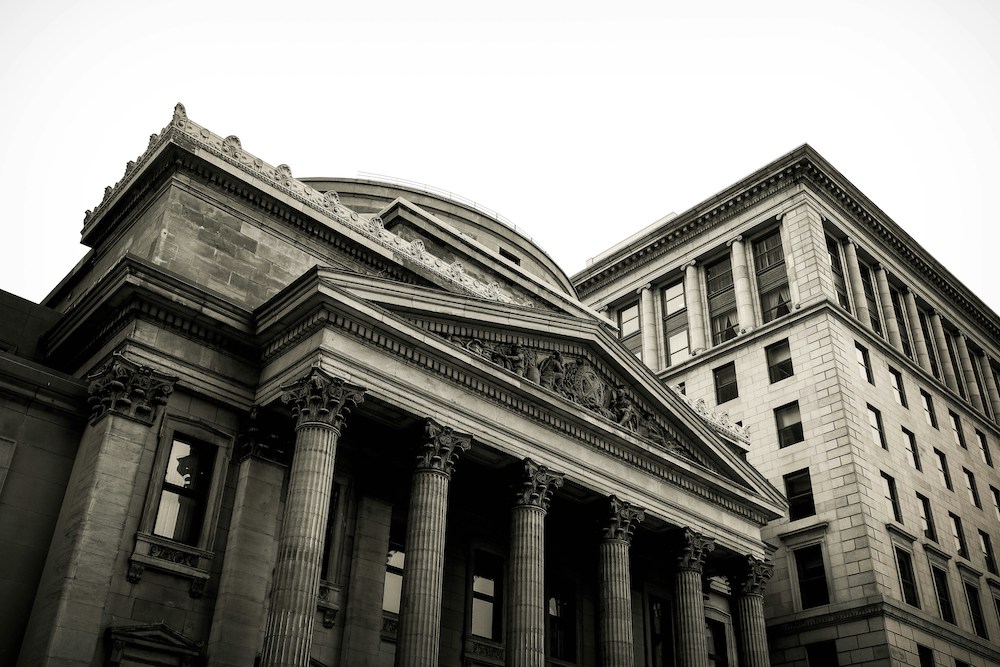
Image: Etienne Martin from Unsplash
Share article
More from author

The long road home
Two days before our flight, Dubai – our leapfrog to Sydney – closed its border. At midnight, we had new tickets routed through San Francisco…At Heathrow we ate egg sandwiches on the airport floor…and checked our email. Our permission to travel through the United States was revoked.
More from this edition

Operator, please
Non-fiction OVER THE LAST few years, I’ve started to do volunteer work for a number of national and international companies. It started off quite slowly....
Conditions of Entry
Poetry Thirty lines max, it says. Only twenty-nine left as some wag might have quipped but who’s counting? All bags must be opened for inspection. All poems disassembled and unpacked so...

No small change
Non-fiction HONESTLY, I WAS a bit shocked. Not only because it was so pointed an accusation but because I hadn’t an inkling my friend felt...
