
Featured in
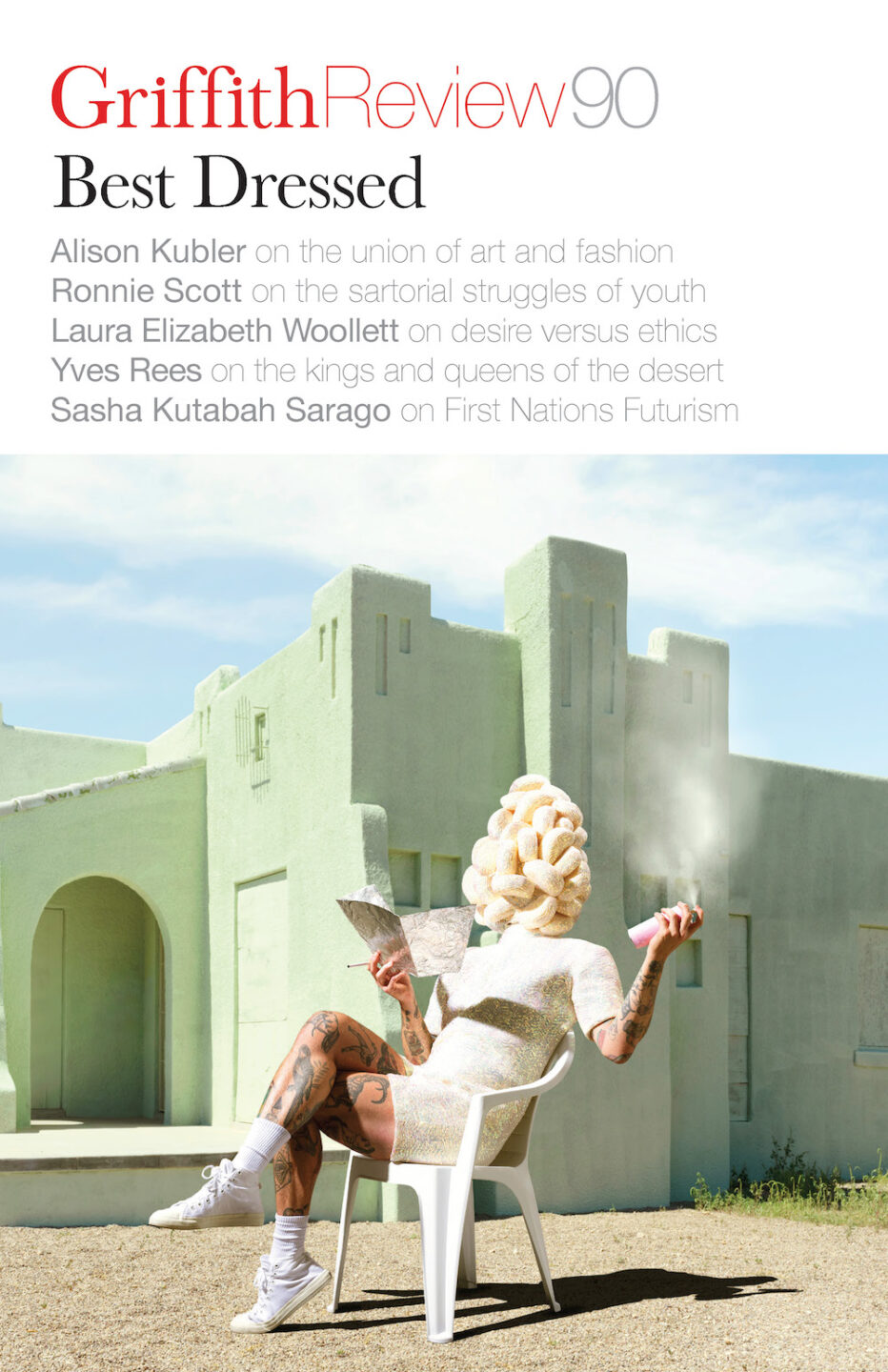
- Published 20251104
- ISBN: 978-1-923213-13-5
- Extent: 196pp
- Paperback, eBook, PDF
AT THE TIME of writing, it’s Paris Fashion Week, specifically haute couture, the most rarefied and specialised of fashion codes. The influence of art on fashion is evident everywhere this season, from Dior to Maison Margiela to Schiaparelli. Many of the shows feature artworks on the runway, garments with patterns inspired by art and artists or accompanying designer notes that reference art.
Art and fashion have long been co-conspirators, collaborating commercially and creatively to mutual benefit since the early twentieth century. At first glance, the disciplines appear to be fundamentally opposed. Where fashion has traditionally been seen as fickle, transient and driven by popular culture trends, designed to make itself redundant with each new collection, art is understood to be more thoughtful, intellectual and elitist, in pursuit of longevity – the nobler pursuit, owing to its intellectual and philosophical origins. Fashion embraces reinvention to make itself relevant, responding to consumer demands and the commercial imperative, whereas art, born of an artist’s creativity, has historically been regarded as the higher form, one that does not necessarily depend upon financial gain, nor require money for its creation.
Of course, these are outmoded, romantic notions – absolutes. Art is a commodity like any other, bought and sold as an investment. Art and fashion are economic systems with a great deal in common: both exist because they can, not because they serve a practical purpose.
If we accept that fashion aims for popularity within the era in which it’s created, sometimes resorting to gimmickry – a criticism often directed at designer Demna Gvasalia during his time at Balenciaga, for example – whereas art eschews popularity for cultural longevity, then it could be argued that fashion is for the masses while art is for the elite. Art, ostensibly, captures the Zeitgeist that ultimately influences fashion – although the cultural markers of what constitutes the Zeitgeist, too, have shifted with the rise of social media. The pluralities of contemporary popular culture have done away with a mono lens; multitudes of styles and genres and opinions coexist and disappear in real time so that the Zeitgeist is continually being revised.
Today, discussions of art and fashion inevitably come back to the concept of implied value and worth. We understand that fashion has a ‘price’ and art has a ‘value’. Art might be seen to appreciate, whereas fashion, on the whole, depreciates.
There are exceptions: in mid-2025, as I’m writing this, Jane Birkin’s original Hermès Birkin bag, the ‘it’ bag to rule them all, just sold at auction for over AU$15.2 million. The buyer was the Japanese CEO of Valuence, a luxury resale vendor. Will he resell it? Here’s an example of a fashion object with value by virtue of its provenance, something that art puts great importance on. Yet very few fashion items hold their value outside the world of haute couture and beyond the immediate desire that surrounds an ‘it’ bag or designer, precisely because this desire is by its very nature fleeting. An ‘it’ bag is designed to be usurped by the next ‘it’ bag. This is the natural attrition of fashion because fashion is, after all, fashionable.
Yet several factors must coalesce for art to appreciate and become a tradable commodity: it must be collected, written and talked about, exhibited, bought and sold. The risk here is that artists go out of fashion – their work can, and does, lose favour with curators, critics and collectors, or a shift in critical thinking can result in the rise or demise of a specific medium. In the contemporary cultural landscape, artists are increasingly recognised as brands in their own right, mirroring the structures, tactics and aesthetics of the fashion industry. This shift reflects a broader convergence of art and fashion, where both now function less as purely creative fields and more as image-focused systems linked to celebrity, commerce and cultural influence.
Traditionally, an artist has been judged critically based on their larger body of work, assessed over a long period. In the not-too-distant past, an artist’s work would command large sums of money only after their death, but this is no longer the case. A-list artists, to borrow a fashion phrase, now enjoy millionaire status in their lifetimes, often seeing their work sell on the secondary market multiple times. Historically, too, artists resisted the language of branding, often cultivating mystique or prioritising ideas of authenticity and autonomy. But today, many artists embrace visibility, repetition and recognisability – the core tenets of branding. Names including Yayoi Kusama, Takashi Murakami and Jeff Koons (all of whom, it should be noted, have collaborated with the storied French luxury maison Louis Vuitton) are emblematic of this change: their signatures and motifs are instantly recognisable across mediums and markets, from museum walls to high-street collaborations. These artists operate with the fluency of fashion designers – staging launches, creating content, controlling their image, collaborating with luxury houses, and building visual identities that transcend traditional art boundaries.
At the same time, fashion has adopted the codes of contemporary art. Designers now position themselves not just as creative auteurs but also as cultural commentators, staging runway shows in galleries, referencing conceptual artists or collaborating with them directly, framing their collections as intellectual projects. The result is a fusion where fashion borrows the gravitas of art, and art adopts the marketing strategies of fashion.
Designers are also brands. A fashion house or designer is valued commercially by their latest collection and its economic viability, which means fashion’s intellectual value and professional endorsement can sometimes be confused with its commercial worth. Fashion houses frequently undergo changes of head designer: in 2025 alone, Alessandro Michele moved from Gucci to Valentino, Pierpaolo Piccioli from Valentino to Balenciaga, Demna Gvasalia from Balenciaga to Gucci, and Jonathan Anderson from Loewe to Dior.
This game of musical chairs is driven by fashion’s desire to remain relevant as much as it is a fiscal strategy. Fashion is relevant only as long as it keeps moving forwards, even if that means looking backwards.
Social media has hastened this mirroring effect. In a visual economy dominated by Instagram and TikTok, both artists and designers must cultivate a persona and aesthetic cohesion – their work must be ‘scroll-stopping’. This expectation has led to a shared embrace of spectacle, limited editions and immersive experiences. The rise of fashion exhibitions in art museums and the popularity of artist-designed capsule collections reflect a consumer base eager to participate in this hybridised culture.
PARIS HAUTE COUTURE Fashion Week 2025 was all about nostalgia and history, a perfect example of this new hybrid approach. Always eagerly anticipated, the house of Schiaparelli staged one of the most Instagrammed shows of the season. Schiaparelli, which was shuttered from 1954 to 2014, is ‘new old’– a brand that has at its heart longevity, authenticity and a strong connection to art. It offers a contemporary vision for haute couture that ironically looks to the past for fresh cues.
Now helmed by Creative Director Daniel Roseberry, Schiaparelli heralded the Haute Couture Fall/Winter 2025–26 collection, shown amid a Parisian heatwave – such is fashion’s discombobulating future-forward schedule. A bejewelled beating heart stole the show of the entire fashion season, appearing on a model wearing a red dress backwards, as though her body had been twisted (à la Meryl Streep in Death Becomes Her), with breasts on her back and the gem-encrusted heart, which ‘pumped’ as she walked, worn as a necklace.
Roseberry based the heart on a 1953 work by Salvador Dalí, The Royal Heart. The nod to Dalí was significant: long before ‘collaboration’ was a buzzword, Elsa Schiaparelli, founder of the iconic maison, collaborated with the famous surrealist several times, most memorably on the lobster dress, worn by Wallis Simpson in a photograph by Cecil Beaton in 1937. Elsewhere, for the collection he called ‘Back to the Future’, Roseberry showed dresses embroidered with sequinned eyes or trompe l’oeil embellishments that hark back to ‘Schiap’s’ other collaborations with artists, such as fellow surrealist Jean Cocteau.
Haute couture is perhaps where fashion hews most closely to art, as it embodies the hand of the artist or, in the case of couture, many artists. Haute couture, by definition, is handmade, involving large ateliers of artisans who contribute to the creation of each garment. Consequently, it’s phenomenally expensive, starting in the tens of thousands and reaching up to the millions, and collected by fashion aficionados (ultra-rich ones, like Lauren Sánchez Bezos, who wore Schiaparelli straight from the Spring 2025 runway to her pre-wedding dinner in Venice) and museums alike. Haute couture pieces are unique.
In his 1936 essay, ‘The work of art in the age of mechanical reproduction’, Marxist theorist Walter Benjamin argued for the primacy of the original artwork over its copy. He claimed that no matter how flawless a reproduction may be, it inevitably lacks one crucial aspect: the specific presence of the original in its time and place. This ‘presence’, he argued, was essential to the notion of authenticity. Benjamin’s concept centred on the unique ‘aura’ of an artwork – an intangible quality that gives a piece its artistic value – and how this aura diminishes when it’s reproduced.
According to this theorising, haute couture (which Benjamin most likely would not have been thinking about) – by definition, garments produced by hand for a specific body – would share the status of high art by virtue of its unique production, its unique ‘aura’. Similar to limited-edition prints, haute couture pieces are numbered and catalogued; in contrast, a mass-produced, machine-sewn item of fashion might be seen as lacking the aura of authenticity.
But art is everywhere on our ready-to-wear runways, too. Born from fashion’s desire to remain relevant, stay ahead of the Zeitgeist and shape it, art injects the ‘aura of authenticity’.
When Marc Jacobs was creative director of Louis Vuitton (from 1997 to 2013), he made art a key part of the maison’s vernacular, and the tradi- tional French brand’s profits soared – largely thanks to Jacobs’ thoughtful art collaborations with artists such as Takashi Murakami, Cindy Sherman, Stephen Sprouse and, most famously, Yayoi Kusama. So successful was the original 2012 Kusama collaboration that Louis Vuitton reprised it in 2023 to equal economic benefit.
What do all these collaborations ultimately bring to either fashion or art? Art lends fashion that ever elusive authenticity and collectability; a luxury bag is nice, but with the imprimatur of an artist like Kusama, it becomes a cult classic, a limited-edition object. Is it an artwork? Maybe, maybe not. What is certain is that the fashion industry now wields unparalleled cultural influence alongside business clout.
Individual luxury fashion houses are predominantly owned by three main conglomerates: Louis Vuitton Moët Hennessy (LVMH), Kering and Richemont. Their owners, the most famous of them Bernard Arnault and François Pinault, are among the world’s top art collectors and, by extension, some of the most generous patrons in the art world. These fashion giants, the new Medici if you like, sponsor art exhibitions, sell luxury watches alongside art at art fairs (Art Basel), finance and produce films (Saint Laurent Productions is behind Parthenope by Paolo Sorrentino, The Shrouds by David Cronenberg and Jacques Audiard’s Emilia Pérez), support cultural institutions (Fendi funds the restoration and upkeep of Rome’s fountains, Tod’s Group of the Colosseum), scholarships and prizes (Chanel’s Culture Fund and Chanel Next Prize, or Max Mara’s Art Prize for Women in collaboration with London’s Whitechapel Gallery and Collezione Maramotti), build brick- and-mortar stores with art hanging alongside the garments (Louis Vuitton, Hermès), and boast impressive foundations with museums and galleries designed by renowned architects, like Rem Koolhaas’ Fondazione Prada, Jean Nouvel’s Fondation Cartier pour l’art contemporain or Frank Gehry’s Fondation Louis Vuitton.
These museums and galleries, in turn, attract leading curators, art historians and writers to their staff – and, of course, artists. The stand-out art show of 2025 was David Hockney at the Fondation Louis Vuitton in Paris. That exhibition was followed by another spectacular survey, this time of German artist Gerhard Richter, which opened in October. Exhibitions of this calibre were once the reserve of the Museum of Modern Art or the Guggenheim, but these institutions now lend work for their exhibitions – fashion foundations have deeper pockets and greater resources at their disposal.
Fashion itself also offers regular exhibition fodder for museums and galleries, which have recognised the popular appeal of such content, as well as the financial boost it brings. No longer the exclusive purview of dedicated fashion museums or decorative arts departments, fashion shows now dominate international calendars. Roseberry’s show coincided – uncoincidentally – with the announcement of Schiaparelli: Fashion Becomes Art, opening in March 2026 at the Victoria and Albert Museum, London, the first major exhibition in Britain dedicated to the original fashion disruptor. Tracing the maison’s past, present and future, the show will bring together over two hundred pieces to highlight Schiaparelli’s deep connection to the art world and her collaborations with prominent figures, including Pablo Picasso, Man Ray and Dalí. Curated in close consultation with the couture house, the exhibition will also feature contemporary designs by Roseberry, and it will open shortly after Marie Antoinette Style, sponsored by shoe designer Manolo Blahnik. Schiaparelli is also supporting Man Ray: When Objects Dream, a landmark exhibition at The Metropolitan Museum of Art in New York, running until 1 February 2026, evidence that fashion is now intimately involved in the creation of culture as well as the presentation of art history.
The increasing number of these art and fashion collaborations each season is noticeable. The boundaries between art and fashion are dissolving in part due to the sheer volume of, and easy access to, fashion content on social media, which has turned runway shows into content and content into cultural moments. Haute couture fashion shows, for example, used to be the exclusive domain of the rarefied one per cent, but the majority are now livestreamed, and this visual accessibility has led fashion brands to seek stand-out collaborations with artists to differentiate themselves and add an extra layer of visual and cultural value. Artistic collaborations with brands such as Louis Vuitton (Yayoi Kusama), Loewe (Lynda Benglis) and Dior (Joana Vasconcelos, Judy Chicago) gain viral traction not just for their aesthetic value but also for their shareability. This accessibility reframes how we experience both art and fashion – no longer as distant or exclusive but as part of everyday life. Fashion has effectively brought art into the mainstream, inviting consumers to connect with it on their own terms. In this way, it has become a powerful conduit for contemporary visual culture, collapsing hierarchies and making new spaces where high art and popular style mix.
BACK TO FASHION Week for a moment. Schiaparelli may have been a scene stealer, but the hottest and most eagerly anticipated show by far was Jonathan Anderson’s first collection for Dior Menswear as the recently appointed creative director of menswear and womenswear (replacing Kim Jones and Maria Grazia Chiuri, respectively). Social media outlets as well as internet forums dissected every detail of his inaugural show, and as a sign of the regard in which he’s held, fellow designers Daniel Roseberry, Simon Porte Jacquemus and Donatella Versace, among others, all sat front row. A party sprang up nearby in a Parisian bar, where people watched a livestream of the runway together, cheering and discussing the collection.
Anderson came to Dior straight from a hugely successful stint as creative director of Loewe, where he reimagined the storied Spanish luxury brand for a modern audience. Before him, Loewe was more of an ‘if you know, you know’ brand – quietly chic, a stealth wealth label. During Anderson’s tenure at Loewe from 2013 to 2025, he transformed it into one of the highest performing brands on the market, a fashion unicorn, an ‘it’ brand for both young and old – not just because he possessed a sharp eye for consumer desire but because he infused each collection with his passion for art and craft, collaborating with various artists and drawing inspiration from diverse art forms. He wore his art heart on his sleeve, basing whole collections on an artist or art movement or placing art at the centre of his runway presentations, elevating the fashion moment to a theatrical performance.
Anderson’s artistic proclivities are eclectic and informed; he does not shy away from difficult art. A highlight was the Spring/Summer 2024 menswear collection: this drew inspiration from feminist trailblazer Lynda Benglis, who gained prominence in the 1970s with her radical poured latex and foam sculptures that challenged minimalism while celebrating sensuality and process. She gained notoriety for a provocative 1974 Artforum ad that challenged traditional gender norms and power dynamics in the art world: it occupied two pages at the front of the magazine, resembling a fashion ad but depicting the artist naked except for a pair of white sunglasses and holding an oversized double dildo. It was so controversial that five Artforum editors publicly condemned it, and two resigned. Benglis later explained that she aimed to create something ‘ambiguous enough that it couldn’t be said what it was’, whether an artwork or an ad for sunglasses.
Undoubtedly, Anderson’s interest in Benglis helped shine a brighter spotlight on her practice and introduced her to a broader audience. Models walked around an installation of her large sculptures, which influenced a line of exclusive, limited-edition sculptural jewellery created in collaboration with the artist. This collaboration coincided with several public museum and commercial exhibitions of Benglis’ work.
Elsewhere, Anderson collaborated with Austrian artist Franz West (Spring/Summer 2024 men’s collection) and the Josef & Anni Albers Foundation (Fall/Winter 2025 collection), and made Serpentine Galleries Artistic Director Hans Ulrich Obrist, shot by renowned photographer Juergen Teller, the star of an ad for the Fall/Winter 2023 campaign. Anderson even started an art prize, the Loewe Foundation Craft Prize, in 2016, to celebrate excellence in innovation within contemporary craft. With its international scope, it’s quickly become one of the most coveted awards. In 2025, Australian First Nations artist Margaret Rarru Garrawurra was a finalist with her beautifully woven traditional baskets.
For his Dior debut, Anderson looked to the archives; he began by reprising the original font and label on grey grosgrain. He teased the collection with photographic images of the artist Jean-Michel Basquiat, which became relevant when he sent out a model wearing a similar style necktie-slash-cravat. For the runway, he took inspiration from Berlin’s Gemäldegalerie art museum, mimicking the gallery by covering the interior walls of the runway venue, Les Invalides, with off-white velvet, and hanging two paintings as a backdrop to the fashion: A Vase of Flowers (1750/60) and Basket of Wild Strawberries (1761) by eighteenth-century French still life artist Jean Siméon Chardin, apparently a favourite of Monsieur Dior, loaned from the National Galleries of Scotland and the Louvre respectively.
Securing loans for works is a lengthy process. Most collections require a request to be made at least one year prior. The Louvre acquired the Chardin last year after LVMH contributed almost two thirds to the purchase (around €15 million). And who owns Dior? LVMH. Red tape was cut. This subtle inclusion of art constitutes a power move, locating the collection in a wider discussion about cultural capital, quite literally. (In further evidence of the deep pockets and might and power of fashion houses, Dolce & Gabbana just staged their Alta Moda collection within the Foro Romano, one of the world’s most important archaeological sites in Rome, with the permission of the Ministry of Culture. Money talks.)
Anderson, like Roseberry, recognises that looking back to go forwards is a strategy with unlimited cultural and economic returns. Those Chardin paintings, that Dalí heart: they speak across time and history and will endure long after both designers have moved on to other fashion houses.
BUT THE REAL test, of course, is the profit margin.
Anderson’s predecessor at Dior was Maria Grazia Chiuri, who was responsible for some of the maison’s most important artistic engagements. Specifically, Chiuri turned her focus to women artists in recognition of a worldwide movement that’s seen many reassessed historically. This focus is important for several reasons; fashion has been and still is male-dominated. All of the aforementioned houses are run by men.
As creative director at Dior Womenswear from 2016 to 2025, Chiuri’s tenure was defined by a strong emphasis on feminist discourse, craft traditions and contemporary art; she often commissioned women artists and global artisans to collaborate on sets, embroidery, installations and imagery. In 2016, she heralded her arrival as the first female creative director of the house in its then seventy-year history with a powerful debut: models walked the runway to a soundtrack of African author and feminist icon Chimamanda Ngozi Adichie’s 2014 manifesto, ‘We should all be feminists’, wearing T-shirts with the same logo. It was both a call to action and a statement of intent. No slouch, Chiuri followed it up two years later with her Spring 2018 collection, which featured a new T-shirt, this time emblazoned with the catchcry why have there been no great women artists?, the title of Linda Nochlin’s important 1971 feminist essay, and instituted a woman-photographer-only policy for Dior campaigns.
Some of the most memorable and impactful moments included her work with feminist icon Judy Chicago for Spring/Summer 2020, where the artist created a monumental installation for the runway show titled ‘The Female Divine’ at the Musée Rodin in Paris. It featured embroidered banners in French and English asking, ‘What if Women Ruled the World?’ and a floor covered with a mille fleurs design taken directly from the drawing for the Eleanor of Aquitaine runner from Chicago’s most celebrated work,The Dinner Party. The entire structure, built in the museum’s garden and resembling a giant uterus, was the realisation of a project from the 1970s that Chicago never actually completed. This show cast Chiuri as both commis- sioner and designer: a patron.
Chiuri also placed strong emphasis on celebrating the craftsmanship of the ateliers’ artisans and craftspeople (the majority of them women) with whom she worked, a nod to the labour involved in haute couture. From 2016, she collaborated with the Chanakya School of Craft on numerous collections, including Haute Couture Spring/Summer 2024. This show paid homage to iconic African American singer Josephine Baker: Chiuri commissioned artist Mickalene Thomas to create thirteen photo collages of a new pantheon of Black women, including Eartha Kitt, Nina Simone and Dorothy Dandridge, to line the runway. The collages were then digitally printed at vast scale on fabric and embroidered by artisans from the Chanakya. Anderson has a deep passion for craft, too, but it remains to be seen whether he will honour the artisanal relationships set up by Chiuri. Chiuri’s art and fashion collaborations amounted to a calculated financial risk; she quadrupled Dior’s profits.
BUT LET US return once more to Fashion Week and to a show that offers yet more possibilities for the future of art and fashion. On 7 July 2025, Grace Lillian Lee made history as the first Indigenous Australian woman – and the first Torres Strait Islander – to independently present a collection at Paris Fashion Week. Her debut, titled ‘The Guardians’, marked a significant moment for both Australian fashion and First Nations representation on the global stage, with its fusion of traditional Torres Strait Islander weaving techniques and contemporary couture. The showcase was a collaborative effort, featuring eight First Nations creatives and family members who contributed to the performance and narrative of the exhibition. It was also attended by Jean Paul Gaultier, no less, who invited Lee to collaborate with him on a special piece for the 2024 Brisbane Festival showing of Gaultier’s Fashion Freak Show.
Lee’s practice sits at the confluence of fashion, art and cultural revival. Drawing on her heritage, Lee reclaims traditional weaving techniques and reimagines them through a contemporary lens, creating sculptural garments that are as much artworks as they are fashion objects; blurring the lines between clothing and installation; elevating ‘wearable art’, performance and ritual; and reinforcing the idea that fashion can be a powerful vehicle for cultural storytelling. Through her collaboration with community, she fosters intergenerational knowledge exchange and cultural continuity. This community-based approach stands in contrast to the often individualistic model of the fashion industry, where houses have a creative director at the helm. Her performances contain the properties of culture and ceremony in their slow, deliberate and symbolic presentation, and her garments activate the space, not only adorning the body but also animating cultural memory.
Perhaps most significantly, Lee’s work resists the rapid turnover of trends, instead embracing time-intensive techniques that honour cultural protocols and the handmade – or true – haute couture, and in the process asserting the value of Indigenous knowledge systems within contemporary fashion and art. By blending fashion with performance, installation and community engagement, Lee’s Paris show presented an opportunity to see fashion outside the system: not as a fleeting commercial product but as a site for meaning-making, reclamation and transformation, as a deeply expressive and culturally resonant art form.
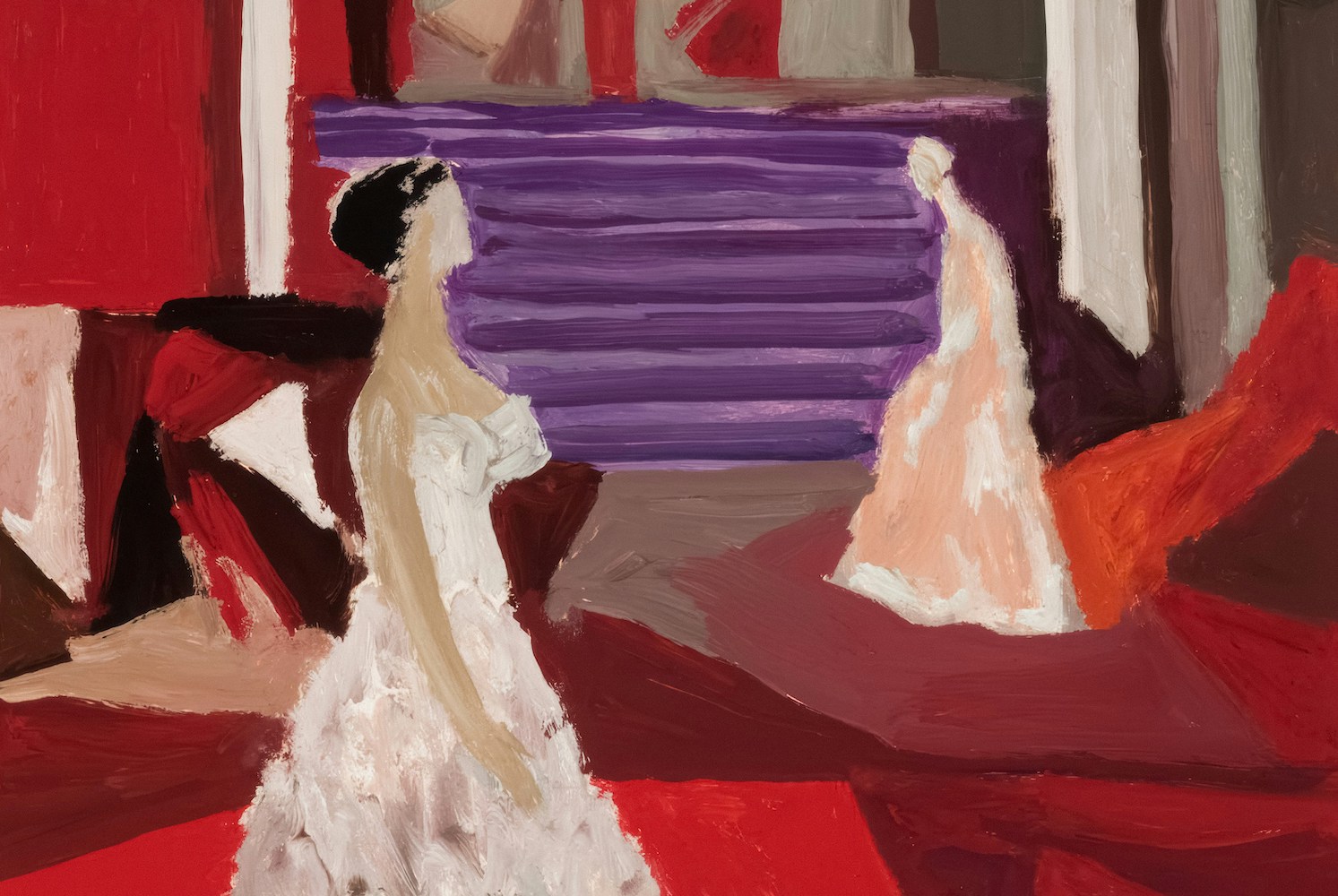
Image courtesy of Europeana via Unsplash
Share article
About the author

Alison Kubler
Alison Kubler has a double major in Art History from the University of Queensland, Australia, and a Masters in Post-war and Contemporary Art History...
More from this edition
Behind the seams
Audio THESE PODCAST EPISODES, which you can listen to via the links below, gather the voices of just a few individuals among the many tens...
The little black book of black dresses
Non-fiction THE FIRST LITTLE black dress I ever owned was an A-line mini with cap sleeves and a cut-out neckline that buttoned just below my...
Buyer beware
Non-fiction IS CLOTHING GETTING worse? As I sifted through the racks at Myer recently, I was disappointed to find static, lifeless fabrics. A few days...
