
My body is the gallery – enjoy the exhibition!
Musing on permanent fashion statements and alternative artistic outputs
Featured in
- Published 20251104
- ISBN: 978-1-923213-13-5
- Extent: 196pp
- Paperback, eBook, PDF
‘THAT MIGHT BE the greatest arse I’ve ever seen in my life.’
Four men in cargo shorts and ragged T-shirts hover behind me, staring at my naked arse. It isn’t long before two women join them, eager to see what’s going on. My friend, Jess, pops a glob of ointment onto my buttocks and starts rubbing it in. I nestle my head into the pillow of my makeshift bed and grimace, partly with pain and partly relief.
‘Every time I think I’m done looking at it, I find something new,’ one of the men says with a chuckle before addressing me personally for the first time. ‘Hey, mate, mind if I take a photo to send to my brother? He’s gotta see this.’
I tell him to go for it. It’s nice to be appreciated.
Jess wheels her chair up to where my head is. ‘I swear this has got to be the only environment where six strangers can stare at an arse while someone rubs ointment on it to ease the pain,’ she says.
‘Maybe if there was a really unprofessional doctor?’ I joke.
‘Speaking of professional… I need to somehow get a photo of this for Instagram without it getting flagged for being a bit inappropriate.’
The six onlookers are now discussing their favourite part of my butt. There’s a diverse assortment of art back there, courtesy of various tattoo artists who’ve met the challenge of drawing on one of the most difficult parts of the human body, with its soft, elastic skin. A couple of the spectators, nationally renowned artists in their own right, are enamoured with the Gummi Venus de Milo (aka Gummi Venus, made famous during The Simpsons’ golden age). Another loves the nearly sixteen-year-old rendition of Bender’s head (an homage to Futurama). Others are struggling to get over the sexy, naked female form of the pin-up model whose head has been replaced by Toucan Sam (mascot of the sugar-infested breakfast cereal Froot Loops). There’s also the cute (but rude) bunny-and-dog handpoke, the skull heart, and the title of one of my all-time favourite movies (Makoto Shinkai’s 2016 anime film, Your Name, a phrase that doubles as a cheeky party joke: ‘Holy shit, I have Your Name tattooed on my butt!’ I can say when someone introduces themselves to me).
Eventually, my audience agrees that the star of the show is the freshly carved cowboy frog, a tear sliding down his face as he stares in awe at the naked, womanly Toucan Sam. In my headcanon, these two are in love and due to be wed next summer.
This frog is the end result of nearly three hours of excruciating pain inflicted by Jessica Penfold. She’s a British tattoo artist I admire so much that two years ago, I flew to the UK to visit the tiny town of Haverhill, where Jess was based at the time, just to get illustrations from her etched onto my body. It was a gruelling process: being under the needle for nine hours at a time on consecutive days. The wound was carved into with a needle again and again and again to make sure the colour was deeply saturated in my skin. Even though Jess has a light touch for a tattoo artist, I felt my soul leave my body multiple times. I was miserable, regretting my choices, knowing I couldn’t tap out because I’d end up with an unfinished piece.
Yet I’d do it all again in a heartbeat – even knowing, as people have told me multiple times, that if you like an artist that much you can just buy a T-shirt featuring their work instead.
TATTOOING HAS EXISTED for thousands of years. Some of the earliest known tattoos belong to Ötzi the Iceman, a 5,300-year-old mummified corpse whose body art is suspected to have been made for therapeutic purposes. Various Indigenous cultures have long practised ritualistic tattooing, and early Christians undertaking religious pilgrimages often wore faith-based markings. Then, during the many centuries of the British Empire’s domination, English sailors picked up the practice from other cultures on their travels. But tattooing wasn’t widely reported in Western history until a 1719 British court case regarding a break and enter. Shortly after tattooing was first mentioned in these written records, tattoos in Western culture came to be associated with undesirables: early records refer to tattoos as indicators of savagery and take racist pot shots at various Indigenous peoples due to their skin markings. In his 2024 book, Tattoos: The Untold History of a Modern Art, Matt Lodder suspects this negativity became the default attitude because only wealthy pilgrims were notable enough to have their journals published, and since tattoos often adorned the skin of the marginalised and the underground, the art form came to be associated with criminality. But perhaps the disaffected were drawn to tattoos as ways to defiantly and permanently show off their loves, morals, beliefs and interests. Or perhaps they marked their skin for a deeper reason: to stake a claim on their identity.
MY SENSE OF self-worth has always been like a game that relies on random number-generation. Some days, when I was younger, I’d wake up and look in the mirror and think, Goddamn, Beau my boi, you are one clickity cool cat! But most days I wanted to dropkick the mirror to destroy the person looking back at me. I put a lot of effort into my appearance and yet still I felt like the dunked-out dag of a kid I’d always been told I was: youthful tormenters had overachieved in their mission to destroy my self-esteem.
My entire childhood was built around worshipping larger-than-life characters who oozed a quixotic quality of cool: ‘Macho Man’ Randy Savage with his colourful entrance outfits and wild demeanour. ‘The Heartbreak Kid’ (HBK) Shawn Michaels in sparkling bikie-inspired male stripper gear. James (of Pokémon’s Team Rocket fame) with his lavish dresses and rose-themed accessories. X-Men’s mutant thief, ‘Gambit’ Remy LeBeau, in his stylish trench coat and pink-and-blue armoured tights. Neji Hyuga (from the anime Naruto) with the puffy cream top, a headband with fun little side dangles, and bandages wrapped around a single arm and leg purely for cosmetic purposes. Their bold and vibrant looks made these characters stand out to me.
I thought adopting similarly striking fashion choices would make me feel cool, too. But when I looked in the mirror, I saw right through my attempted self-deception. The ruse felt like disguising a pile of shit by sprinkling parmesan cheese on top and calling it pasta. If I wanted to feel good about myself, I needed to do something at a deeper level. Something permanent, enduring, timeless – like Shawn Michaels’ tattoo, which had come to represent his entire wrestling persona as The Heartbreak Kid. I needed a way to define myself.
IN 1872, TATTOOS became fashionable in the UK thanks to the trial of Sir Roger Tichborne. The heir to a wealthy British family’s title and fortune, Sir Tichborne was presumed dead in an 1854 shipwreck. Twelve years later, his mother, desperate to believe Roger was still alive, accepted the suspect claims of a butcher in Wagga Wagga that he was her long-lost son: he’d survived the wreck and made a new life in Australia. Now, he’d returned to England to claim his grand inheritance – an act that kicked off a year-long trial and a storm of public interest. Ultimately, ‘Roger’ was proven to be an imposter when a school friend of the real Sir Tichborne revealed he had some distinctive tattoos he’d long kept secret – tattoos that the Wagga Wagga butcher, of course, did not have. The startling revelation that a British aristocrat had been tattooed, and the prominence of the trial, meant that tattoos enjoyed their first moment in the spotlight as a trendy accessory for anyone who dared to go under the needle.
THE DECISION TO get my calf tattooed with my favourite DC Comics character was both well planned and impulsive. After getting my first tattoo, where I’d thrown up all over the studio floor midway through the line work and had to push getting the colour done to a fortnight later, I’d mentally sworn that I’d never do it again. One, I had a fear of needles. Two, now I had a fear about throwing up on the studio floor. Three, the grating pain of that first time was still burnt into my mind.
Yet every time I looked down at my forearm after that day, I’d feel an overwhelming sense of pride, and my mood would immediately lift. A heart pierced by a sword and a snake wrapped around them both: this was a tattoo I’d wanted my whole life, an enhanced version of the one my childhood hero, HBK Shawn Michaels, had on his arm.
That pepped-up feeling made me think it’d be a good idea to get a tattoo of my favourite comic book character, the Green Lantern, on my leg. If a replica of HBK’s tattoo lifted my spirits, then surely the Green Lantern would do the same – after all, this was a character who’d gone from a bland, one-dimensional silver-age superhero to a ‘deranged’ villain before returning as a broken shell of a man desperate to redeem himself for villainous acts that weren’t even his fault (see Geoff Johns’ mythos-defining era of Green Lantern). How could a constant reminder of that incredible character arc not raise my spirits? And I was right. After eight hours of tattooing, I brandished a vibrant green symbol of willpower. Every time I glimpsed that tattoo, I was reminded of what strength and conviction truly mean. After paying the artist, Crispy Lennox, $800, I mentioned offhandedly that maybe, in a few years, I’d ask him to add more characters to the same leg.
‘I’d love to, man,’ he said, crouching down to snap a photo of his work that would end up in an international tattoo magazine. ‘I’m moving to the UK at the end of the year. But I had so much fun with this piece that if you want more, I can make time to squeeze you into my schedule before I leave…’
Scared that he might renege on the offer – and with no real time to think about it – I booked in for another three sessions over the next few months. Despite having a low-paying job and struggling with rent, I committed myself to this project: $3,600 and more than thirty-five hours of needle pricking later, I had all my favourite DC Comics characters on my leg and a dynamic explosion of reds, yellows, greens and greys lighting me up every time I looked down or caught sight of my full reflection.
At points when the needle hit close to the back of my knee – and a single, silent tear ran down my cheek – I swore yet again that I was done. How I pushed through those torturous moments while remaining still as a rock and silent as a Bob, I still don’t know. What I did know was that this was it. No more. I couldn’t bear it.
TATTOOS HAVE RIDDEN the unpredictable waves of societal acceptance over the last couple of centuries, from trendy to trashy and back again. Every time they gained some ground, they’d be shot back down by elite snobs with a need to scapegoat others in order to preserve the social hierarchy. In the early twentieth century, conservative men with power in religious circles would mount campaigns likening ink-based skin insignias to marks of the devil. Youthful embrace of tattoos always tended to bring them back on trend – but in the wake of both world wars, the art form entered an extended winter. Tattoos came to be seen as the markings of criminals and traitors – or as identifiers the Nazis had forced upon concentration camp victims. It wasn’t until the rebellious counterculture of the late 1960s that tattoos started to gain widespread acceptance once more. Some subcultures, looking for ways to distinguish themselves, began to adopt different styles as a sort of trademark. The more ink-stained scars you wore, the more pain you had endured; the more pain you had endured, the stronger you seemed in the eyes of your peers.
THE ONLY PEOPLE who say tattoos don’t hurt are the ones with marks that took less than an hour (often the case with currently on-trend micro tattoos or simple line work: tattoos that have you in and out of the studio in under twenty minutes). Sessions that take a lot longer, and involve a lot of ink packing, are a whole different rock band.
Ask a tattoo artist if tattoos hurt and they’ll be the first to say, ‘Fucking hell, do they ever! I hate getting tattooed. Why do we do this?!’
Just the other day, Jess messaged me to let me know she was getting the back of her thigh done and needed to apologise for having previously put me through the same torture.
The pain, as most artists will say, is how you earn the tattoo. Sure, you can use topical numbing agents – but they change the texture of the skin and often lead to a longer session and poor healing.
I was going through a different kind of pain in 2020, when I lived alone during the Covid lockdowns. I was constantly on the lookout for things to keep my mind engaged, lest the ever-present darkness snatch me into a camel clutch and stretch me till I passed out. Eventually, my endless scrolling of Steven Universe fan art led me into the realm of Instagram for tattoo artists. It’d been over a decade since I’d last been tattooed, and I had no urge to submit myself to that agony again. But I was fascinated by the artwork Instagram constantly recommended to me during my lonely, post-midnight doomscrolling.
This was how I first became aware of Jess’ work. She’d started her tattoo career specialising in adorable renditions of animals before introducing unique anime girl–style portraits into her portfolio. Then she mashed those things together and started turning adorable mascots/creatures into anime girls. Her style is incredibly distinctive: vibrant and full of character, tonnes of little references and details, with the smoothest colour I’ve seen in tattoos. Ever.
A post on Jess’s Instagram revealed that she was moving to Melbourne. But then Covid did what Covid does (ruins things). Her portfolio enchanted me so thoroughly that it squashed my long-held resistance to getting more tattoos. I began to hope she’d make it to Australia one day so I could get some of her work on me. Once the world opened back up, travelling terrified me far too much to consider flying to her. I already needed Valium to get on a plane, but now my fear of germs was overwhelming. Plus: other people would think travelling overseas to get tattooed was a silly waste of time and resources.
When the lockdowns ended, at long last, I broke my decade-long vow and impulsively booked in at a Melbourne Central studio to get a small tattoo on my left hand, a symbol that means love – a constant reminder to try to love myself. By this time, I was drowning in an abyss of loneliness and self-loathing for letting myself fall into such an isolated place in life. Every time I caught sight of my reflection, the only thing I saw was a weak wisp of a human – someone who wasn’t worth even a five-minute conversation with another human.
But that small tattoo on my hand began an eighteen-month streak of at least one tattoo a month. Every new bit of ink gave me more respect for myself. I was defying the limits of pain – pain I’d previously thought was too much for me to handle. I fucking hated the hurt, and I’d find myself crying internally for most of the tattoo process – but I never let my artist know that. Still as a rock, I never complained. I didn’t want them to feel bad on account of my pain; I wanted to be the best canvas I possibly could for them. Was it the people pleaser in me or the defiant encourager of anyone and everyone’s ability to meet their artistic goals? All I know is that every new tattoo made me feel stronger.
THE TATTOOS GOT bigger and more detailed. A giant Appa on my thigh, then below him a booty-baring Gudetama (the lazy egg mascot from Sanrio), then next to that an ode to Max and Roxanne from my favourite childhood film, A Goofy Movie, and then right above my knee (RIP me: do not recommend) two bumblebees dressed in ghost costumes with the word BOO between them. (My boo bees are the bee’s knees; you’d agree if you saw them.)
I was pushing through one of the worst depressive episodes of my life, but now I had what I like to call my ‘fun thigh’ – every time I dropped my pants, I’d smile. And whenever I’ve dropped my pants in front of other people since, to flash the fun thigh, it makes them smile, too.
Soon, I got my first big ‘job stopper’ tattoo on my hand (one you can’t hide with clothing, one that could make employers turn their nose up at you) from the immensely popular cute-tatt specialist Carly Kawaii. The Australian queen of kawaii pop culture–inspired tattoos, Carly creates art that makes statements: ‘I’m bright, I’m colourful, I’m cute, and I don’t give a flying fuck if you think that makes me look fruity!’
Most importantly, during my multiple sessions with Carly, she tattooed me in some of the most sensitive, painful areas possible. Areas that make people cry. Not only did this needle-phobic, anxious wreck not cry…but I forwent listening to music during these sessions (something that had previously helped me find a place of zen to moderate the pain). Instead, I had conversations with Carly and the other staff who came in to take a peek at what she was working on. Deep and meaningful conversations about my hopes and dreams, my fears and my mental health, and the extreme isolation I’d felt during lockdown. Despite the harrowing pain, these sessions spent chatting to relative strangers made me feel like a real person again.
CELEBRITY CULTURE HAS slowly eroded the negative connotations associated with tattoos. In the ’80s, punk and heavy-metal rockers used body art to cement their anti-consumer images into mainstream minds. Since the turn of the century, reality TV shows including Miami Ink and Ink Master have accelerated the normalisation of tattoos. Now, partly thanks to social media, tattoos have become another kind of commodity to show off to the world. Outside of the job stoppers (hands, neck, face), tattoos can be seen on lawyers, corporate drones and even White House staff.
But tattoos have always been more than fashion statements. They connect people to subcultures. They express commitment to particular ideals and fandoms. They’re the ultimate form of self-expression. Even a tattoo you get impulsively can make a statement. Tattoos become stories shared at social gatherings. Icebreakers to get the conversation going when you meet someone new. Gruelling, painful rituals that highlight how strong the human spirit can be. Dedications to a belief or a thought or a love that you wish to always be reminded of. Signifiers of who you are.
WHEN I WAS younger, people always said: ‘You’re lucky you’ve got such fair skin, you can hide that you’re one of dem Aboriginals.’ I never felt lucky. Instead, I felt like an outlier on the wrong side of every track.
Towards the end of my eighteen-month tattoo streak, I stumbled across Curran James, a Koori tattoo artist who creates Aboriginal designs exclusively for mob. I knew I had to get some of his art on me. And I wanted it in a prominent spot – somewhere it could be easily shown off and worn with pride.
‘Are you sure you want to put another target on yourself?’ replied a friend of mine when I told them of the plan. ‘I don’t mean to offend – just looking out for you. You stand out so much, and sometimes it brings negative attention your way.’
My mind immediately went to the tics and stimming (an autistic action of uncontrollable repetitive movements) that manifest when I’m nervous.
‘People look at me when my body acts out anyway, so this tattoo isn’t going to change that,’ I told him. I’ve grown comfortable with people looking at me for the actions I can’t control.
I’d be lying if I said his words didn’t spike my anxiety. But, ultimately, I want to be proud of who I am…and nobody has the right to stand in the way of that. If people look down on me for tattoos that identify my culture, that’s a strike on their name, not mine.
Curran tattooed a stunning piece of traditional Aboriginal art on the side of my neck and followed it up with an outlined rendition of our flag on my finger. Marks of pride in my identity. In my heritage. In my history. In my people.
My confidence began to soar as I started to feel in control of my body. These were my choices, and I would wear them on my skin forever.
There was just one more thing I needed: when the opportunity presented itself, I gave fear the middle finger and booked a flight to the UK.
A CRUSHING PHOBIA of public transport made the trip challenging; getting to the small town of Haverhill would require a twenty-five-hour flight, several hours on a train, a couple of hours on a bus and then a half-hour walk to stay at one of only two hotels in town. But Jess’ artwork was something I wanted so badly that I was willing to push myself, even if it meant confronting a massive fear and then sitting through back-to-back days of tattooing. (And it wasn’t just the pain that was tugging at me. It was the thought of having to spend two whole days with a stranger and not come off as weird.)
But when I arrived at the studio for the first day, my worries immediately vanished.
‘I love the design so much,’ I told Jess with an awkward curtsey. ‘Oh my god, thank the heavens,’ she breathed with obvious relief. ‘I’ve been so flustered and anxious about this design. You know this is so huge? Like, you’re famous in my family and here at the studio. Flying all the way from bloody Australia for this work. This design had to be the best thing I’ve ever created.’
So began the two-day, eighteen-hour process of getting anime girl renditions of Venusaur and Charizard to completely cover the outside of my thigh.
Surprisingly, the experience was manageable. Day two resulted in a huge spike of pain, but I remained statue-still. And the conversation came easily. Being under the needle seems to provoke my need to overshare, but with Jess (who felt like a long-lost neurodivergent twin), this tendency hit new extremes as I talked about times I’d been rejected, embarrassing situations that had led to injury, and even a time I’d soiled my pants.
If my odyssey to self-contentment was a Japanese role-playing game, this trip would have been the final boss to vanquish, and I’d conquered it with hit points to spare. Now, with Jess having moved to Melbourne, it’s a boss I plan on returning to so I can unlock my final form.
Tattoos have helped me shed a person I never chose to be, and they’ve turned me into a person I have chosen. I’m proud of my body – but also my strength and my self. And for a bonus ego boost, I’ve got people telling me I have the greatest arse they’ve ever seen.
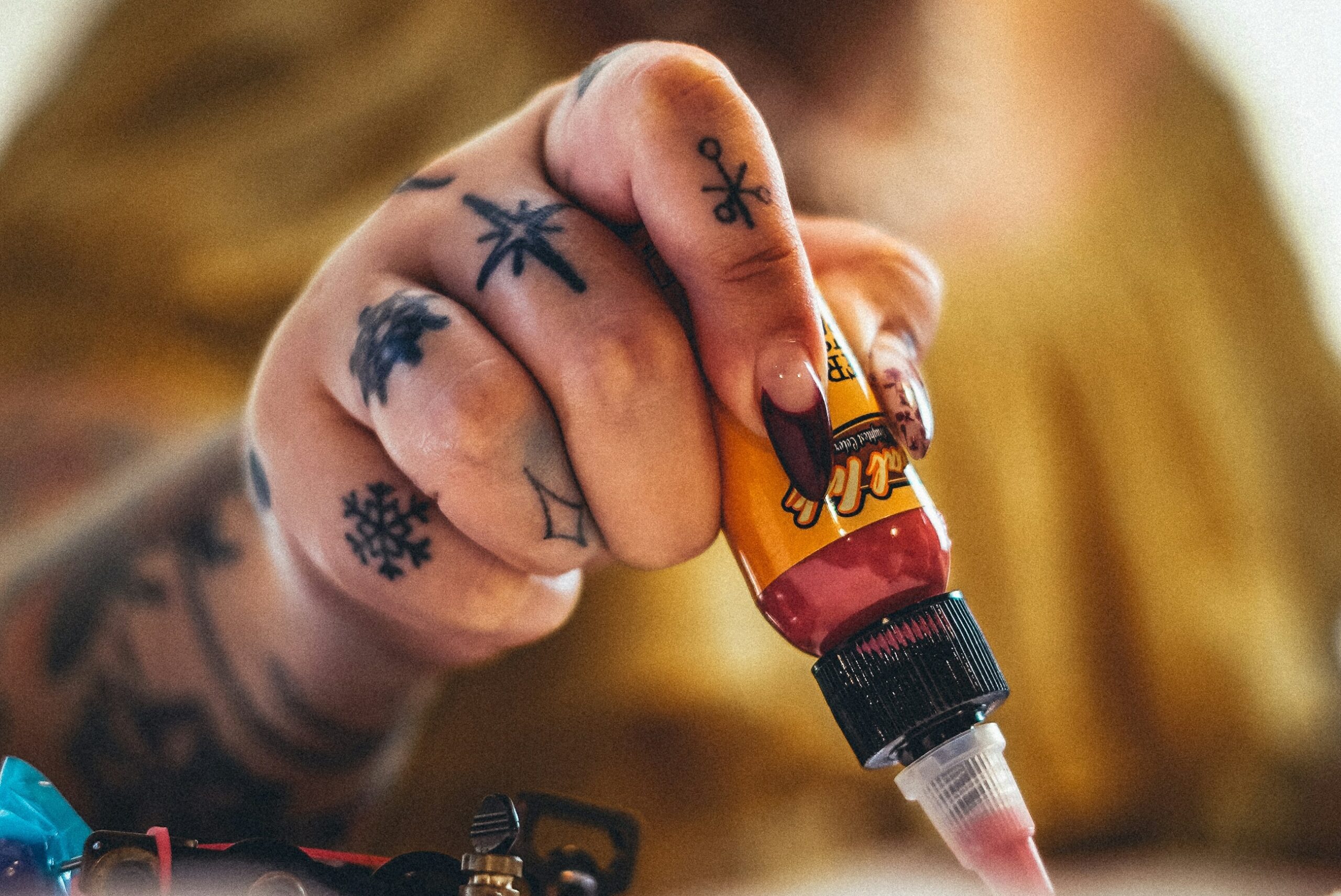
Image courtesy of José Pinto via Unsplash
Share article
More from author
My tiny green teacher
In June 2025, I was one of the many people emotionally wounded by a viral video clip of a little puppet named Tiny Chef (affectionately known as Cheffy) receiving some bad news. I hadn’t heard of this character and his playful children’s show, but the clip had a profound effect on me. It depicts a more potent vulnerability than many human skits achieve.
More from this edition
Out of the closet
In Conversation Lesbian fashion historian Eleanor Medhurst has an eye for hidden style. After spending her university years discovering the many untold stories of lesbian fashion...
That J-Lo dress
Non-fiction HAVE YOU EVER visited a museum, art gallery or very posh shop where you longed to touch the items on display but, for whatever reason...
Behind the seams
Audio THESE PODCAST EPISODES, which you can listen to via the links below, gather the voices of just a few individuals among the many tens...
