
Featured in
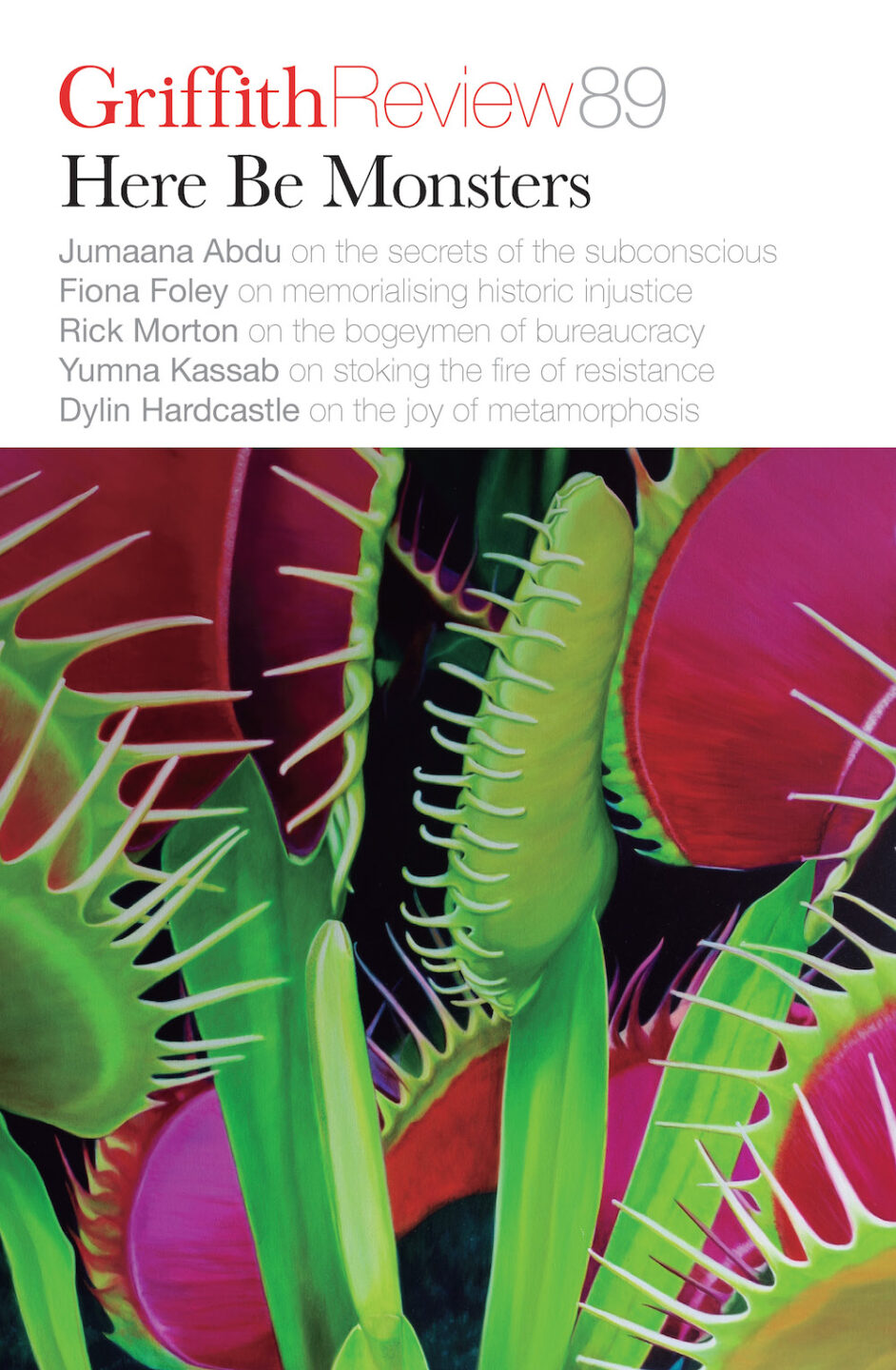
- Published 20250805
- ISBN: 978-1-923213-10-4
- Extent: 236pp
- Paperback, eBook, PDF
EARLIER THIS YEAR, I was lucky enough to interview the Argentinian writer Mariana Enríquez at Sydney Writers’ Festival. Enríquez’s fiction overlays the real horrors of Argentina’s military dictatorship – the years of forced disappearances, state terrorism and human rights violations; the subsequent decades of psychological and political fallout – with the horrors of imagination: monstrous bodies, restless spirits, malevolent entities.
For Enríquez, realism is an inadequate schema for expressing the manifold mysteries and terrors of existence. But the language of horror, with its ability to conjure the unthinkable, to trace the contours of our deepest fears and darkest imaginings, can lead us into those shadowy corners of the human psyche, giving us permission to peer into the gloomy space under the bed or creak open the door to the basement. It allows us to sit with the uncertainties of life: fiction, Enríquez told me, is the place where we can exorcise our curiosity, ‘the place where we can make a mess’.
Horror is also a language we all speak. Enríquez grew up in the 1970s and ’80s, so her experience of Argentina’s civil unrest was interwoven with her consumption of the era’s pop culture: the Wes Craven movies and Stephen King novels and boundlessly imaginative fiction of Ray Bradbury. In the 2020s, the monstrosities of life in the real world are increasingly lamented or exorcised in analogous forms of artistic and cultural expression, from Coralie Fargeat’s 2024 body-horror flick The Substance, a mesmerisingly grotesque exploration of beauty standards,to the growing ranks of Latin American women writers (Mónica Ojeda, Silvia Moreno-Garcia, Samanta Schweblin and many more) whose fiction refracts historical and social complexities through prisms of terror and dread.
THE MONSTERS THAT stalk the pages of this edition take similarly varied forms, each of them revealing something true and unsettling about the ways we move through the world. Some embody the existential crises of our current political moment: the impenetrable bureaucratic maze that led to the Australian Government’s illegal robodebt scheme; the hollow rhetoric of fossil-fuel giants intent on continuing their extraction of the Earth; the ecomodernist ethos underpinning a resurgent interest in nuclear power; our national refusal to adequately acknowledge the brutality of the Frontier Wars. Other monsters embody collisions of personal and social anxieties: the burden of gendered expectations, the ineffability of inner demons, the disquiet of cowardice, the longing for connection with a loved one who’s passed. Importantly, not all the monsters in these pages should be feared – some represent transformations and new beginnings, others the cathartic possibility of rage and resistance.
And, of course, there’s an array of fictional monstrosities to keep you up at night, among them the final two winning stories of our 2024 Emerging Voices competition: Kobi Ashenden’s ‘Gallows humour’ and Sarah Kanake’s ‘The body’. Thanks, as ever, to the Copyright Agency Cultural Fund for their support of this competition and for enabling us to showcase these exciting new writers in the pages of Griffith Review.
Here Be Monsters’ contributing editor is the award-winning writer and editor Lisa Fuller, who commissioned and worked with Elder and researcher Wendy Somerville on her chillingly atmospheric short story ‘The Mountain’, in which two young cousins venture into forbidden terrain. Thank you, Lisa and Wendy, for the energy and imagination you both brought to this edition.
Reading and rereading Enríquez’s kaleidoscopic work has given me a renewed appreciation for the language of horror and the hidden psychological and imaginative doors it can unlock. It’s made me return to my other favourite masters of the form – Shirley Jackson, JG Ballard and, of course, Ray Bradbury – whose fiction slides into those hairline cracks between the real and the unreal, the known and the void. Whatever forms your own monsters take and however you choose to face them, I hope this collection offers you a similar means of parsing the anxieties and possibilities of being alive.
– June 2025
Image courtesy of Eduardo Gutierrez from Unsplash
Share article
More from author

Finer details
The team at GR HQ had some thought-provoking conversations while selecting the cover art for Griffith Review 91: On the Money. Of course, there are obvious symbols that convey this evergreen theme – bulging wads of cash, a bank, gold bullion – but these felt like low-hanging fruit. In the age of Amazon, online shopping and next-day delivery, how could we represent contemporary commerce?
More from this edition
The other side
Non-fiction BEFORE I LEAVE my house to visit my ninety-year-old great-aunt, I pause at my front door, faltering at the threshold. I glance down at the singlet...
victoria pedretti is my sleep paralysis demon
Poetry act one i try to write a happy poem but i am bed rotting, watching...
I Cavalli after Bella Li’s ‘Il Bambino’
Poetry At the beginning of all motionthe horses galloped towardthirst. A land steeped in droughtexcited them. In each countrydecayed the myth of origin, ineach people...
