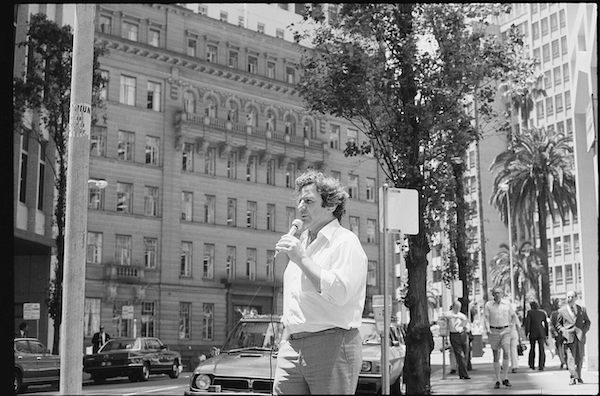
IN SYDNEY’S THEME park of working-class history, The Rocks, you’ll find many commemorations of the union legend Jack Mundey. In one mural, Mundey’s weathered face looks down Globe Street, past the tourist-trap shops and towards the harbour. Commissioned by the Sydney Harbour Foreshore Authority, this monument of labour’s hero – whose union gave teeth to the 1970s housing, environmental and heritage movements called the ‘Green Bans’ – is ironic considering subsequent labour market reform. The institutionally created memorial suggests that the causes Mundey cham-pioned are no longer a threat but can be incorporated into a story of national pride. Closer up, The Rocks’ labour memorials read more like gravestones. Australia is haunted by figures like Mundey. He’s part of a labour history that’s all around us: in our legislation, cities, workplaces and archival memory. Yet this part of our national story is easily sentimentalised and scarcely understood. Today’s absence of unionists – membership rates are around 13 per cent of the workforce, compared with 50 per cent in the 1970s – refutes the existence of a strong collective memory. As the unionist population also continues to age, there are fewer and fewer parents, grand-parents and relatives who can pass down loyalties. May Day marches are increasingly unpopulated and devoid of class politics. There’s little explica-tion of the links between contemporary and past struggles; labour history is frozen over, and its present is reputably teeming with thuggery. For the non-due-paying population, the repetition of stereotypes and limited repre-sentation of current issues mean easy assumptions solidify into fact.
I was one of few in my university cohort to study labour history. Writing my thesis on the Green Bans, I realised the memory of this movement was more complicated than today’s romanticised and over-simplified narratives suggest. I found the archives meaningful: as I went through old union tracts, the present appeared clearer. I began to under-stand workplaces as political entities and noticed how unions changed the relationship between management and labour. Like many who had come before me, I concluded that every time the government or management strengthened workers’ rights, it was when they absolutely hadto. Often reforms were achieved by militant behaviour. Later on, however, the history of the movement would be misshaped by mainstream discourse, and militant behaviours would be erased in service of a crowd-pleasing narrative.

Already a subscriber? Sign in here
If you are an educator or student wishing to access content for study purposes please contact us at griffithreview@griffith.edu.au