
Featured in
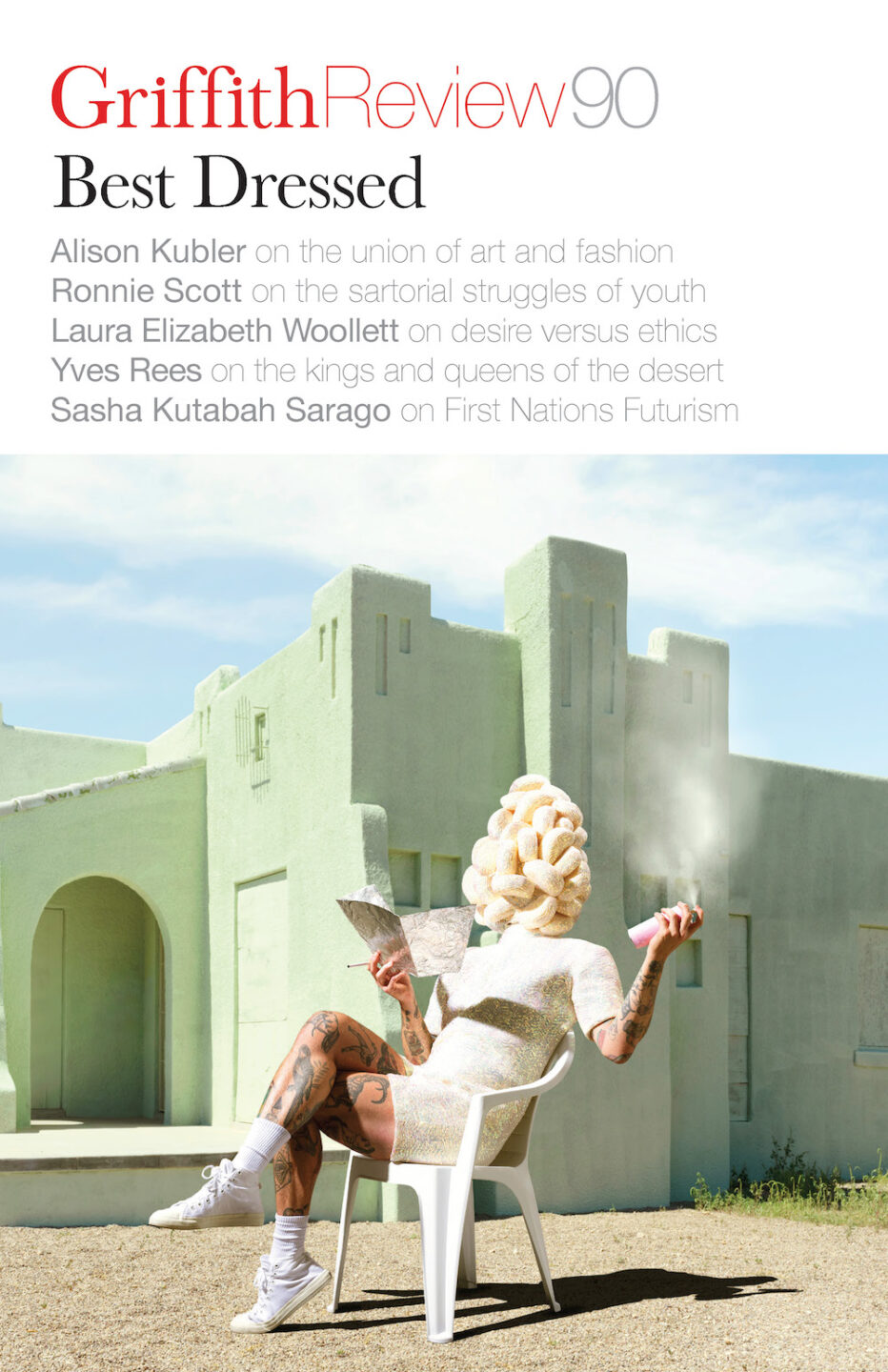
- Published 20251104
- ISBN: 978-1-923213-13-5
- Extent: 196pp
- Paperback, eBook, PDF
THESE PODCAST EPISODES, which you can listen to via the links below, gather the voices of just a few individuals among the many tens of millions who make our clothes in factories across Asia. They are stories known primarily in part: perhaps after tragedy, like the collapse of Bangladesh’s Rana Plaza factory, or a sweatshop scandal affecting a famous brand. Such fleeting news-cycle examples are by now well recognised. Yet they also feel forgotten: an awareness hovering somewhere in the background, constrained within a narrow news frame, disconnected from our everyday lives.
Episode 3 – Two Stories from Mae Sot
Episode 4 – Who Cares – It’s Great
The look and function of the clothes we wear – the fashion and fads, the self-expression and social trends, the cultural moments and spectacle, the plain, practical use, and the joy: these are our front-of-mind images. But their aesthetics and familiarity, distance and convenience serve to erase the many hands that have created exactly those looks in this material against our skin.
Or, better said: these factors are deliberately deployed to erase this awareness, by the brands that sell these clothes, that run the industry and impose its conditions. It’s a corporate roll call that runs from A to Z several times over: Adidas and Benetton; Shein and Uniqlo; YSL and Zara; and so on, almost endlessly.
I could see my school playground from my factory rooftop. And that was like one big pain that I got like every day, seeing my friends are playing in the playground and I was in the factory.
In many ways, these stories are an unstitching. They pull up the label to show the threads underneath, made up of the individuals – the several generations – who live through and by this labour. Yet that would also be too narrow a focus. These stories are not simply about how the industry defines people’s lives but also about how people define their own lives within it – sometimes by adaptation, sometimes by immense endurance. And often, in these examples, by struggle.
We want the foreign boss to know our story, to see our suffering, and to pay us what we are owed.
There are many threads beyond the industry itself that tie through this weave and connect several stories. Shared anecdotes of childhood, and of rich potential pushing against lack of money or family misfortune. And war, its enormous and brutal disruption and displacement, profoundly reverberating through entire communities and societies. Also threaded through: gendered inequality and violence, rife in the industry as well as being present in individuals’ lives more broadly. It echoes and plunges deep, reverberating across both spheres.
Something beautiful I learnt is that I have the right to organise, I have the right to bargain. There is a minimum wage, the supervisor cannot slap on me for a minor mistake. I was like, wow. I consider it’s a second birth for me.
Many stories couldn’t be included: of people shifting in and out of work, between cities and villages, factories and farms, starting businesses and closing them down. Stories of spouses separated, moving to different parts of the country or different countries entirely, fragmented between locations as they all seek their families’ livelihoods. The industry appearing or receding sometimes, as people rearrange their lives around marriage and children, or care for ageing parents. The final edited stories are snippets from the much longer pieces that might more fully convey negotiation with this labour across the complete arc of a life.
I never, ever imagined I would work in a garment factory… The purpose is for me to gain skills. In the future, can I use this to start a business? That’s the kind of intention I have.
IT’S NOT ONLY in clothing where appearances are smoothed out: media production has its own aesthetics and elisions, too, its snipping of threads to hide any straining at the seams.
Most of these stories are not in English, so voice actors have performed translations. While translations may be illuminating, they’re also a form of erasure – the storyteller’s voice, tone and meaning supplanted so English speakers can understand. This production attempts to resist such wholesale smoothing-over. Voice actors are named; their connections to the story as members of the same cultural, language and national groups – even if far from the same local communities – are also a part of the telling.
Stories were gathered with the help of Clean Clothes Campaign, a global organisation that has pressured and advocated for the rights of garment workers for over thirty-five years. Some events don’t explicitly appear in the episodes, although their impacts remain profound: in the middle of production, the entire leadership of the Solidarity Trade Union of Myanmar (STUM) – which helped to facilitate one of the interviews – was arrested and detained by the country’s junta dictatorship. At the time of writing, their location is still unknown.
And for the episode about the online fast fashion giant Shein, it was simply impossible – unthinkable – to talk to any workers in China.
Even the industrial researcher who spoke about the business must remain nameless and voiceless. The informant in that interview has been replaced by AI: a voiceprint cipher used to provide protection against a surveillance state with an ever-deepening reach.
This was not the only way I used AI during the production of these stories. The Burmese stories, being in a language I don’t speak, were initially transcribed, translated and time-stamped by the same tools. Using AI in this process was an experiment in response to time and resource limitations. The results were so effective that they proved the inevitability of being able to edit a sound file in another language in the not-too-distant future.
But it means the extraction beyond direct relationships is comprehensive here as well. How many examples of translation practice generated this output, learnt and developed by a multitude of skilled individuals over countless hours of intellectual and social labour? Behind each website’s branded platform, whose work is extracted? And how is that work used and obscured beyond all tracing, in the endlessly expanding network of AI black-box nodules?
AGAINST ALL THIS, a common thread weaves itself through this series: stories of those who are determined for something better – stories of connections made, capacities discovered, victories gained – and the strengths these bring out, which can be a revelation for those who experience them.
Before I wasn’t able to talk about my past, it was too painful. But because of all the positive energy that the union introduced me to, and all the things I learnt – about mental health, about how we can manage our emotions – at last I realised I could do this.
As you work your way through these stories of character and courage, of tribulation and fight and care, spare a thought for the communities who shape and are shaped by this industry – the individuals and families who have cut, sewn, ironed and packaged the clothes you’re wearing now. Those who’ve dressed us best.
We really, really need international solidarity. Ask more questions to these brands…about the workers, how much they have been paid, in what conditions they’ve been working. The only thing the brands and retailers care about is the consumers.
Share article
About the author
Matthew Abud
Matthew Abud is an audio producer and occasional writer. He has worked in or supported media projects, particularly across South East and South Asia,...
More from this edition

That J-Lo dress
Non-fiction HAVE YOU EVER visited a museum, art gallery or very posh shop where you longed to touch the items on display but, for whatever reason...
My body is the gallery – enjoy the exhibition!
Non-fiction ‘THAT MIGHT BE the greatest arse I’ve ever seen in my life.’ Four men in cargo shorts and ragged T-shirts hover behind me, staring at...
The trenches
Non-fiction IN MELBOURNE, A friend tells me about the look: a steely-eyed caress from hair to shoes, taking in every accoutrement, ending in decapitation. Parisiennes: they’re...
