Gay saints

Pasolini and the sanctity of cinema

Featured in

  • Published 20241105
  • ISBN: 978-1-923213-01-2
  • Extent: 196 pp
  • Paperback, ebook, PDF

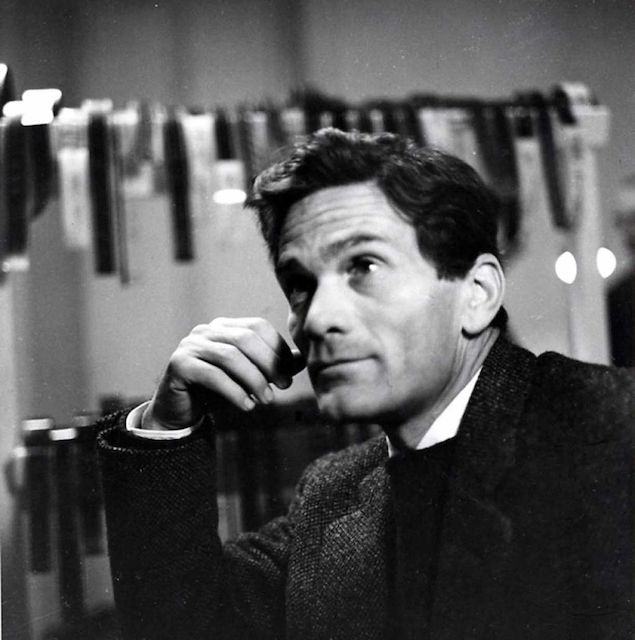
FEW FIGURES EMBODY the contradictions inherent to Catholicism more explicitly than the poet, writer and film director Pier Paolo Pasolini; as Thomas Hardy observed, the greater the sinner the greater the saint. The Marxist/poet/homosexual/atheist was living proof of the efficacy of baptism: holy water does not wash off. If one is serious about emulating the life of Christ, then one has carte blanche to condemn hierarchy and hypocrisy, rail against institutional authority, and ultimately annoy the powerful so much that they order one’s death. If the example of the saints is instructive, then without meeting this last criterion one is not really trying.

In his lifetime, Pasolini managed to annoy almost everyone in postwar Italian society. A Marxist in the tradition of Antonio Gramsci, he was booted from the Italian Communist Party on charges of corrupting youths (a perfectly Catholic euphemism) and later condemned for his counter-­revolutionary depiction of the life of Christ. Near every movie he premiered was attacked by both fascists and communists, who were appalled by what they respectively perceived as the films’ corrosive immorality and unflattering depictions of the urban poor. In the same year he was convicted for blasphemy – Catholicism being the state religion of Italy until 1984 – the Church funded his 1964 adaptation of The Gospel According to St Matthew, included by the Vatican on its 1995 list of ‘Some Important Films’. He fell out and later reconciled with fellow filmmaker Federico Fellini, refused to marry the infatuated Maria Callas, and in the left-­wing student revolutions of 1968 sided with the police, declaring them the true heroes of the class war. It is not surprising that in 1975 he was horrifically murdered aged fifty-­three; the crime remains unsolved. In the tumult of the Years of Lead – the two decades of hyper-­partisan political unrest initiated by ’68 – it’s surprising no one did it sooner.

Already a subscriber? Sign in here

If you are an educator or student wishing to access content for study purposes please contact us at griffithreview@griffith.edu.au

Share article

More from author

Little gifts of flowers

Almost immediately after completing a draft of my novel, I become preoccupied with a letter housed in the National Library of Australia. The 1930s correspondence between the English and American publishers of an Australian novelist concerns their decision to reject that author’s most recent manuscript – so, of course, that’s where my thoughts fixate, yesterday’s triumph already faded to mocking echo

More from this edition

Tawny child

FictionCarefully, Morgan loosened the fabric. The crying increased in volume. Eventually, the small dark head of a bawling, tawny child emerged into the clear light. Morgan looked at the child with her eyes narrowed and her lips pursed, as if she were considering an heirloom of unknown value. Hans took the envelope from the fingers of the man in the blue suit and tore the gold seal. Inside were five crisp, dry banknotes. The man in the blue suit told them that such payments would be forthcoming every month, and that the child’s name was Many-­gift in the local dialect, but they were to refer to him as Albert and raise him as their own.

Religion as resistance

Non-fictionIn their youth, my parents participated in the anti-­apartheid movement, attending meetings and outlawed protests. From birth their lives had been prescribed by the apartheid regime, from the suburbs they could live in to the beaches they could swim at to the benches they could sit on; there was little it saw fit to leave unregulated. Both of their families had been forcibly relocated from District Six when it had been reclassified as a whites-­only area. They attended Coloured schools, where they were taught by both white and Coloured teachers. At one of these schools, my teenaged mother challenged a teacher for making a racist comment and subsequently chose to leave the school when they backed the teacher instead. My father’s father was a Shaykh, his uncle an eminent Islamic scholar known across both the Cape and wider South Africa. In their youth, my parents participated in the anti-­apartheid movement, attending meetings and outlawed protests. From birth their lives had been prescribed by the apartheid regime, from the suburbs they could live in to the beaches they could swim at to the benches they could sit on; there was little it saw fit to leave unregulated. Both of their families had been forcibly relocated from District Six when it had been reclassified as a whites-­only area. They attended Coloured schools, where they were taught by both white and Coloured teachers.

Feeling our way to utopia

Non-fiction JANE AUSTEN WAS just twenty-­one years old when she wrote her first novel, Sense and Sensibility. Today, we understand her works as more than...

Stay up to date with the latest, news, articles and special offers from Griffith Review.