
Featured in
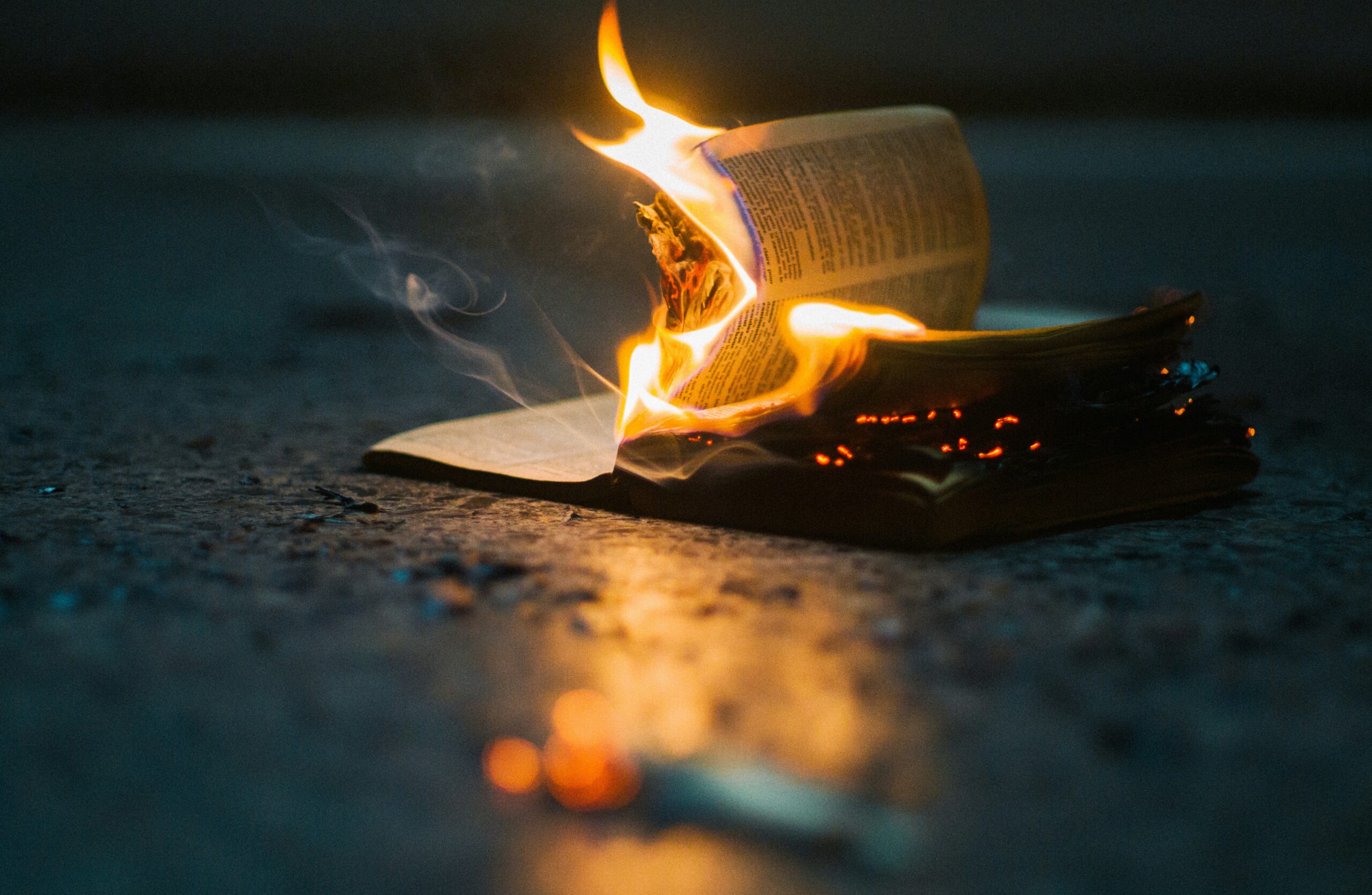
IN LATE AUGUST 1992, a library of nearly two million books, some of them up to five hundred years old, was engulfed in flames. The ashes of a nation’s past, present and future fell from the sky like snow. The library was Vijećnica (the National and University Library of Bosnia and Herzegovina) in the city of Sarajevo. The fire was part of a devastating siege that killed over ten thousand people – a siege organised by the Serbian nationalist government led by Slobodan Milošević, who rose to power at a time of political and national unrest following the break-up of Yugoslavia. Five years prior, Milošević himself deployed the term etničko čištenje (‘ethnic cleansing’), a term that would become the official language of international diplomacy and law in the years following the Bosnian War.
For three days, flames devoured the Moorish building of Vijećnica, which was built during Austro-Hungarian rule in the 1880s. Braving a hail of sniper fire, many Bosnians attempted to save the burning pages, unable to bear the crackles that echoed through the war-torn city. Many would lose their lives doing so. Why risk your life for books? Why not let books burn? Mula Mustafa Bašeskija, a Bosnian chronicler, poet and retired janissary in the Ottoman Empire, once wrote: ‘That which is written down endures, that which is remembered disappears.’ To preserve the written word is to preserve one’s memory and identity. To burn books is to commit epistemicide.
Epistemicide is the systemic annihilation and devaluation of knowledge and knowledge systems because of broader political pursuits. These pursuits are sought by a group of people whose aim is to disconnect another group from their cultural identities, histories and futures. The term has deep roots in colonial histories, whereby the collective memories of Indigenous groups are suppressed or erased by colonisers to delegitimise claims to sovereignty. Epistemicide is not only an attack on culture and collective memory but a step towards the physical destruction of the people themselves.
THREE YEARS AFTER the burning of Vijećnica, my parents fled Bosnia and Herzegovina to Australia with eighteen-month-old me in tow. They were unaware of the flames that had eclipsed the country’s national library many months before. They were too worried about our own safety: hiding in crevices no human should hide in, searching for food in abandoned houses, feeling the graze of glass on their skin as windows shattered from sniper fire and detonated mines.
I would grow up in the shadow of the Bosnian War, learning to speak a foreign language, disconnected from my mother tongue. When I ask my parents about the war today, they don’t share much. I wonder about the trauma they carry that is too horrible to put into words. I wonder if their selective forgetting is a form of cultural genocide, too.
Along with my parents, two million Bosnians were displaced in Bosnia and Herzegovina during the war, and a further seven hundred thousand sought asylum in other countries. We were the ‘lucky’ ones; over one hundred thousand Bosnian Muslims were massacred, with more than eight thousand boys and men rounded up and killed in Srebrenica. Milošević’s aim was clear: to ethnically cleanse the culture, history and identity of Bosnian Muslims and the Bosnians of Bosnia and Herzegovina, and to drive out the population.
Indeed, the destruction of Vijećnica was not just a strategy of intimidation targeting the cultural history and identity of Bosnian Muslims. Its destruction served a long-term goal. Art historian András Riedlmayer’s testimony to the International Criminal Tribunal for the former Yugoslavia was critical in the formal prosecution of epistemicide as a war crime. He claimed that the function of book burning upon displaced people is ‘to remove any evidence that they were ever there to begin with and give them no reason to come back’.
IN LATE MAY 2024, a hot, violent flame burst from a bookshelf and destroyed thousands of rare manuscripts and books on Palestine and the Arab world dating back to the 9th century. As the flames swallowed whole pages of history, an Israeli soldier sat nonchalantly reading, seemingly apathetic about this fire that would reduce centuries to ashes. It was the library of Al-Aqsa University in Palestine in the city of Gaza during a devasting genocide that, since 7 October 2023, has killed over seventy thousand Palestinian people. It is a genocide organised by the Israeli government under the leadership of Benjamin Netanyahu, who was re-elected to the Knesset in 2022.
Across four hundred days, thirteen libraries succumbed to scorching flames in the Gaza Strip, deliberately targeted by soldiers of the Israeli Defence Force. In the time since, any books that remain have been used to fuel fires to cook and stay warm by displaced and starving families who cannot afford wood and gas. The burning of the library of Al-Aqsa University – and the university building itself – is an attack on the very essence of what Gaza represents: a city steeped in Palestinian history and knowledge, Indigenous and unceded. It is also an attack on collective memory, on culture, on a future generation’s right to exist and embrace their identity. Displaced Palestinians still hold the keys to their homes, even those who were forcibly expelled by Israeli settlers during the Nakba of 1948, wishing one day to return. While in exile in Egypt, Khalil al-Sakakini, a Palestinian scholar, poet and writer, wrote a farewell to the books he was forced to leave behind:
Farewell, my library! Farewell, the house of wisdom, the abode of philosophers, a house and witness for literature! How many sleepless nights I spent there, reading and writing, the night is silent and the people asleep…goodbye, my books!… I know not what has become of you after we left.
Libraries hold symbolic weight as bearers of identity and heritage. They are institutions of knowledge that carry our societies forward, remind us of what we are made of. They keep our collective memories alive. When books burn, they do so to pave a way for fabricated memories, those deliberately forged to control and shape a narrative that excludes Indigenous voices. Questions remain: when histories are written, whose memories are preserved? Whose are forsaken? Why? To commit epistemicide is to control the collective remembering (or forgetting) of a people. Netanyahu’s push for a ‘Greater Israel’ echoes the Serbian Memorandum of 1986, which called for a ‘Greater Serbia’ and led to the systemic annihilation of my people during the Bosnian War. All because a nationalist government strongly believed in its historic ‘right’ to exist regardless of which republic it inhabited. How else to justify settler colonialism?
SINCE 2009, TROVE – the National Library of Australia’s world-leading digital library and archive – has accumulated more than fourteen billion fragments of Australia’s history. This digital library receives more than twenty million hits per year from local historians, families, researchers, schoolkids and people searching for their own histories. In late 2022, whispers emerged that Trove was on the brink of being digitally burnt down. All its newspapers, books, images, maps, diaries, letters, biographical information and other archival content were to be incinerated, all those pages dispersed into the ether. The source of ignition: lack of financial support from the Australian Government. Funding came through in May the following year, with the Labor government committing $33 million over four years to maintain Trove and an additional $9.2 million in indexed ongoing funding. But at what cost?
I spent the better part of 2021 and 2022 deep in these archives, researching Australian Muslim history to help with the writing of a biography on one of Australia’s Muslim pioneers: Sheikh Fehmi Imam. Not only did COVID-19 pandemic restrictions isolate me from visiting the National Library of Australia in person; so did my living in regional New South Wales, from where travel to Canberra requires more than three hours of driving. Trove provided the resources I needed to complete Sheikh Fehmi’s story. I cannot imagine how this book would have come together without Trove – how I would have learnt about and understood the historical contributions Muslims have made throughout Australia’s history, cultivating its identity as a multicultural nation. The near closure of Trove is a testament to how close we can get to committing epistemicide, to erasing rich histories of peoples who make up Australia; to continue the imperial injustices of the British Empire towards First Nations peoples whose bodies were the subjects of colonial violence along with their cultures, stories and histories. Indeed, through its First Australians pages, Trove attempts to rectify this deep historical hurt, providing a place for First Nations communities to continue to tell their stories.
LIBRARIES PROVIDE THE material from which our national identities are built. This is how we develop a collective consciousness of ‘us’ as a people, a type of cultural identity that speaks from the heart. When books burn, collective memories are lost and so too is the thread that binds people to their past lives, to their ancestors. We cannot know who we are without knowing who we once were. Different forms of literature, stored in our libraries and archives, act as revelations of cultural expression; they are not only central to social order and to the ordering of history but connect us to our national and cultural identity.
Book burners know words matter because with words comes the preservation of meanings and memories. Books burn because their presence is a threat. Books burn because they are links to memory, to history and to culture. Burnt books pave the way for historical amnesia. Burnt books strangle civilisations.
But this is what the book burners want: to redefine civilisation in their own terms, to demoralise and ‘de-nation’ a people. By ridding a civilisation of their written knowledge, they have the power to rewrite history, to start from a blank page.
Photo credit: Fethi Benattallah via Unsplash
Share article
About the author

Mirela Cufurovic
Mirela Cufurovic researches Australian Muslim history at Charles Sturt University and teaches Australian history and literary studies at Western Sydney University. She is a...
More from this edition
