
Featured in
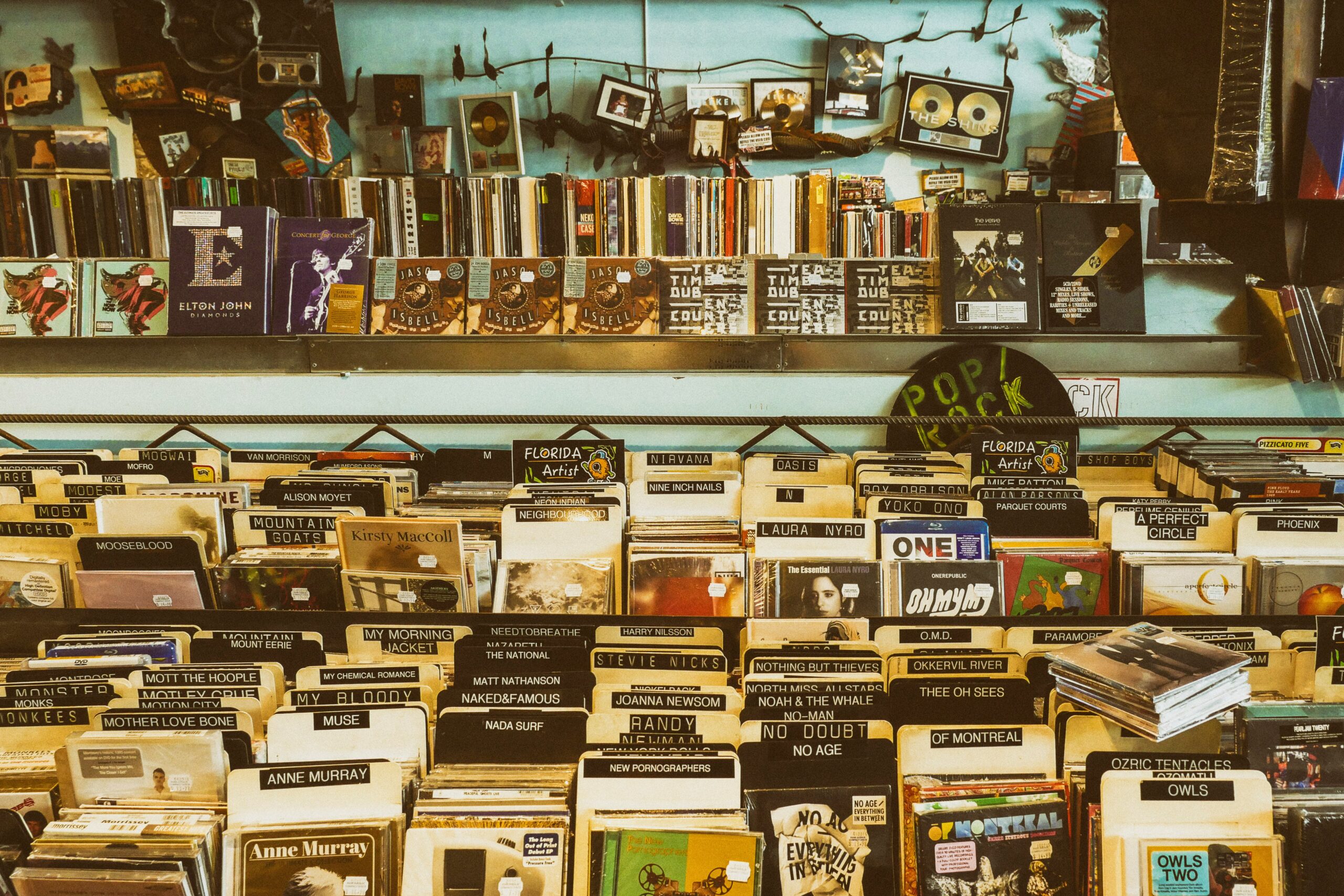
WHEN MY PARTNER, Jerry, and I moved in together nine years ago, he was dismayed to discover my CD collection. Its existence was no mean feat. Since leaving my family home in Adelaide, I had moved fourteen times, including three overseas stints. And yet, the CDs endured.
‘Who listens to CDs?’ Jerry had asked, incredulous that I was still in possession of these musical relics. I could hardly answer ‘me’, as I no longer owned anything on which to play them. And so, after the inquisition, the boxes were promptly stowed away – forgotten about until we had to move, when, upon rediscovering my hoard, Jerry would once again raise the question, ‘Who listens to CDs?’ The third time this happened the question came with an added threat to dispose of the CDs – the boxes, which had been squandering space in the dining room, had overextended their welcome. I had a decision to make: to keep or not to keep?
FOLLOWING THE CO-DEVELOPMENT of the digital optical disc storage format by Sony and Philips, the CD was released in Japan in 1982. The first commercial CD produced was a 1979 recording of Chopin waltzes performed by Claudio Arrau. The first album released on CD was Billy Joel’s 52nd Street (a re-release), one of fifty titles released in Japan. The European and North American launches followed in March 1983. The CD gained widespread popularity in the late 1980s and early 1990s. Dire Straits’ Brothers in Arms (1985) was the first album on CD to sell a million copies, and David Bowie was the first major artist to have their entire catalogue converted to CD. By 1991, CDs had surpassed sales of records and cassette tapes in the United States; by 2000, they accounted for more than 90 per cent of the US music market share. They remained the dominant format of the album era until the rise of MP3s, digital downloads and streaming platforms in the mid-2000s.
AS I WRITE this, lo-fi house music plays in the background – a random playlist streamed from my laptop. I’ve always used music while working, writing or studying. I tend to find silence more distracting. Something about the tempo of 120 beats per minute propels me forward, keeps my fingers moving across the keys and forming words on the page. Growing up, my bedroom was filled with music. I listened to the radio, records, cassettes and, of course, CDs. I even made a few feeble attempts at learning to play music. First, it was the xylophone – which, as my mum will contend, is one of the most impractical instruments to cart to and from school. Then I attempted to learn the acoustic guitar under my dad’s tutelage – his repertoire was strictly limited to the opening bars of ‘House of the Rising Sun’. Finally, the clarinet (I was too slow to secure a school saxophone), but this musical endeavour was also short-lived after my teacher discovered I couldn’t read music and had instead memorised ‘Lucy in the Sky with Diamonds’. I could probably still play it! The one musical item that remained in my room was a stereo. I started with the standard issue black AM/FM radio (with a double-cassette player) before progressing to a more comprehensive system that also included a record player and CD turntable.
The ’90s was a challenging time in Australia. The recession resulted in redundancies and high unemployment (11.4 per cent), of which my dad was a casualty. When he secured a new job, it was in Adelaide; this meant leaving Sydney. We’d moved to Australia just five years earlier and none of us wanted to move again. When I was a teenager, I felt as if life moved at a glacial pace. In comparison to the instantaneous reality of today – a time in which you can download a whole album in under five minutes and stream every imaginable song at any given time or place – it probably did. However, the ’90s was a period of significant transition. In the space of a decade, we witnessed the rise of the internet, the World Wide Web, digital cameras and mobile phones. Throughout all of that, my stereo was a constant and comforting companion. I danced to Björk’s ‘Big Time Sensuality’ as she sang of not knowing about the future after the weekend. I screamed along to Hole as Courtney Love declared that no one cares, on the ‘Miss World’ track, and I cried to Peter Gabriel and Kate Bush pleading us not to give up when their song was played on the radio following news of Kurt Cobain’s death.
AFTER JERRY’S THREAT to throw out my CDs, I hide them in the downstairs linen cupboard, where I know they’ll be left undisturbed. Six years later, I remove the bed sheets and towels that ensconce my collection and discover there’s just one box. This can’t be right, I think to myself. All my teenage angst, anticipation, frustration, fear and boredom reduced to just one box. I could have sworn I’d kept more. I take the box to my studio – it’s not as heavy as expected. I set it on the floor, and as I pull back the lid, my stomach flips. I haven’t been this excited about revisiting the past since stumbling across original copies of Ann M Martin’s The Baby-Sitter’s Club series at a second-hand book fair. I pull out the CDs one at a time. Some are adorned with warning labels: PARENTAL ADVISORY EXPLICIT LYRICS. Others read, SPECIAL EDITION, BONUS US EP and TOTALLY REMASTERED ALBUM. Old price tags reveal their original sources – Virgin Megastore, Muses, Toombul Music – and the investment made: Otis Reading, $13.99, The Beatles, $20. The texture, shape and weight of the CD cases are so familiar, as is the slightly tinny whine of the brittle plastic arms that fix the front lid to the back tray. The small circular teeth that hold each CD in place have disintegrated in many of the cases, causing the discs to fall out when I open them. A standard CD is 120 millimetres in diameter excluding the hole in the middle. The physical dimensions of this hole (patented by Philips and Sony) are the same as a dubbeltje, a Dutch ten-cent coin. Each CD has a data capacity of 650–700MB, which is 74–80 minutes of audio. I’d hazard a guess that, at its peak, my music collection would have amassed close to three hundred CDs. That’s roughly four hundred hours or 16.7 days of continuous listening time.
I study the CD covers, each one triggering distinct memories. Tracks from each album begin to flood my brain, and feelings of joy, wonder and a wistful desire to travel back in time are ushered in. When I pick up my copy of Nick Cave and the Bad Seeds’ The Good Son, ‘The Ship Song’ instantly plays in my head. The skin on my arms prickles as I hear the piano, and my eyes well when Cave’s baritone voice beckons me to shed my wings and fly. The ‘Sink Low’ CD single by Powderfinger transports me to Synagogue Nightclub in Adelaide, where I saw the band perform for the first time to a room of about twenty people. I was fifteen at the time and had just discovered Powderfinger after hearing their track played on a surfing program one Sunday morning. The cover of the soundtrack to Baz Luhrmann’s Romeo and Juliet conjures visions of the vintage Hawaiian shirt I found in a thrift shop and then lost to an ex-boyfriend, while the beats from the brass section in Kim Mazelle’s ‘Young Hearts Run Free’ blast through me. These cases hold more than just music.
ONCE I’VE EMPTIED the contents of the box, a glaring absence becomes apparent. I can vaguely recall culling a few titles at some point, but the limited selection of CDs in front of me leaves me wanting. Where is Jeff Buckley’s Grace or U2’s Joshua Tree and Achtung Baby? The Miseducation of Lauryn Hill is missing, as are the two Hole albums I owned. Crowded House’s Woodface has vanished; so too has the unmistakable lime-coloured cover of Split Enz’s Enz of an Era. There are no Jimi Hendrix CDs to speak of, and the Oasis albums are now just a mirage. Fat Boy Slim, The Chemical Brothers, Counting Crows, Rage Against the Machine, Rammstein, Radiohead’s The Bends, all missing. Most alarmingly, there is nothing from The Tea Party – a band whose influence in my teenage years was so ubiquitous that my parents could probably still recite the lyrics to their songs. The Tea Party track ‘Fire in the Head’ was also the eponymous title of my Year 12 Art Exhibition.
I decide to interrogate Jerry when he gets home. In what universe would I have parted ways with The Edges of Twilight, Transmission or Triptych, opting instead to keep the soundtracks to Prêt-à-Porter and The Full Monty? This must be what it feels like for an archaeologist to uncover a significant burial site only to find it’s been pillaged by grave robbers, or worse, the British! I wonder about other archival absences, about what they reveal.
I search the house for the missing boxes before interrogating Jerry. When I do, he feigns ignorance and again asks, ‘Who listens to CDs?’ This time it sounds more like a protestation than a question. Should I listen to them, I ponder. I could buy a CD player – they’re still available, a quick internet search reveals. They now come with various technical enhancements. But when faced with the $400 investment, I hesitate. It’s not as if CDs are cool, or even collectible items. Who didn’t own a copy of Alanis Morrisette’s Jagged Little Pill or the Pulp Fiction soundtrack? Do I still need to listen to CDs for them to hold value? In marketing terms, the perception of value lies solely in the eye of the consumer, or in my case, the ear of the consumer. Perhaps the more pertinent question is, who listened to those CDs?
My CDs are memory anchors. Each one invokes memories of places, events and experiences that have shaped a large part of my life, as well as the people who played starring roles in it. My musical archive is an extension of me – of my identity. It reflects who I was and, perhaps, who my forty-something self still longs to be. Despite the absences, my archive preserves tangible links to my past. But the question remains: what do I do with them? I can’t fathom throwing them away. It’s hardly the responsible thing to do given the state of landfill. Donating them to a thrift shop seems like an equally sad demise, especially given most of what’s donated will also end up in landfill (according to a 2018 ABCarticle, less than 5 per cent of donations to The Salvation Army make it to the sales floor). My sister-in-law suggests using the discs as a deterrent for a bush turkey we’re waging war against. But I’m not convinced that even an experimental Philip Glass CD or The Presidents of the United States of America’s Peaches disc (both regrettable purchases) could deter turkeys. Given the fact that everything is now digitised, one could argue there’s no need for physical archives such as these. But I’m conflicted about my reliance on music streaming services, which serve only to profit from rather than promote the artists they exploit. In 2021, CD sales in the US increased for the first time since 2004. At the same time, both vinyl and cassette sales reached record levels not seen in thirty years. In 2023, CD sales exceeded downloads. A recent Forbes article deemed 2026 the year of analogue living. Perhaps I should invest in a CD player.
But then I keep coming back to the mystery of the missing box of CDs and how much it pains me to know that much of my precious collection is lost. I scour every possible storage space in the house multiple times; each attempt fails to materialise my musical relics. Jerry has been questioned repeatedly, his denials of any disposal emphatic. I’m not convinced, but, following in the footsteps of many true crime podcasts, this mystery will sadly remain unsolved.
For now, I’ve put the CDs back in the box. They’ll be returned to the safety of the linen cupboard, where I hope they’ll live unbothered until our next move. Perhaps they too will mysteriously vanish. I hope they don’t.
Image credit: Mick Haupt via Unsplash
Share article
About the author

Jaclyn Knight
Jaclyn Knight is an emerging writer based in Magandjin/Brisbane and is currently completing a Master of Writing, Editing and Publishing at the University of Queensland....
More from this edition
