
The lemon tree, in winter
On finding the strength to endure difficult seasons
Featured in
Please note that this piece includes Yumplatok and Kala Lagaw Ya, as well as language pertaining to identity that may be sensitive to Aboriginal and Torres Strait Islander readers.
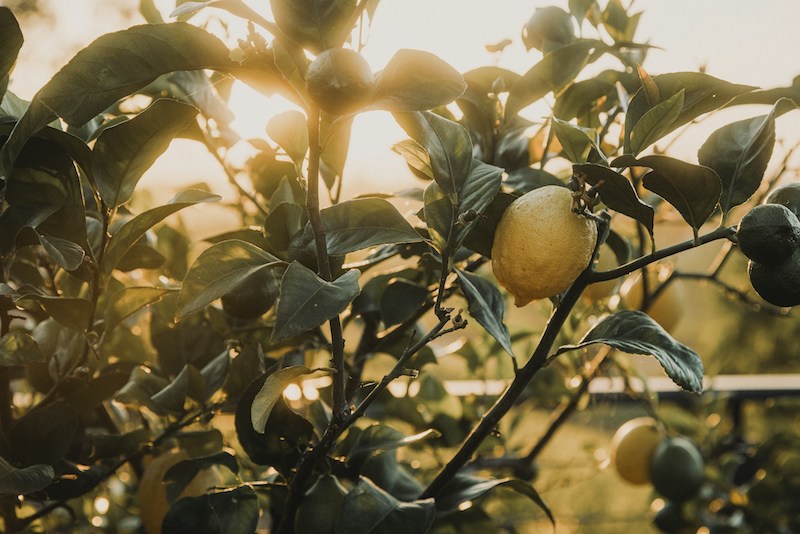
I WAS SITTING in my backyard, writing ‘The Lemon Tree, In Winter’. I thought about how my life is so different from how I imagined. I stared into the tree as though lemons would suddenly appear. I had used fertiliser for the last few months, trimmed it down completely and cleaned all the citrus bugs that covered its limbs.
/
My neighbour walks her dog twice a day. I was out the front of my house when she stopped to say, ‘Joy, I can see that there is a lemon on your tree.’ I responded, ‘Oh, really? I will go check because I had no idea there was a lemon tree in my backyard.’ As I walked back up the wooden stairs, I said to my housemate, ‘Gee, I’ve been in this house now for almost six months, and I never noticed the lemon tree.’ Gently, he approached the tall tree, his body stretched long to pluck the luscious lemon, a bright yellow amidst the wintry branches. He turned and yelled ‘Joy! I got it!’ He studied it and said, ‘Huh, it really is a lemon’. We’d both been oblivious to what had been growing in these cold and dark months. I wondered how I didn’t see the lemon there before. Why did my neighbour have to tell me? Why didn’t I notice the hibiscus trees either?
I called my sister Sani and said, ‘Chay sis, you be sabe e gad pink and red hibiscus tree front my house plus the orange one ya side?’ She responded, ‘Wa sis, I mina thankful you can feel and see thempla clear one, make sense that you couldn’t see your own beauty and power, and to be fair you almost lost your life so I glad you can see yourself where them hibiscus trees now.’ Hibiscus trees were part of our upbringing and among the stories that our Aka told me and Sani. I lowered myself onto the old timber step to take my seat. It creaked with personality. This is where I always feel most at ease, just metres from the pink and red hibiscus tree.
Last winter, my nieces and I enjoyed our fires with marshmallows. They really loved sitting in the backyard telling stories. We were singing language songs around the fire with their Aka Matilda Bani and Athe Brian Whap. To our surprise, as we were singing, my niece walked over to the lemon tree and looked up to see that Gugu had been watching over us.
/
The Lemon Tree, In Winter
centres my life now
I didn’t notice the lemon tree last year
My neighbour had to tell me
Beyond the fire, I feel everything so clearly
The Owl be keep watch over me while I inside my own war
just above my right shoulder my gal
and I stood near the fire that night.
She said ‘Mama Joy, look Owl’
I smile and say, ‘how you know sa Owl bubba?’
She smiles back and replies ‘cause of the head’
Kuyk in language is head and Gugu is Owl.
In Wayaban Gidha the song says
Ama, Gugu ipal siyawmaka e, kaazi nguzu za
I haven’t seen Gugu since, so I stay close to the fire
In Winter, where
The Lemon Tree?
/
I’ve been sitting here for four days now with my ginger tea. I’ve been waiting for lemons to grow, wondering whether the waiting will solve my life problems. I have always worked. I have always strived to pull myself out of the hellish pits of the Empire. I have known nothing else but hard work and the daily grind towards an invisible line that I feel I never reach. The days roll into one, and the colonial violence wrapped in settler innocence is difficult to endure. So insidious is this entity, so dark is its malevolence, that it eventually left me internalising and projecting its violence back onto myself.
I’d been so bullied and vilified for my blackness that the trauma manifested in my body. Deep within the walls of my own heartbreak and pain, I found it difficult to stand, move, even breathe. Unable to get out of bed, unable to dress, unable to commute to work, I was left with no choice but to stop full-time work and take a measly Income Protection insurance claim to get me through. I thought, just maybe, this claim could make everything in my life easier. Upon receiving an intermittent financial hardship endowment, I still had to endure an agonising ninety-four-day waiting period for payments which ultimately provided little, if any, relief.
MY TEENAGE YEARS at the Rockhampton and Ipswich Girls Grammar Schools were horrible, despite the white teachers’ insistence that I be grateful to be part of such prestigious institutions. My tuition fees were covered by Abstudy and my single mother’s income. I shared the dormitories with the Cape and Island girls who, like me, were also sent away from their families and communities. I didn’t enjoy being sent away and being separated from my siblings. I knew other girls felt the same way. As traumatic as it was to be so far from our families and communities, we created beautiful memories growing from young girls into young women. We held conversations that lasted hours about how we would manage living as adults, outside of our remote communities and islands. We talked about how many children we would have and who we would have them with. We had to be specific about who we wanted to be with in our communities, just in case we were related. We were inseparable, and it was special when we were together to share in all that joy and love.
Unfortunately, I soon discovered that white private school environments were never built to accept me, or any of us. I remember feeling so stuck when my identity came into constant question. To me, the epitome of beauty was, and is, my two Akas – their broad noses, strong legs, wide shoulders, bold black skin, and their most desirable curly jet-black hair, but according to the standards of glorified white beauty, there was no place at those schools for a girl like me. My blackness was mocked, particularly when I won races in the track and field school events. I was compared to fast, wild animals for their quickness or athleticism – dehumanised rather than recognised with genuine comradery. I started to believe that my perception of true beauty would never be spoken about with love in such a world.
As a visibly dark-skinned daughter of a ‘half-caste mother’ and ‘full-blood father’, I couldn’t figure out why sending children out of reservations into dormitories was the right thing to do. To me, it felt like a repeat of them mission days – scars of assimilation woven and buried within the schooling system. Today, I find myself grappling with the younger version of myself who didn’t know how to stand up for herself and her Aboriginal and Islander friends more – the version of myself who didn’t question the racist authorities or the lack of discipline against the white girls who taunted and teased us with racist names like ‘monkey’ and ‘ugly ape’. We existed in an environment where their behaviours were normalised, even encouraged by the school itself.
Our teachers were unable to be completely present for us, completely loving of us. They allowed the seeds of hatred, loathing and fear to take root. In what ways did that violence from the white teachers, the white girls and the white school system inform the way I saw myself? Since those days, I have held the weight of a thousand lifetimes in my body and wondered how could I have better protected myself? How could I have better protected us?
AS AN ADULT, the colonial abuse and pressure to go back to work made me feel like I had to return to the status quo or forever be cast out as lazy and undeserving. My insurance policy’s months-long waiting period felt like a strategy to get me to go back to work despite my condition. I have been denied access to commonwealth payments in the interim, denied the flexibility to take accrued employee leave benefits concurrently despite the excessive amount of medical evidence in my claim application. Perhaps the long days with no income was a punishment for not adhering to the colonial order. During the waiting period, I spent the mornings enjoying two cups of Moccona instant coffee (classic, medium roast) beside the lemon tree. I began to write, visualising the words flowing onto the page. I felt so disconnected from all aspects of my life, even when Mother Nature was trying to show me that there was light buried deep within the darkest and coldest of soil. Buried under the colony that allows white supremacy to dominate, that enables the very same white girls and women from my boarding school to succeed in their racism. The machinery of this settler war is what had me and many other Aboriginal and Torres Strait Islander girls, now women, believe that we don’t deserve the fruits of our own labours or the ability to simply grow and flourish in peace like that lemon tree, which bears fruit in its own season.
/
After all the watering, fertilizing, pruning and waiting, I was done.
I know innately that I did what I had to do to survive. I simply met white girls and women with the same level of violence they had constantly put us through.
Today, I stare into the lemon tree and think about how I did the best I could with the little knowledge I had. I was an innocent young girl. How could I have known how to deal with colonial abuse? ‘The Lemon Tree, In Winter’ helped me realise how proud I am that our roots run deep, despite the many seasons that come and go. The seeds will always endure.
/
I’m proud of us
This poem is for all the Cape Torres Girls
I went boarding school with
I’m proud of that day
you all fought them white girls
in the dormitory
They all racist like their parents anyway
I don’t really approve of any violence and
I don’t usually resort to fighting
But
To the white girl I hit in the face and
got expelled
and
punished for
You and your white family mustering cattle on
Stolen Land
So I don’t mind hitting a racist Cunt in the face
For the other white girl that said to
My sisters from Woorabinda
‘They smell’
This for you too
Get your stinking cattle and F off
This piece was commissioned and edited by Ruby Ingra at State Library of Queensland’s black&write! project.
Image credit: Gilley Aguilar via Unsplash
Share article
More from author

Nanu Gaamu / Google said
WRITING GIVES ME the power to transform the colonial settler narrative written for me (the racialised assumption and notion that ‘natives are unlovable and uncaring’). Writing reminds me why I shouldn’t fear my language too, in spite of the old colonial notion that ‘Islanders’ speaking their language are criminals or evil. Every Thursday at 7 pm, I sit at the dinner table with my cultural parents, ready to hear and analyse the sound theory of Kala Lagaw Ya.
More from this edition
