
Featured in
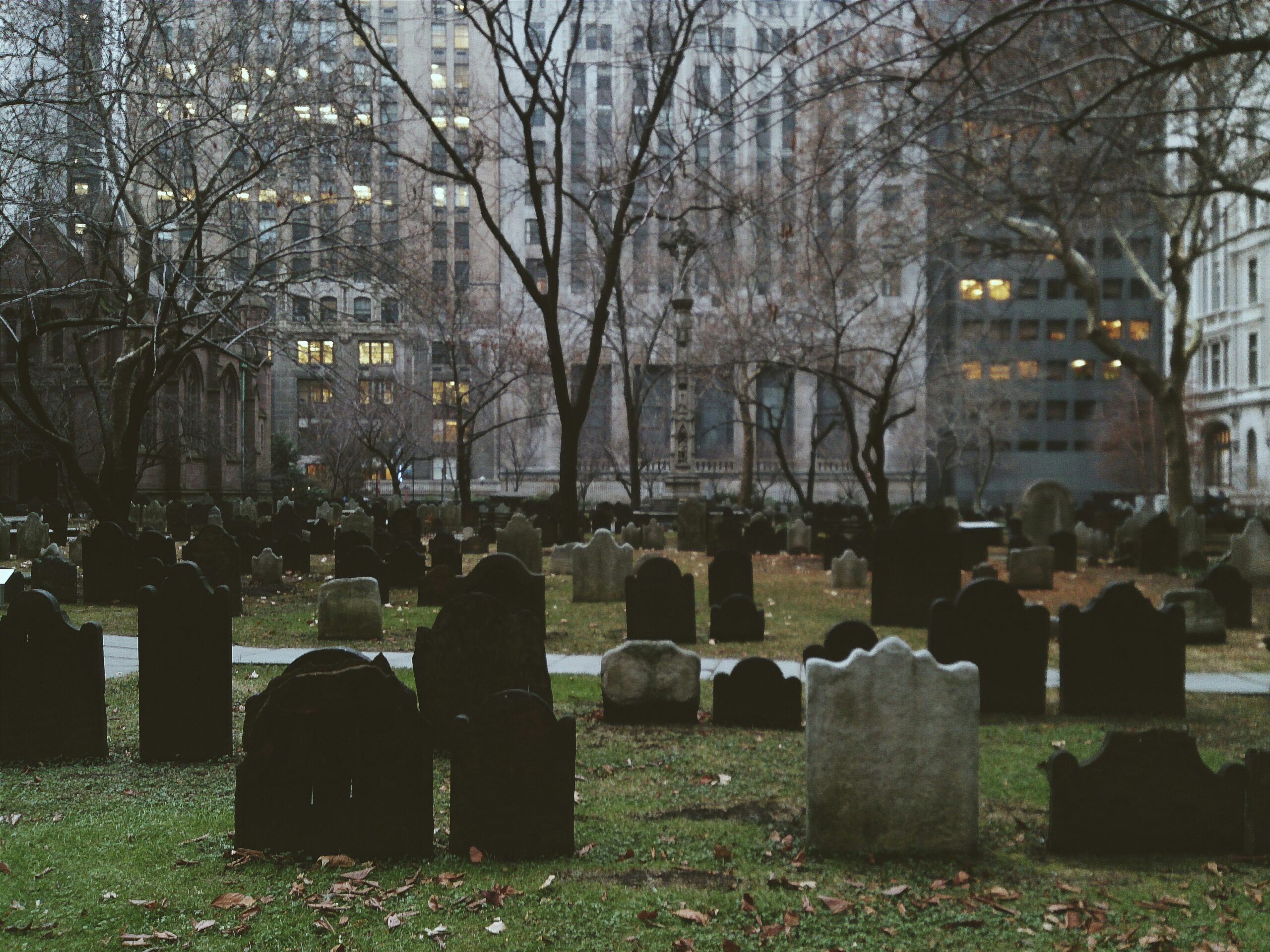
MY GRANDMOTHER HELEN is buried in a garden cemetery in Sydney’s north-west, beneath Roman Catholic Lawn, Block 13, Grave 0005. Her brass plaque is nestled below a manicured hedge, next to hundreds of identical others that stretch over the freshly mown grass. Helen was interred on 15 November 2000. Apparently, I was there, but when I try to remember the funeral, my mind goes blank. The plaque bearing her name shows signs of time’s passing but looks new in comparison to some others nearby, which are cracked and ashen.
I visit Helen’s grave on a morning in September. The day is oddly warm, and the wind has picked up, spurring dead leaves and dust particles. I sneeze all the way to Block 13. On my walk, I’m distracted by a mechanical beeping. I squint at an orange excavator a few lawns away, reversing and heavy with a trough full of dirt. I wander over to the site, where two workers in high-vis lean over an open grave. I ask if someone just went into the ground.
‘About to go in, around twelve-thirty I think,’ one of them replies. I peer into the hole. I’ve never seen an open grave before. Thin, fragile roots hang limp and broken around the sides of the grave, and the earth is dark with moisture. The other worker pours sawdust into the grave, but most of it is caught by the wind. A gust whips it upwards along with the top layer of dirt from the excavator. They wait for the wind to ease, shielding their eyes, before continuing the preparations.
‘How deep is it?’ I ask.
‘About four feet,’ one worker replies.
‘How many can fit in one plot?’
The other worker scoffs: ‘As many as they pay for!’
‘It depends,’ says the worker pouring sawdust. She’s crouching down, her back to me. She tells me that a relative of the soon-to-be-interred is beneath this grave. It’s a tricky dig because there are two neighbouring graves next to this plot that have to be supported, otherwise they’ll crumble into the freshly dug hole. I ask if they know anything about renewable tenure, or grave reuse. They tell me no; they don’t do that here.
Today, a right of interment for a lawn plaque in this cemetery costs upwards of $10,995, excluding the lawn-burial interment fee of $3,075. This cemetery offers only perpetual interment rights: once you’re buried, you remain undisturbed forever. The vast majority of gravesites in New South Wales operate this way. A 2020 statutory review of the Sydney burial crisis, titled The 11thHour Report, states that Rookwood Necropolis, Botany, Field of Mars and Macquarie Park – cemeteries that have served Sydney for centuries – will soon be unable to accommodate the city’s burial needs. The report found that all existing Crown cemeteries will close to new burials by as early as 2032.
RENEWABLE OR LIMITED grave tenure is considered a niche burial option by the few cemeteries in New South Wales that offer it. I hadn’t heard of it until I began looking into sustainable deathcare after a conversation with a friend about water cremation (or alkaline hydrolysis): a process whereby the body is broken down in a steel vat of hydrogen peroxide and water, heated to 93 degrees. What remains is a green-brown-tinged liquid and soft, white bone remnants, which are easily powdered – and often used as fertiliser. Another method I came across is promession, developed by Swedish biologist Susanne Wiigh-Mäsak, who derived the name from the Italian promessa: promise. The body is cryogenically frozen in liquid nitrogen and transformed into crystallised particles. These particles are then shattered by ultrasonic vibration until all that remains is a fine powder. Promession is currently not available in Australia, nor is human composting, another sustainable alternative gaining traction among advocates for greener deathcare.
Grave reuse is not a new concept. It’s common practice in many parts of the world, as well as in Western and South Australia. In Spain and Greece, families rent a ‘niche’ (an above-ground crypt) where the deceased is left to decompose before being moved to a communal grave, at which time the crypt is available for reuse. The catacombs of Paris are a network of underground ossuaries – a communal repository for remains – and were a response to the city’s overcrowded cemeteries during the eighteenth century. In Singapore, burials are limited to fifteen years before the graves are exhumed, and the land is reused. Most cemeteries in Singapore have closed – their remains exhumed to make way for new city infrastructure.
A renewable interment right means remains are buried for a limited amount of time. In New South Wales, this is for a minimum of twenty-five years and a maximum of ninety-nine years. If the right-holders choose not to renew their lease, the cemetery can reuse the grave space after two years from the expiry date. For the plot to be reused, a non-cremated tenant must have been buried for a minimum of twenty-five years and, at the time of exhumation, should be in a condition that allows them to be collected. Once the remains have been collected, they’re either reburied deeper, allowing a new tenant to be buried on top (a method known as ‘Lift and Deepen’), returned to their family or retired to an ossuary.
BEYOND BLOCK 13 are the family vaults, ornate crypts of marble and black granite, some adorned by stone angels or the Virgin Mary. One of the vaults is unmarked by the characteristic nameplate or framed photograph of the resident(s). Taped to the closed glass door is a QR code and, beneath it, an italicised quotation: Where Individuality and Personalisation meets Craftmanship. I realise this must be a display crypt. Walking through this section is like walking through a quiet, bouquet-lined neighbourhood. A footpath winds through the crypts. Some are even protected by gates. A magpie perched on a nearby gum surveys the scene, its call carried by the wind.
Humans are creatures of habit and often resistant to change, especially when it comes to ritual and tradition. It’s difficult to tell whether renewable tenure will be popularised in New South Wales, yet experts agree it’s a necessary next step for more sustainable deathcare. Melbourne University researchers Hannah Gould and Kate Falconer argue that perpetual tenure makes grave space a ‘single use’ resource, and that by making renewable tenure the default option, Sydney’s need for burial space over the next century would decrease by 38 per cent. Because it’s currently rare in this state, there’s been little opportunity to gauge public sentiment regarding grave reuse. In certain religious traditions – for instance, Judaism and Islam – disinterment or exhuming of bodies is prohibited.
Aside from religious or spiritual requirements, the main argument against grave reuse seems to be that the dead should be left alone to rest as a matter of respect. There’s an inherent sense of transgression in digging up the dead that’s not necessarily rational but persists nonetheless. It feels wrong. Then again, by what rights can we take up space once we’re gone? Haven’t we taken up enough already? Here, on stolen land, where colonial cemeteries were built, built over, then built over again – where relics and remains are still being dug up, and where many tombstones still stand as a reminder of all those who came here, their names nailed into the ground.
ONE EVENING EARLIER this year, I sat with some friends in my backyard, our bodies silhouetted by the kitchen light. Somehow, we got on to the topic of death and that none of us had really thought about our own deaths in any great depth. I mentioned that I thought about my parents’ deaths quite often, after a close call not long ago. A few friends of mine have lost their parents – have lived, are living through, a grief that terrifies me. One friend wanted his body donated to science. Another liked the idea of a natural burial, where the body is returned to the earth sustainably, and there’s still a place for her family to visit and remember.
Since Helen’s death in 2000, I’ve visited her grave maybe four times. Mum admitted to me that she hasn’t visited Helen much either. This year, Helen has reached the minimum requirement for renewable tenure. Hypothetically, we could renew the tenure for another five or so years, or longer, until we max out in 2099. In 2099, Mum will be gone, and, unfathomably, I could still be alive if lifespan predictions are correct, thanks to synthetic augmentation. Against this timeline, and considering the many billions of humans who have and will pass over this earth, the frame of human memory feels minute in comparison to the reality of forever.
Mum doesn’t visit Helen’s grave often, but she thinks of her all the time. She told me she takes comfort in the fact that she knows where her mother is. I think I would take comfort in that, too. Perhaps feelings about renewable tenure will shift as time wears on and we necessarily have to reorient our ways of thinking and doing to adapt to our changing world, in which perpetuity feels like an increasingly antiquated notion. Perhaps, in time, our rituals will shift in the direction of sustainability and community. Personally, I’m coming around to the idea of being composted and turned into soil, to in death sustain the Earth. I think of this transformation as I trace the ridges of my left-hand knuckles with my right index finger, watch them move, feel the sensation. I notice fine crinkles on the back of my hand when I flex my knuckles, a few freckles I’ve had since kindergarten that grow slightly darker each year.
Transformation into soil takes just eight to twelve weeks.
Image credit: Francisco Suarez via Unsplash
Share article
About the author
Tess Scholfield-Peters
Tess Scholfield-Peters lives and works on unceded Gadigal land. She is currently a Lecturer in Communications and Creative Writing at the University of Technology...
More from this edition
