
Featured in
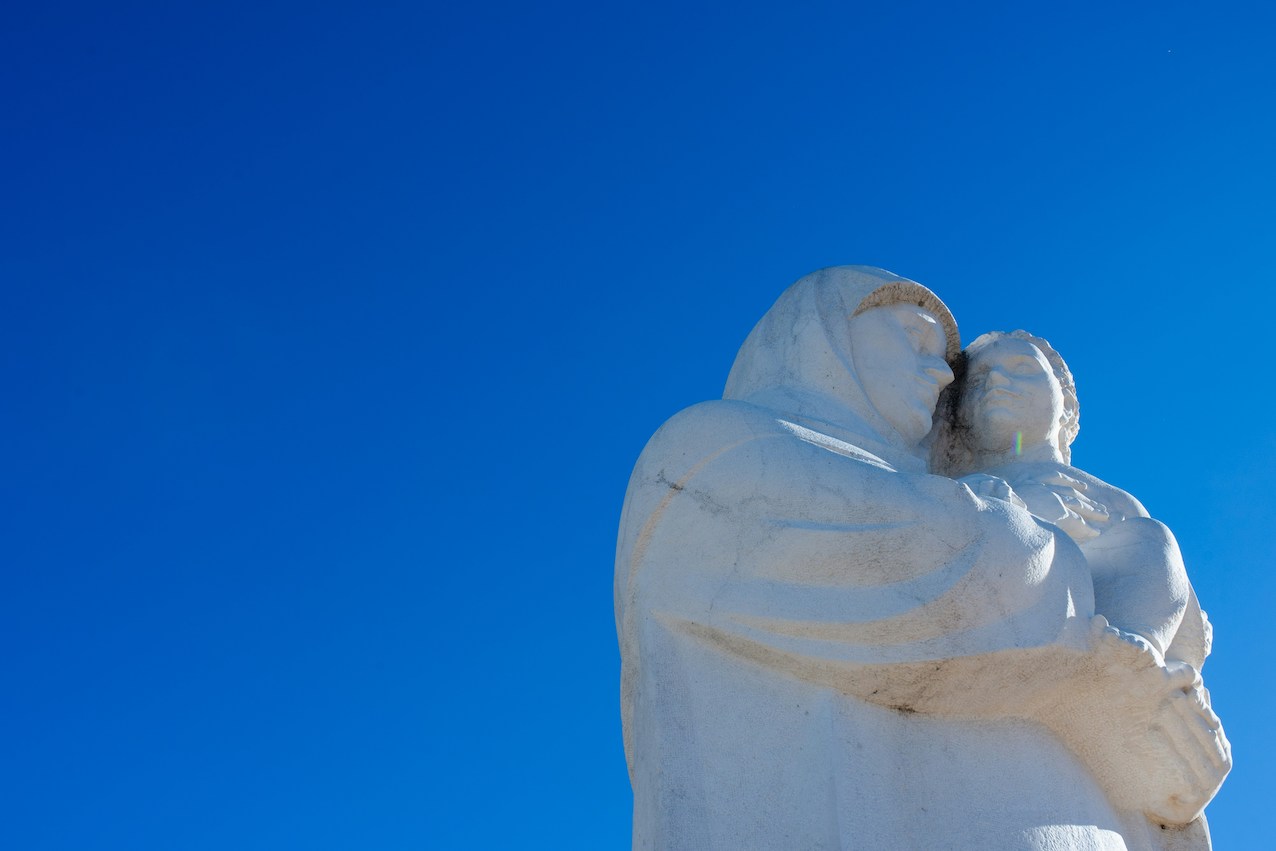
MY DAUGHTER WAS two years old when I wheeled her into a motherhood-themed art exhibition, picked up the catalogue and read a description of the ‘catastrophe of identity brought about by becoming a mother, when even one’s own self must be shared’. It’s a sentiment redolent of Sheila Heti’s Motherhood, a book that captures our culture’s notion of vexed motherhood, as well as the dashed spirit of today’s art on the subject of matrescence (the complex, eternal process of becoming a mother and its impact on mind and body).
Since being pregnant with my daughter, I’ve encountered this story across countless gallery presentations. Contemporary mother-artists as far and wide as Valie Export, Annegret Soltau, Tabitha Soren, Camille Henrot and Tala Madani tend to visualise mothers in isolation in their work – howling, smeared in shit, ragey red and lacking community or identity beyond the title of ‘mother’. Art’s ancient iconographic image of the mother and child was often suggestive of a social unit in and of itself. But motherhood today is regularly conceptualised by artists as an abstract identity shorn of relational ties to children, community, kin and beyond. Today, the child or baby is often a projection of the new mother’s anxiety and resentment, evident in works such as Marlene Dumas’ The Painter (1994), in which her spectral daughter glowers out of the white canvas with accusing, resentful eyes.
The toils of motherhood are real: a New South Wales parliamentary inquiry in 2023–24 found that one in three women suffer birth trauma; caregivers are often lonely and secluded due to the privatisation of public spaces and the loss of extensive child-rearing networks; postpartum trouble in the form of depression and anxiety is only now coming to light; and postnatal health care is designed for babies rather than holistically for parents and families. Representations of motherhood as a nightmare affirm this reality. They also pose a rhetorical pushback against the fantastical, postwar ideal of the Madonna-like, valium-happy mother in the suburban household. But where do these representations take us? And is there a different way to visualise parenting and the expansive, enriching role that care can take in our lives?
I’VE SPENT YEARS researching artists’ perspectives on motherhood and caregiving. I’m convinced that, along with the unfinished claims of 1970s feminism, the long shadow of neoliberalism fuels artistic representations of maternal ambivalence. I have learnt that parenting, community-building and caregiving are not just magnificent but intellectually challenging and historically shaped in a way that I rarely see taken seriously in contemporary art. Is what the art world perceives as the fraughtness of motherhood triggered by the biological process of having children (as American feminist artist Judy Chicago argued in her 1980s Birth Project), or by social conflicts and the institution of the nuclear family? This conundrum led me to the work of Hayley Millar Baker.
Millar Baker is a Naarm-based artist of the Gunditjmara people whose photographic and video work contains an amalgam of elements: horror tropes, the fantastical, the ecological. In cinematic black and white, she presents kitchens and homes in strange and imaginative ways. She’s also a parent of two children. Her work is currently in All the Stars We Do Not See: Australian Indigenous Art (beginning its North American tour at Washington’s National Gallery of Art); it will soon be in MOTHER at the National Gallery of Victoria.
I called Millar Baker over Zoom to discuss what lies beyond the constraints of contemporary representations of motherhood and how art might convey it in more expansive terms. I told her I’d always had this sense that her work represented motherhood in a dominant yet diffuse way.
‘It has always been there,’ she told me.
Even before I became a mother, I had imagery of my mum, my nan and my aunties – that intergenerational link. My understanding and reading of their experiences pass through me into the next generation… In my direct maternal line, we have six generations of women before a male – my son – comes in. I was [taught] that women are the leaders, women hold the power. That was kind of a given: to focus on the female experience.
With this, Millar Baker acknowledged more than the socially imposed limitations of motherhood. She was speaking of the cycles of time, generations, seasons and knowledge passed down through mothers – an inherited, living history. It’s fitting, then, that Millar Baker’s practice employs a clever artistic strategy – the incidental depiction of mothers occupying multiple roles, without being overtly signaled or exclusively defined by motherhood. Examples of this include Nyctinasty (2021) and Entr’acte (2023).
[When my firstborn] Maeve was about four months old, I saw motherhood – for me, an Aboriginal woman – as defiant. It was a position [from which] to say, ‘You can’t and you haven’t killed us.’ My bloodline, the Gunditjmara people, were the first point of colonisation in Victoria. We fought back. We’re known as the Fighting Gunditjmara. When I was twenty-eight years old, having a baby proved that I hadn’t lost – that we hadn’t lost. I’m going to be staunching there, I’m going to take my kid everywhere I go if you want me to work. [I thought of] motherhood as an act of survival or existence or progression.
‘The experiences of Aboriginal people with children are very different,’ said Millar Baker.
Being an Aboriginal person, life’s just a fucking battlefield. I battle the schools so hard. [My daughter] Maeve [has] experienced racism from teachers, and there was no inclusion of Aboriginal publications in the school library. I need to nourish myself and create something that will nourish my children [to counter] the pain and the suffering and the trauma that is intergenerationally inherited. We’ve got such a special magic within us. So many of us Gunditjmara people were killed, but we continue.
INDEED, PARENTHOOD HEIGHTENS discord with power and institutions in the family unit, school, healthcare and other authorities. It also encourages us to internalise these social conflicts, perceiving them primarily as personal, emotive assaults on us as individuals. This is the phenomenon I see at work in the pre-eminent theme of maternal ambivalence in the art world.
American scholar Dr Jennifer C Nash points to the flourishing cultural markets around maternal ambivalence – naming it, creating characters and stories around it. She critiques the way in which the cultural genre of white political motherhood performs ambivalence about the role of the mother and its relentless demands. In her paper ‘Black Maternal Aesthetics’, Nash argues that Black maternity is only ambivalent in that Black mothers pre-grieve the possibility of the state imprisoning or killing their children. Citing Jessica Friedmann’s Things That Helped (2017), Meaghan O’Connell’s And Now We Have Everything (2018) and – the book that heralded the current zeitgeist – Rachel Cusk’s A Life’s Work (2002), Nash concludes that the cultural trend of maternal ambivalence is a function of race: a white thing. A common thread throughout the cited narratives is the newness of caregiving in the artist’s life. Readers witness the shock of the initial entrance to motherhood by parents who had presumably never assumed caregiving responsibilities – cups of tea brewed for grandparents, pasta boiled for siblings – in their youth. This brings us to the dimension of class, or, perhaps, the dark side of prosperity in the developed world. The wealthier our societies grow, the more caregiving is outsourced or simply not expected.
Nash’s critique of the ambivalent posture of white political motherhood could just as well apply to the world of contemporary art, which has deservedly elevated the figure of the mother to ubiquity since the COVID-19 pandemic laid bare the denigration of care work. Since then, dozens of major exhibitions worldwide have taken motherhood as their theme, including New York’s Museum of Modern Art and London’s Southbank Centre. On its website, the National Gallery of Victoria recently framed a public talk titled ‘Mother and Child’ in purely emotional and individual terms: ‘from tenderness and nurturing, to perseverance and grief.’ Exhibitions gesture to ‘the labour and terrifying love of motherhood, using domestic routines and recycled materials to record the flux of daily life’ and ‘the complexities of maternal identity’. A recent news headline about another motherhood-based exhibition touted ‘Project aims to show “true essence of motherhood”’, as though there is one sole – and bitter – truth to be exposed.
Perhaps what is most concerning is that depictions of homebound motherhood infused with despair, depletion, and loss of intellect and creativity are validated as the most authentic, intelligent and progressive explorations. Materials derived from the home are privileged: unstretched canvas tablecloths, household debris, fabric remnants. Artistic dissertations motion to subjective and female-coded experiences, writing of motherhood’s catastrophes, ambiguities and doubts. It’s hard not to see a doomed cycle: an oscillation between the increasingly entrenched dichotomy of the miserable mother and the unthinking, conservative housewife.
The irony of such a focus is that it reinforces the cultural tradition of male narratives that centre on ambition, while women’s stories are spurred by endurance and suffering. Much more remains to be considered in relation to parenting and care, such as themes of the village, queer models, male carers, or challenging pregnancy’s presumed association with live birth.
Speaking to how the prevalence of motherly ambivalence in art homogenises varied ideas and experiences, Millar Baker stated:
Tragedy is [seen as] the driver of culture. It all comes down to the patriarchy in the arts, and what comes across as interesting. That’s not to say that I haven’t had a major identity crisis. I just feel everything that I have seen focuses on the identity crisis and struggle of motherhood from middle-class white women. We absolutely need those stories; it’s like the community needs to get the trauma out first. We gotta get out the bad and get that into the world before we give you the good.
The identity crisis narrative is valid and necessary, though far from universal – there is more to explore beyond brokenness. Millar Baker cited American artist Carmen Winant as a luminous precedent. Winant rigorously uses motherhood as a framework to think historically about the conditions and structures that preceded present-day caregivers. ‘The work [about motherhood] that gets airtime is her most confrontational work – the abortion work, the controversial work of women’s autonomy and rights over the body and the gore of birth,’ said Millar Baker. Winant’s My Birth (2018), for instance, is a wholly beautiful and unifying photography project, held in MOMA’s collection, that features thousands of images of women preparing for or going through childbirth. And yet the artist’s investigations into the flawed, ongoing experiments of lesbian lands (separatist intentional communities) in rural America, as well as the unsensational paper-based archives of the frankly amazing labour of abortion workers, are less cited and documented online and by arts writers. Why is maternity art considered most worthy when it manifests the emotive and domestic, the oozy and bloody, rather than the intellectual and social?
This is an ongoing trend in feminism: the public’s attention is brought to the most flammable fight, the violent and the affective, like bombs outside abortion clinics. What about the philosophical conundrum of the doubled maternal-fetal body, the historical censorship of pregnancy in art, curiosity about care, and the myriad ways people live together outside the single-family household? What about exploring the concept of the mother as a role, mothering as a verb – something to be done – rather than mother as a lonely me to be inhabited?
FOR ME, PARENTHOOD has incited a ferocity of desire, imagining and possibility beyond the narrow present. Throughout history, depictions of motherhood have more closely conveyed this feeling, transcending the narrow scope of contemporary representation. On residency in Italy, Millar Baker ‘saw a lot of beautiful Renaissance and classical works, which portray motherhood as actual fantasy and surreal mythology’. She cited the muscular torso of the she-wolf that birthed Romulus and Remus in Roman mythology and the Crouching Venus as working allegorically towards ideas of transformation. Some artists, such as Louise Bourgeois and Kara Walker, continue this artistic tradition of grandiosity and mystery through their visualisations of creation and care. Inversely, Alice Neel employs the theme of the glorious everyday, unapologetically presenting pregnant women in a continuum alongside activists, labour organisers, neighbours in Spanish Harlem, her lover. She paints the linea negra and mottled veins of gestating skin in much the same manner as the stripes in men’s suits. All are in the tumble of daily life, not a realm of terror and rupture.
WHAT MAKES LIFE worth living for parents today? Where are the moments of pleasure, autonomy, everyday lavishness, provocation and surprise? The idea that pregnancy, breastfeeding and raising children could be horizon-broadening remains strangely relegated to conservative commentators, influencers and mommy lifestyle blogs. Since falling pregnant with my daughter, I have searched for representations of how it felt to carry a pregnancy, or birth, or breastfeed in previous eras. Three hundred years ago, how did women on Ngunnawal Country, where I live, experience the context of childbirth; did it diverge greatly from today’s ambient vibe of fear and anxiety? How did my ancestors in the Ottoman Empire determine that they were expecting without pregnancy tests and ultrasounds? What were their natural pharmacological remedies for first-trimester nausea? Had my other forebears on the outskirts of Dublin known their midwives their whole lives? Before the abortion ban was lifted, what was the difference for them between miscarriage and termination? What were hospital births like for the first generation of women who experienced them in the West, and did they want to keep birthing at home? My exploration of art history books, museum collections and history archives has made the past seem sharp, exact and almost real in a way I can’t see in contemporary art.
I for one am glad that the exploration of maternal ambivalence exists. And yet, motherhood is plural. Mothers do not only experience motherhood as an immutable, noxious shadowland; nor are women only interesting and strong as subjects of art when they reject roles of care or walk away from child-rearing.
We are twenty-five years into this century, more than fifty years after feminism’s second wave, and it’s not easy to find art that reckons with the prospective power of parents in the world’s remaking, or imagines a vision beyond maternal suffering. The end of our preoccupation with maternal ambivalence would mean nothing less than a re-enchantment of everyday life and some kind of shared investment in the future. Could we also imagine more stories in which mothers encounter possibilities, growth and expansion, in which the spheres of love around children are widened? The quiet successes of mutual aid, the cultural recuperation of erased birthing practices, maternal connections to Country, the invisibility of miscarriage as a feminist public health crisis, the visual language of zines circulated by abortion doulas – so many zones of enquiry still lie outside what I’ve seen on the walls of galleries. They could broaden the horizons of parents and non-parents alike.
Image credit: Stephanie Wubben via Unsplash
Share article
More from author
Palestine 36
To finish with empire, we must first remember the truth of the violence that made it possible. This is what British academic Paul Gilroy believed, and that the loss of empire is the central social, political and cultural fact of British society today. But the more brutal realities of imperialism, the realities of violent death following occupation, emergency laws, judicial murder, the bloodshed accompanying deportation — horrors fundamental to the British state — are rarely captured by filmmakers for a large, multiplex audience.
More from this edition
