
Featured in
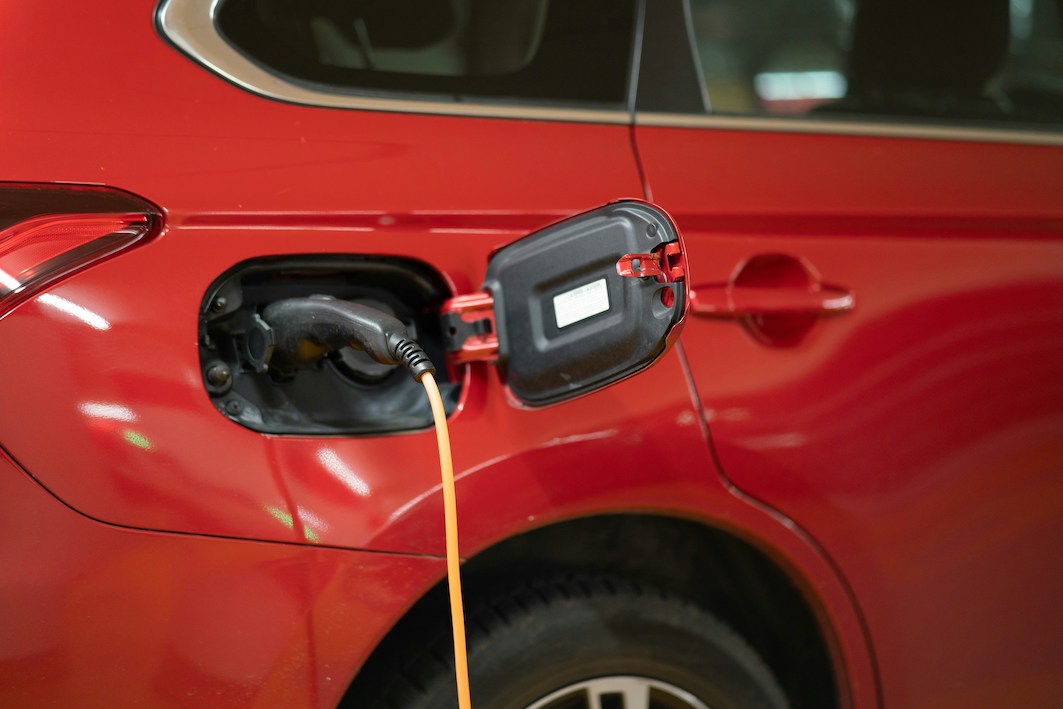
I WAS WORKING out with my friend Matt when he asked if I wanted some coolant. Confused, I quipped darkly that I was depressed, not suicidal. Then I twigged – he’d recently bought an electric vehicle (EV) and no longer needed the half-bottle of Castrol Radicool he was offering. I said ‘yes’, and later – in a group chat we’re both members of – ‘Happy to take it like the internal combustion engine-running schlub that I am’.
All my friends are getting EVs. Matt and his partner, Samantha, own a Volkswagen ID. 4; our mutual friends Alex and Diana bought a BYD ATTO 2; June and Diego, a third couple we’re all close with, own a Kia EV5. Within this circle of middle-income professionals, my wife and I are the only couple clinging to a petrol car (two petrol cars, to be exact, as well as a lawnmower that – likewise – runs on the extracted remains of prehistoric organisms).
As I walked home from the gym that day, the hydrocarbon fug of Preston’s High Street rising to meet my nostrils, I noticed a bunch of EVs prominently displayed among the strip’s umpteen car yards. One was a gleaming white ARIYA, Nissan’s new mid-sized electric SUV (a follow up to the carmaker’s LEAF, the world’s first mass-marketed EV). I’ve owned more Nissans than any other make and felt a dopaminergic rush as I passed the car. Could we afford its $60,000 price tag? Should we?
THE UPTAKE OF EVs in Australia – while increasing – remains modest, accounting for around 12 per cent of total car sales and only 2 per cent of the cars on our roads. The CEO of the Electric Vehicle Council, Julie Delvecchio, has said that sales need to lift to 50 per cent by the end of the decade if the country is to meet its emissions reduction targets.
This is the kind of language in which one expects CEOs (even of ‘green’ organisations) to speak, framing systemic issues as problems that can be solved by individual consumers rather than through political agitation or direct action. But it is also a language we – the consumers so fervently courted by the world’s automakers – are increasingly internalising.
Take, for example, the recent spike in EV sales since the global oil price surge in the wake of the Iran war. As fuel prices climb and uncertainty remains around supply, it’s common sense to consider trading in your petrol car for an EV – if you can afford the outlay. That’s a considerable ‘if’. As ACT Independent Senator David Pocock recently pointed out, those reliant on income support are most impacted by the increasing cost of petrol and groceries and tend to benefit the least from EVs and rooftop solar.
Meanwhile, some motorists without the wherewithal to invest in an EV but with sufficient resources to continue buying petrol – at least for now – have begun to stockpile it. Much as it did during the COVID-19 pandemic, the government has cautioned against panic-buying, which is often characterised as hopelessly individualistic and selfish. But it’s no mystery why it should occur within populations conditioned to respond to uncertainty of all kinds – be it mid-afternoon jitters or an intractable global crisis – by spending money.
IT’S EASY TO forget, given the ubiquity of the petrol car, that the EV’s relative novelty in the early twenty-first century is not the result of some kind of technological determinism but rather of conscious choices – albeit by corporations and governments rather than citizens. The first viable EVs appeared during the 1890s following key developments by French inventors Gaston Planté (the rechargeable lead-acid battery), Gustave Trouvé (an electric tricycle) and Charles Jeantaud (a contender for the first battery-powered electric car, the Tilbury). In 1890–91, the Scottish chemist William Morrison created a six-passenger wagon considered to be the first successful electric automobile in the US. Within a decade, one third of all vehicles in the US. were electric. In 1897, the bestselling car in the country was the battery-powered Columbia Motor Carriage. This vehicle – capable of achieving a top speed of 15 miles (about 25 kilometres) per hour – was praised by the Hartford Courant for heralding the arrival of the ‘horseless era’.
While the drivers of the Columbia Motor Carriage were not vexed by climate change, that automobiles were as noxious as the manure-producing horses they were superseding was commonly understood and often decried. ‘Imagine,’ wrote one early critic of the internal combustion engine, ‘thousands of such vehicles on the streets, each offering up its column of smell.’ In our world of more than a billion petrol cars, no imaginative leap is required to contemplate such a scenario.
In addition to being unpleasant and polluting, petrol cars were also dangerous. Hand cranking was required to start them, a process that – as well as being difficult in cold weather and requiring significant strength – frequently resulted in broken bones and dislocated shoulders from ‘kickbacks’ when cars backfired. Pedestrians were at even greater risk than motorists; in the first decades of the twentieth century, tens of thousands of people were being killed by automobiles on US roads every year.
The story of the internal combustion engine’s triumph over the EV is usually told as a technological one: petrol cars were faster and could travel further, and when, in 1912, the need for a hand crank was obviated by the electric starter, the writing was on the wall. But this narrative of inevitable and irresistible ‘progress’ is only partially true. What it elides is that the fossil fuel and auto industries purposefully destroyed the alternatives not once but twice, in the early decades of the twentieth century and again in the early twenty-first, when GM controversially terminated its EV1 program and destroyed most of the 1,117 vehicles it had produced.
While GM claimed the EV1 was technologically and financially unviable, early detractors of EVs employed psychological as well as practical means to undermine their development and uptake. First, they made EVs appear redundant – slow and unable to go far – in the face of increasing urban sprawl. Second, they painted them as undesirably feminine in their cleanliness and ease of operation. The third, and perhaps most damaging, strategy was to wage war on the safe, environmentally friendly electric streetcars millions of Americans travelled on while ensuring that the infrastructure needed to support the expansion of EVs never received the massive public investment it required (investment that the fossil fuel industry would come to claim as its right).
To paraphrase Edwin Black, had corporations and governments not succeeded in addicting us to oil and derailing the alternatives, the world would look markedly different today. It’s worth pointing out that while EVs are unquestionably less environmentally harmful across their lifespans than cars with internal combustion engines, their construction and lithium-ion batteries rely on the energy-intensive mining of essential minerals. While it has, predictably, become a right-wing talking point, the reliance of EVs on mineral mining is deeply problematic. Not only are deforestation, water scarcity and pollution common to sites in South America, Indonesia and China, but cobalt mines in the Democratic Republic of the Congo are also, according to Amnesty International, rife with child and labour exploitation. All of which is to say nothing about the politics of Elon Musk, whose turpitude has inspired legions of Tesla owners to distance themselves from him with bumper stickers reading ‘I bought this before we knew Elon was crazy’. As the old saying goes, there is no ethical consumption under capitalism.
THE FATE OF the OG EVs also tells us something important about the limits of individualised consumerism as a tool for change. In pushing internal combustion engines over EVs, automakers were not merely selling us one kind of car in preference to another. They were selling a lifestyle based on an auto-centred transit system and the marginalisation, if not elimination, of public transport.
Today, we barely notice how ubiquitous private transport has reshaped our lives, sequestering families (especially working-class families) and communities into areas evermore distant from CBDs and suburban employment nodes. What has been a triumph for the same automakers now hawking this ‘lifestyle’ in various shades of green has been a catastrophe for human flourishing. Studies have repeatedly shown a strong correlation between the rise of private car ownership, car-centric infrastructure planning and increased rates of social isolation and loneliness. When do we ever speak to our neighbours, except in the harried passage from front door to car door?
On the other hand, as Jeff Sparrow writes in Crimes Against Nature (2021),
… had the desire of working Americans for safety been prioritised, and their enthusiasm for public space been respected, transport might have been designed on the basis of public good rather than private enrichment… Instead, a relatively small number of entrepreneurs successfully campaigned to reorganise the country – and subsequently the world – so that their particular business model might succeed.
Technology may be enabling this business model to greenwash itself by creating EVs every bit as fast, reliable and high output as their petrol counterparts, but there is no techno-fix for the alienation we feel in a world built for cars rather than humans.
IT IS NOT hard to imagine that by the time my four-year-old son is as old as I am now, he will inhabit a world very different to the one we currently live in. Perhaps, beneath a rooftop glistening with solar panels, lab-grown meat simmers on an induction cooktop while his unnaturally youthful family – beneficiaries of yet unimagined life-extension technologies – gathers round a smart TV. Outside, in the driveway, their EV quietly charges. His world may very well be one premised on the idea of ‘decoupling’ – that is, economic growth unyoked from greenhouse gas emissions.
The merits of each of these marvels – indeed, of the choice so many of my friends have made to replace their petrol cars with EVs – are clear enough. Yet I can’t help but think of the broader meaning of ‘decoupling’: to disengage, to dissociate, to become separate. That, too, is a promise inherent in the shift to EVs: a doubling down on our commitment to the private automobile, and all the ennui that entails.
Pass the coolant.
Names have been changed.
Image credit: Michael Fousert via Unsplash
Share article
More from author

A discovery of witches
Unlike the patriarchal and monotheistic Abrahamic religions, paganism is structurally non-hierarchical – although covens (groups or meetings of witches) tend to be nominally led by a high priestess and high priest – and, in the words of influential English Wiccan Vivianne Crowley, pagans ‘worship the personification of the female and male principles, the Goddess and the God, recognising that all forms of the Goddess are aspects of the one Goddess and all Gods are aspects of the one God’. There is no holy book, messiah or central administration, and its ethos is fundamentally exultant – celebratory of the body, nature and the divine.
To clarify a common misconception: most pagans neither believe in nor worship Satan, a figure rooted in Judeo-Christian traditions rather than nature-based spiritual paths. The conflation of pagans with ‘devil-worshippers’ dates to the twelfth century and is a product of the Catholic Church’s campaign to quite literally demonise the horned, cloven-hoofed gods – Pan, Herne, Cernunnos and others – central to the pre-Christian spiritualities the Church was intent on suppressing.
The witch trials of the early modern period, where accusations of devil worship were frequently levelled against those, usually women, who practised folk magic, herbalism or traditional healing (or, in many cases, had simply drawn the ire of a relative or neighbour), reinforced the association between nature-based religion and Satanism. As the historian Ronald Hutton observes in The Witch: A History of Fear, from Ancient Times to the Present (2017),the standard scholarly definition of ‘witch’ has come to denote, in the words of anthropologist Rodney Needham, ‘someone who causes harm to others by mystical means’.
More from this edition
