
Featured in
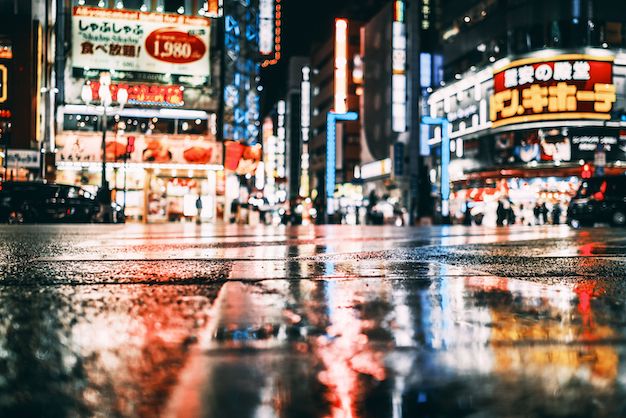
I DREAM THERE is a serial killer and I am his next victim. The dream wakes me up at 2 am. For the first time since recovering from shin splints I go for a run. I run along the Sumida River listening to Mozart’s Symphony No. 25. Would I run faster if I were being pursued by a maniac? The murder rate in Japan is 0.3 per cent per 100,000 people. I can barely run two kilometres. For the rest of the day I feel like Edward Norton in Fight Club, red-eyed and teetering on the edge of insanity. At the grocery store I buy ingredients for dog bowls, which are meals human men eat if they are trying to achieve a body fat percentage in the low teens. When I Google ‘dog bowl human seasoning’ the AI tells me this can refer to ‘the viral dog bowl fitness and dietary trend or the dangerous practice of seasoning your dog’s food with human flesh’. Dangerous for whom? Cycling through Kappabashi, the district where tourists go to buy sharp knives, I listen to ‘Lucky Ones’ by Lana del Rey, crying.
I go to see a French movie with Japanese subtitles. My French is not good and my Japanese is worse. I had thought I would be able to understand it because I recently rewatched Jean-Luc Godard’s Breathless, but maybe because Jean Seberg is American, or because Breathless is for teenagers and I have seen it plusieurs fois, it has led me to overestimate my facility with French. This also happens when I watch Éric Rohmer films (I think I understand everything because all the characters talk about is love). The cinema is underground and very small. There are six other people in the audience. From what I can gather, the movie is about a witch who exacts revenge on the narrow-minded townspeople for murdering her pet goat by becoming a prostitute and having sex with all of them. The director is a woman who was born in Argentina. If I were to tally all the words I understand across the film’s two-hour runtime it would clock in at about a minute. When the movie finishes, no one leaves the cinema until the end of the credits. The Japanese do this out of respect for the crewmembers, but what if the movie does not deserve respect? Reading the synopsis on the film’s Wikipedia page I am surprised to discover I understood it perfectly.
I attempt to read a Murakami book, The Wind-Up Bird Chronicle. I have only read Norwegian Wood because people who are into Murakami tend to be annoying. The book is about an unemployed househusband to whom strange things happen. I stop reading it. Since moving to Japan with my husband for his job, I have mostly read Australian fiction and Dickens. The most celebrated Japanese novels available in English tend to be about alienated people with mental health issues. At Uniqlo I buy a blue cashmere sweater; later, I realise it is identical in colour to one worn by Scarlett Johansson in Lost in Translation. When they made that movie Scarlett Johansson was the same age as Joan of Arc when she broke the siege of Orleans; I am currently the same age as Alexander the Great was when he died. It’s true, women mature faster.
I make no friends except for a rickshaw runner who, it turns out, is from Brisbane. One night I go out with him and his friends to a bar where they let you fire a gun. He and his mates work as extras on Japanese television, which means they often play CIA agents or WWII POWs. Because their line of work occasionally requires them to pretend to get shot, they show me the techniques they have perfected, crumpling to the sticky tabletop as they are struck down by invisible bullets. One of them is so good at it I can easily imagine blood spurting from his neck. They tell me I should sign up to one of the casting agencies, as white guys are in high demand; I am pretty sure my friend almost says ‘you don’t have to be good-looking’ before catching himself. All this is accompanied by the clatter of gunfire. Apparently there are lots of Russians in Japan on modelling and acting visas because if they return home they’ll be conscripted into the war. Because they keep ducking into the bathroom I suspect my friend and his friend are on coke. Another night, when I am at an izakaya with my husband, one of the waiters tells him, ‘You are very handsome, you look like this movie star.’ Holding up his phone he shows us a picture of Matt Damon.
OCCASIONALLY A BLACK van will drive through the streets draped in Rising Sun flags and blaring nationalistic marching tunes. The rhetoric issuing through the public address systems calls, I believe, for the expulsion of all foreigners. But you don’t understand, I want to protest, I’ve read almost everything by Yukio Mishima! Though the vans are very loud everyone on the street ignores them.
My best friend, who is living in France, tells me he weighs sixty-five kilograms. He is six foot two. Another close friend has recently finished treatment for cancer. At the gym I use BIA scales to calculate my body fat percentage and net muscle mass. Because I go to the local government sports centre most people at my gym are pensioners; I am the only gaijin. In Japan people have special shoes they wear to the gym and nowhere else. I have worn my shoes elsewhere. Whenever I go to the gym the radio is playing The Carpenters. Because there are no other white guys if I don’t go for a couple of days the bloke on the desk asks me if I’ve been busy with work. Hai, I lie, totemo isogashii desu. There is table tennis downstairs, and a sumo training area. I wonder if you have to be built like a sumo wrestler to train like one or if there are really skinny dudes throwing each other around in loincloths. A single session at the gym costs the equivalent of two Aussie dollars.
I cannot find the words to properly convey this sorrow. Today I will again stare out the window and cry. There are ninety-nine people in the room who do not believe in me. These are the phrases Duolingo is teaching my husband. He studied Japanese in high school; I have been studying for 326 days. I spell tomato wrong in katakana; the word is the same in Japanese and English. I eat a cookie I bought at a taco restaurant thinking it contained CBN, a mildly active ingredient in marijuana, because cannabis is illegal in Japan. I hope it will help me sleep. When it takes me a really long time to hang our shirts in the wardrobe I realise I’m high. ‘Baby,’ I say, when my husband gets home. ‘I accidentally got so stoned. I thought the building was swaying.’ It was. There was an earthquake. By the end of the month Japan has outlawed CBN products, too.
At a jazz bar my husband sings ‘Feeling Good’ with the house band. The regulars are astonished when he sounds like Mel Tormé. They are nicer to us afterwards, and we sit with an older couple at the bar, smoking and talking in fragmented Japanese and English. The woman is, her husband tells us, the most renowned Japanese interpreter of Chopin. When I tell her I like the Martha Argerich 1964 concert recording she rolls her eyes, exhaling a contemptuous plume of smoke. ‘Plonky plonky plonk,’ she says.
I go to an exhibition of Andrew Wyeth paintings. I look at his portrait of Christina Olson, gazing out from the doorstep of her house in Maine. I go to an azalea garden. I teach myself the choreography from the music video for ‘Got Me Started’ by Troye Sivan. I go to Onitsuka Tiger with my teenage cousin and buy a pair of sneakers he tells me ‘look sick’. I have an autoimmune episode. I search for a replacement part for a rangefinder camera Olympus stopped making in 1969 and when I try to tell the people in the camera shops what I’m looking for they look at me like I’m crazy. I watch Nagisa Ōshima’s Cruel Story of Youth, which was made the same year as Breathless and might even be better, or perhaps just more nihilistic. I run after a bus as I’m pushing my friend’s baby in a pram and when I manage to get on the bus I am amazed that the baby has finally fallen asleep. I watch leaves falling from the gingko trees, gold paint flaking from a translucent canvas, and am as happy as I have ever been.
Image credit: Wenchang Jiang via Pexels
Share article
More from author
Little gifts of flowers
It’s unclear whether Boyd, who would have been two years old when Wilde was convicted and imprisoned for gross indecency, similarly literalised his homoerotic fantasies. Contemporaneous reviews of Brenda Niall’s 1988 biography, Martin Boyd: A Life, commend Niall, in a way that reveals the soft prejudice of the times, for how she handled the subject of Boyd’s sexuality. Paraphrasing Boyd’s family friends – who referred to Boyd, endearingly, as Floppy – Niall writes that Boyd was probably ‘too fastidious for casual sex, and with too strict a sense of honour to exploit the innocent, he probably repressed and aestheticized his sexuality’. This conclusion is buttressed by the conspicuous absence of the only work in Boyd’s catalogue that presumably possessed an unambiguously homosexual point of view, of which we know little except that there were flowers.
In a way that strikes me, again, as typically Australian, Boyd is slightly behind the times with his fin de siècle attitude towards classicism and homo- sexuality. His novels are uniquely appealing to me for the narcissistic reason that they are perhaps the only Australian books I can imagine myself having written. It’s why I find the correspondence about The Shepherd of Admetus so appallingly fascinating. I’ve read countless gay novels, by gay authors, in an attempt to discover my own writing. The author to whom I feel closest, by virtue of nationality, style and subject, wrote one such novel, and for all anyone knows, it might have been rubbish.
More from this edition
