
Featured in
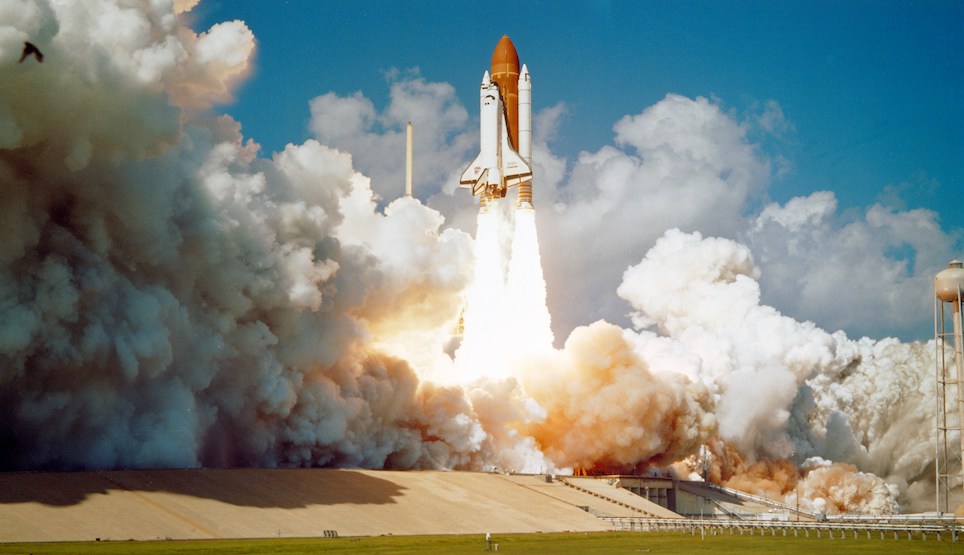
IN THE WAKE of the news that the All-American Varsity Space Team recently splashed down after not dying aboard their Artemis mission, Americans are feeling good about how they nailed space again (stickers and lollipops all ’round). To riff on my second-favourite film review of all time (after this review of Melania, of course): in space, no one can hear you bleat on about how America is the best at space. Call me the fun police, but their celebratory morning tea at the White House seems a touch gauche considering people in Lebanon no longer have houses. I don’t want to kill everyone’s buzz (Lightyear), but perhaps it’s time to reconsider how much money we waste on space stuff? Given the state of things on Earth, how can we justify (largely performative) space science? As someone who spends a lot of time attempting to make people care about science, I may be dying on a strange hill here, but I’ve been struggling to quantify how useful millions of dollars of expenditure is proving to the scientific advancement of…what, exactly?
The faux-philanthropy of the rich and infamous does nothing to hide their colonial urges – despite their claims that research done for and in space will save humanity. The latest twist being that the Trump administration is hot for both Jesus and telling everyone that space belongs to them because they’re the (very) best at everything. Dear Donald errs so perilously close to monologuing large portions of the script for Team America: World Police that I’m beginning to wonder if Parker, Stone and Brady are writing his speeches.
Space bores and tech bros are now wholly synonymous. Speaking of boring tech bros, Musk has long insisted that we can, should and will colonise Mars. To wit, the man makes up for what he lacks in self-awareness in spouting nonsense. Interesting that Trump thinks climate change is a ‘hoax’ but will take the word of an artificially hirsute tech bro as gospel. I guess there’s no accounting for taste.
I am the bearer of a reality check: we are not going to colonise space. Moreover, I’m no intergalactic space law expert, but I’d wager you can’t zoom around space, claiming shit that belongs to the cosmos, utilising the British technique of shoving a flag in things. Importantly, I think it’ll also be about three space days until someone comes up with a giant space laser. My money’s on the US (y’all will recall how excited someone got about a wall…). But let’s say we did (and it pains me to suggest this, even hypothetically) colonise space. History has taught us that between eugenics nuts and the mega-wealthy, there will be ugly squabbles over who gets a ticket – like Fyre Festival but for Silicon Valley billionaires trying to fill their quasar quivers. Why is this such a predictable trajectory for men of independent means? They have one good year and suddenly believe they can dominate space. What, pray tell, does that say about their psyche? Imagine, for a moment, the singular horror of being trapped in space with a tech bro. I don’t know about you, but I’d choose climate breakdown and certain death every time. I can’t believe I have to say this out loud, but we really shouldn’t be listening to Silicon Valley billionaires – definitely not when it comes to what constitutes a good use of finite resources.
These men are spouting a nonsensical narrative of inevitability by suggesting that Earth is fucked (thanks, in no small part, to them) and that there’s not even any point in trying to keep it habitable. Unsurprisingly, space is already littered with our junk too – excruciating evidence as to why we can’t have nice things and why making more mess in a different place is not the answer. To invoke Jeff Goldblum’s Dr Ian Malcolm: we’ve been so busy asking whether we can, we haven’t stopped to ask if we should. If your room’s a mess, you tidy it up – you don’t move house.
A ROMANTIC DEFENCE of space exploration is that it inspires humans. While it’s true that stories of space travel have sparked the imaginations of generations of schoolchildren, very few have become astronauts or meaningfully contributed to our space programs. Nevertheless, there has been a continuous human presence at the International Space Station since 2 November 2000. To what end, I cannot say. Science fiction writers were kicking arses and taking names long before a roster of white dudes were making nice with the Russians on the ISS. Isaac Asimov wrote a collection of short stories called Earth Is Room Enoughto counter the idea that galactic settings were a requirement to facilitate mankind’s imaginative romps. Perhaps we should extrapolate his idea to suggest that conquering, dominating and decimating one planet is also (more than) enough. As it happens, the cover of my well-loved copy of Earth Is Room Enough depicts a giant blue (fantastically phallic) object protruding from the surface of a foreign planet. The dude called it in 1960.
Speaking of science fiction, GRU Space plans to build the first-ever hotel on the moon. Look, I love sci-fi as much as the next gal, but I’m content for that to be the limit of my space travel. Here’s an idea: instead of spaffing our scant resources (cheers, Donnie) into the outer atmosphere, perhaps we’d be better advised to focus our energies and budgets on terrestrial matters. Who knows, if we weren’t distracted by the sparkly things in the sky (and building mega phallic rocket ships), perhaps our clever scientists could fix the problems we have right here. Climate catastrophes, for example, are set to become even more expensivethan space stuff. Globally, governmental space spending hit an eye-watering US$135 billion in 2024. In that same year, the US alone spent nearly US$80 billion. Far be it from me to tell others how to spend their taxpayers’ money, but those wars won’t pay for themselves, you know. It does seem a bit rich to tell your populace that you’re cutting back on climate science and vaccine research to send another handful of frat boys/tech bros into orbit and that the life enrichment born from oceanic splashdowns should bring society-wide contentment.
ADDITIONALLY, SPACE TRAVEL – like all good things – suffers from representational issues. White dudes, celebrities and billionaires are not a diverse cross-section of humanity. I am all for sending over-indulged celebrities and the mega-wealthy into the void, but must they continue to insist on return tickets? Plus, how likely is it they’re offsetting all that rocket fuel? It hurts me to bring this up, but we need to talk about Blue Origin NS-31. Firstly – physicists and physicians will back me on this – that rocket looks like a dick. I don’t know why that was important to the design team, but here we are. Secondly (spectacularly deep breath), what the actual fuck? On what grounds was Katy Perry (who I’ve given shit to before for her lipstick liberalism) selected? Her celestial waist-to-bust ratio? It sure wasn’t for adding credibility to female astronauts – the force is not strong with Katy. Also, given Lauren Sánchez Bezos’ taste in tech bros, I think I’ll spare myself the tokenism these lady star-sailors were peddling. We may have been playing a bit fast and loose with the term ‘crew’, too – those ladies weren’t operating anything other than their personal brands and X accounts. NASA’s own figures are pretty representative (see what I did there?) of its diversity problem. Of the 370 astronauts it has recruited since its inception, 299 were men and sixty-one were women. If you think that’s disgusting, I’ll remind you that they’re still selling commemorative merchandise from the Blue Origin NS-31 ‘mission’.
Abysmal gender diversity is just the beginning. The space program, like much of the scientific establishment, is wildly institutionally racist and only serves a couple of people up to the stars at a time (a huge amount of squeeze for not a great deal of juice). Guion Bluford and Mae Jemison (the first Black American astronauts) didn’t make history until 1983 and 1992 respectively. Of the over 350 NASA astronauts who have been into space, only fifteen were Black Americans. Despite their jumpsuit-clad theatrics, the Sánchez Sisterhood did not undo the legacy of racism, sexism and elitism that pervades space exploration.
Whenever I think deeply about space travel, I experience the mother of all existential crises. I’m tormented by how insignificant we are, the infinitesimally small chances of us existing at all and the crushingly endless possibility it will all have been for naught when we get annihilated by some unforeseen celestial baddie. See – not healthy. It’s time to focus on terrestrial matters. A bit of casual space racing was all jolly hockey sticks when the international order had, well, order. But now that rogue space rangers, Billy big bucks and the tangerine tyrant are at the control panel, perhaps it’s time to step away from the rocket ladder. The male (star)gaze, fully operational tech bros and jingoistic, expansionist rhetoric must not be allowed to pillage the collective purse. We shouldn’t be jettisoning money or rocket fuel all over the exosphere – we have other, much more important investments to make.
Image credit: NASA via Unsplash
Share article
More from author

Post-apocalyptic parenting
How does one balance raising children with a sense of wonder and innocence in a world that’s just waiting for them to get hot/legal/sign up to the heterodoxy? As their mother I reserve the right to irrevocably damage them. It’s my job to give them some good therapy fodder in case future them have any money to spare after buying future air and water.
More from this edition
