
Featured in
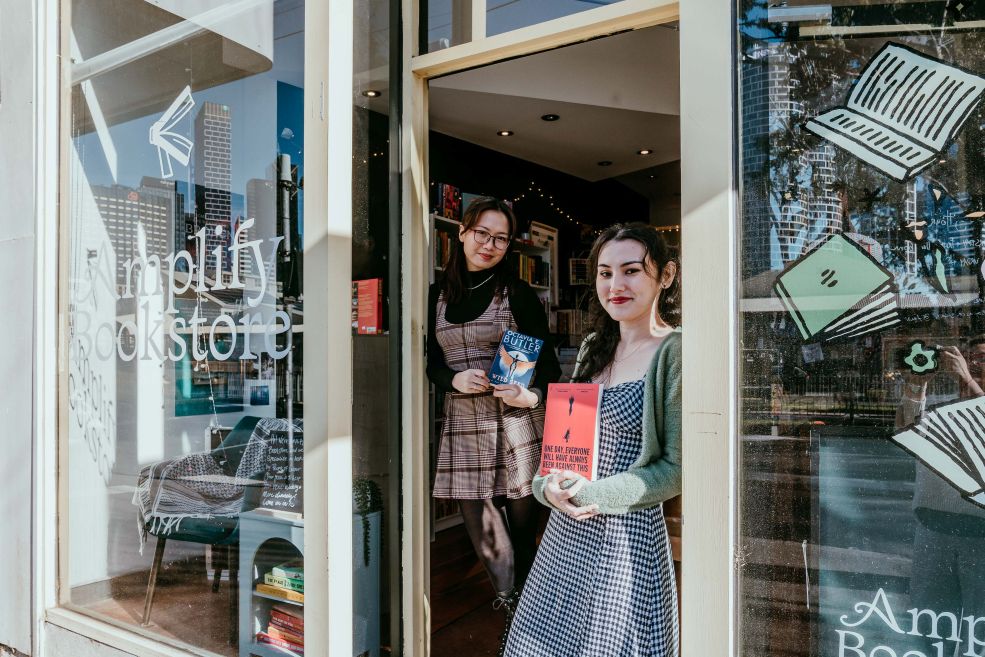
IT’S A FUNNY thing to work a highly romanticised job – especially when that job is one you created to combat the deep-seated systemic failures of your industry.
Customers and visitors to our shop, Amplify Bookstore, often sigh with jealousy at the idea of owning and operating an independent bookstore. It’s a career often viewed as quietly aspirational, a perceived embodiment of the ‘slow life’, made complete by the image of a bookseller who’s surrounded by books and able to read all day. We’ve seen these assumptions time and again in the persistent subtropes of ‘cosy fiction’ and romance novels set in and around bookstores (such as Days at the Morisaki Bookshop by Satoshi Yagisawa and Book Lovers by Emily Henry). This assumption is also portrayed in other forms of media, such as the popular 2025 Nintendo Switch game Tiny Bookshop and the enduring memory of cult classic TV show Black Books (which doesn’t shy away from the financial precarity of the industry).
What those who work outside of publishing don’t factor in is that, ultimately, bookselling is a niche form of retail work. You are working in a bookshop. The curatorial process is certainly unique, but the basic business premise of a bookshop is that it’s a place of commerce. And unfortunately, as much as we’d love to live in a world free from the shackles of capitalism, businesses need to make money to survive.
IN LATE 2020, A little way through our master’s degrees in publishing, we started Amplify Bookstore with the idea of bringing diverse books to the forefront of the public’s reading and browsing options. In the US, only about 11% of books published are by people of colour; if you’re looking at local Australian publishing, that number becomes even smaller. We wanted folks to know that there are options outside of a single diversity-oriented display shelf they might find in their local bookstore (if they’re lucky). We figured that if readers didn’t know how many books existed by authors who are Black, Indigenous and/or people of colour (BIPOC), they wouldn’t know to seek them out.
We soon realised that there were going to be more hurdles than just trying to face down these statistics. This industry can be brutal and unforgiving. Stock is constantly turning over. There are new releases every month that add to a store’s catalogue, on top of core backlist titles that get restocked. If you don’t have books that people want, customers won’t buy what you’re selling. If you have the same thing that every other shop has, there’s no reason for readers to come to you specifically.
Financial considerations are, of course, an additional factor to consider. The price of a book is determined by publishers and sold to bookstores via distributors. Margins are especially tight in small, independent bookstores like Amplify because we can’t purchase in the kind of bulk quantities that justify huge discounts from our distributors. Deep discount stores like Kmart and Big W add to this pressure when they undercut bookstores by selling books for almost half the recommended retail price. There, books are used to help draw people in while they browse other goods. In bookshops, books are our primary wares. These large businesses can afford to use books as a loss leader; we can’t.
Bookstores hold the promise of creating a cultural and communal hub. When things are going well, they’re centres of knowledge and exchange, places where readers can keep up with contemporary thought and trends and be exposed to the stories and ideas that are shaping our societies. Publishers might be the gatekeepers of whose knowledge and story gets to be written down, but it’s up to booksellers to ensure that these stories reach the hands of the people.
Where a store like ours makes a difference is in our offering. At Amplify, we only stock books by BIPOC authors, and we make a concerted effort to maintain breadth across geography and genre. There is no other shop like ours in the country, barring the similar endeavours made by Magabala Books and Saqi Books. In our catalogue, readers can find titles that are often much harder to come by in other bookstores. We have a hugely globalised range, and everything is catalogued so customers can find titles from specific countries or by authors from specific backgrounds. Maintaining this breadth often means placing a gamble on books and authors that we’ve never heard of, batting hard for small presses who often have more curated lists, or going against the publishing industry wisdom of ‘comp titles’ to support something that’s truly original.
Bookshops are the final piece in the publishing puzzle, but we have very little agency. We are dependent on what the publishers produce. At a specialist store like ours, choice is a luxury. We take most titles published by a BIPOC author that are readily available in Australia, but it’s a bizarre game of chance. We are at the mercy of publishers trend-chasing the ‘Hot New Culture’ (or, at least, the hot new way to commodify a culture).
In an ideal world, the sales figures of a store like Amplify would be fed back to publishers to prove that there’s a market for books by BIPOC authors. A bestseller for Amplify is usually a title that’s sold more than thirty copies, but that’s peanuts compared to the sales larger stores can turn over. This also means we see books that are important sellers for us go out of print or transition to print-on-demand. As much as they’re consistently popular titles for us, the few copies we buy in each time barely make a dent in the balance sheet for the publisher.
One of the biggest tools that’s helped us build community and customers has been social media. For all its faults, social media is an incredibly powerful way to find ‘niche’ demographics, and it’s helped us find readers that share our values. Since we first opened as an online-only operation, we used social media to digitally replicate the experience of stumbling upon a bookshop. The wider publishing industry, on the other hand, has a funny relationship with social media. There’s an ever-growing expectation for (especially debut) authors to have an established internet presence to ensure their marketability. At the same time, internet and #BookTok reviewers and are only taken seriously by publishing insiders if they can sell a million copies of a book (or at least enough copies to slap a #TikTokMadeMeBuyIt sticker on the cover). Maybe this is because #BookTok is a community primarily filled with and run by young women, or maybe it’s because this community can circumvent the old guard of the literary elite and the publishing establishment. More likely, it’s a combination of the two.
For all the value that social media has to elevate a diverse range of voices and perspectives, it can become the same echo chamber that drowns them out. Users are fed click-driven, homogenised content based on their own existing interests and biases, reinforcing dominant norms as ‘popular’. In turn, this fuels an attention-driven algorithmic logic that’s then reflected in the publishing industry’s output.
SINCE OPENING AMPLIFY, we’ve witnessed the need for a bookstore like ours. Contrary to the popular (racist) belief, there is a demand for books by BIPOC authors. We’re now almost six years old, and our catalogue showcases an incredible breadth of books that do indeed exist and are indeed being published. But if you were to walk into pretty much any other bookshop, you simply wouldn’t know.
What’s become clear to us is that we need a publishing and bookselling industry that works collaboratively. We need an industry that breaks up silos and champions the diversity of form and genre available rather than one that relies on the same stale, rinse-and-repeat approach to publishing. The publishing industry has proven repeatedly that despite its projected image of rigid institutionalism, it’s highly capable of adapting to trends. If there’s a financial windfall to be made, big publishing isn’t far behind. We saw this in the rise of books on antiracism in 2020, and similarly in an increase in books by Palestinian authors in 2024. Whether the ideas behind these changing currents are something that will be upheld or actioned in any meaningful way in the long term is a different question.
Imagine what we could have if this effort was used to reshape the publishing industry’s output to make it more equitable and representative for us all. With more of us supporting the commitments of shops like ours and of publishers like Magabala Books and Saqi Books, this is a future we can create together.
This essay was commissioned and edited by Contributing Editor Jasmin McGaughey, thanks to funding support through the Copyright Agency Cultural Fund.
Image credit: Amplify Bookstore
Share article
About the author

Teo Jing Xuan
Teo Jing Xuan is a freelance copywriter, marketer and co-founder of Amplify Bookstore, Australia's first antiracist bookstore specialising in books by BIPOC authors. She holds...
More from this edition
